2013 Lin chuang er bi yan hou tou jing wai ke za zhi = Journal of clinical otorhinolaryngology head and neck surgery Review / Meta-analysis Unspecified
2013 · Wang — Introspection of oxidant/antioxidant imbalance in the inner ear
Super-Abstract
Free radicals play a central role in inner ear damage from noise, ototoxic drugs, and aging — but antioxidant therapy without knowledge of the specific oxidative stress type risks further harm. This review introduces molecular hydrogen as a selective antioxidant that neutralizes only the most harmful reactive oxygen species without disrupting normal antioxidant balance. (Journal of Clinical Otorhinolaryngology Head and Neck Surgery, 2013.)
Commentary
This Chinese-language review (title and abstract in English translation) examines the role of oxidative stress in inner ear pathology and why indiscriminate antioxidant supplementation can be counterproductive. The authors argue that conventional antioxidants are blunt instruments that may disrupt the normal oxidant/antioxidant equilibrium if the specific ROS type is not known beforehand. Molecular hydrogen (H₂) is proposed as a uniquely selective alternative: it targets hydroxyl radicals (·OH) and peroxynitrite (ONOO⁻) — the most cytotoxic ROS — without scavenging the ROS involved in normal cell signaling. This is a theoretical and literature-based argument, not an experimental study of H₂ in patients with inner ear disease.
Key quotes
- „hydrogen therapy represents a promising therapeutic tool because it can selectively scavenge the strongest oxidant species, the hydroxyl radical and peroxynitrite anion, without disturbing normal oxidant/anti-oxidant cellular processes.“ — the core H₂ argument: selective scavenging of the most harmful ROS
- „antioxidant therapy could be harmful if the improper compound or dose is employed.“ — honest critique of blanket antioxidant use
- „systemic anti-oxidant therapy is generally performed „blindly“ and therefore likely to disrupt normal antioxidant levels in the inner ear or elsewhere in the body.“ — why conventional antioxidants carry risks without targeted diagnostics
Our assessment
This is a review / theoretical paper on oxidative stress in inner ear disease. The argument for H₂ selectivity is mechanistically sound and well-documented in the broader H₂ literature, but this paper presents no new experimental data — specifically no clinical or animal studies of H₂ for hearing loss or tinnitus. It should be read as a hypothesis-generating theoretical argument, not as clinical evidence. The selectivity of H₂ for ·OH and ONOO⁻ is a key mechanistic advantage that merits further experimental investigation in otology.
Study design
- Type: narrative review / theoretical analysis · n: n/a (literature review) · H₂ relevance: H₂ proposed as selective ROS scavenger for inner ear antioxidant therapy
- Scope: free radical physiology, inner ear disease (noise, ototoxins, aging), limitations of conventional antioxidants, H₂ selectivity as theoretical solution
Abstract
Free radicals are atoms, molecules or ions with unpaired electrons. In biological systems, free radicals can have a dual role, being beneficial in some situations and deleterious in others. Free radicals are required for normal cellular metabolism, but they lead to cellular degeneration if overproduced. To prevent the excessive buildup of free radicals, cells have developed an elaborate series of antioxidant enzymes that counteract oxidative stress and protect cells by maintaining the proper balance of oxidation and anti-oxidation. Therefore, when there is an oxidant/anti-oxidant imbalance, no matter what direction, cells are likely to be damaged. Numerous reports in the literature indicate that free radicals play important roles in diseases of the inner ear as a result of noise exposure, ototoxic drugs, aging, and other pathological conditions. Therefore, there have been many attempts to employ antioxidants treat inner ear damage. However, antioxidant therapy could be harmful if the improper compound or dose is employed. Effective antioxidant therapy requires prior knowledge of the type(s) of oxidative stress occurring in real time in the inner ear. Since most techniques for detecting free radicals in the inner ear are not clinically feasible, systemic anti-oxidant therapy is generally performed "blindly" and therefore likely to disrupt normal antioxidant levels in the inner ear or elsewhere in the body. If only a single anti-oxidant is used to treat a disease, it may disturb subsequent steps the oxidative/anti-oxidative chain reaction. An alternative approach, hydrogen therapy represents a promising therapeutic tool because it can selectively scavenge the strongest oxidant species, the hydroxyl radical and peroxynitrite anion, without disturbing normal oxidant/anti-oxidant cellular processes. In addition, hydrogen has no cytotoxic effects to cells so that it provides a near ideal therapy to eliminate toxic free radicals.
Source & links
Screenshot of the PubMed page
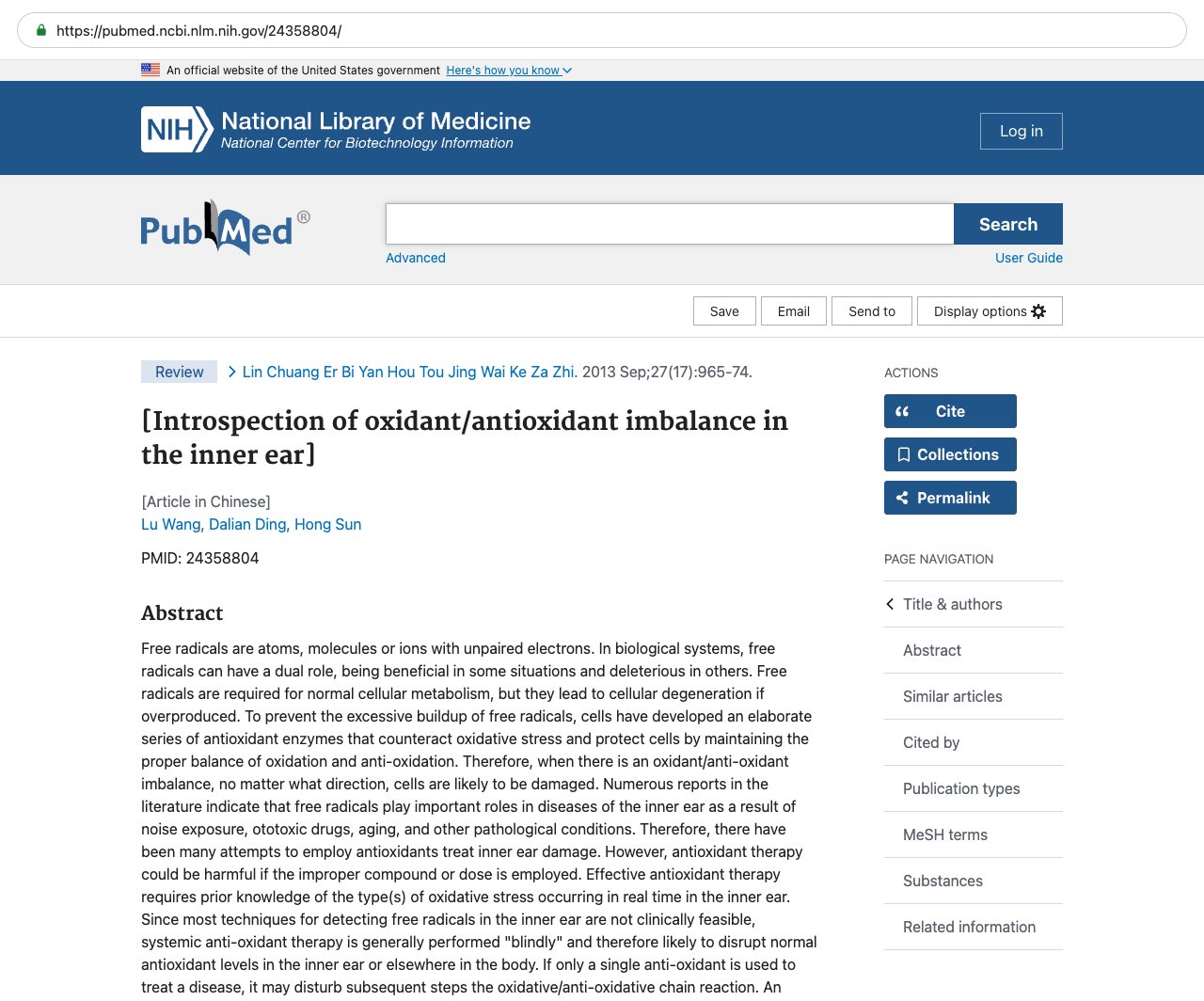
This page mirrors the published abstract (© the authors / publisher) for reference and citation. The canonical source is the PubMed record linked above. This is not medical advice.