2013 · Wang — Regulative effects of hydrogen-rich medium on monocytic adhesion and vascular endothelial permeability
Super-Abstract
In this in-vitro study, hydrogen-rich culture medium significantly reduced the LPS-induced adhesion of monocytes to endothelial cells, lowered inflammatory adhesion molecules (E-selectin, VCAM-1), and protected vascular endothelial integrity (VE-cadherin). These findings suggest that H₂ may help counteract early-stage vascular inflammation triggered by bacterial endotoxin — though this is a cell culture study, not human evidence. (Zhonghua Yi Xue Za Zhi, 2013.)
Commentary
This is a well-structured in-vitro study using human umbilical vein endothelial cells (HUVEC) to model LPS-induced vascular inflammation. The experimental design is rigorous for a cell study: four groups (control, H₂ alone, LPS alone, LPS+H₂), three time points (6, 12, 24 hours), with adhesion staining, ELISA for adhesion molecules, and Western blot plus immunofluorescence for VE-cadherin. The results are internally consistent across all time points. H₂-rich medium reversed the LPS-induced increase in monocyte adhesion and adhesion molecule secretion, and preserved the VE-cadherin integrity that LPS disrupted. This is mechanistically plausible — inflammatory ROS downstream of LPS/TLR4 signaling can damage VE-cadherin and upregulate adhesion molecules, and H₂ selectively scavenges the relevant ·OH. However, as a cell study, it cannot predict human efficacy or appropriate dosing.
Key quotes
- „Hydrogen-rich medium may reduce the LPS-induced release of adhesion molecules, lessen monocytic adhesion to HUVEC and regulate the expression of VE-cadherin to protect vascular permeability.“ — main conclusion: H₂ protects endothelial integrity in LPS-challenged cells
- „adhesion decreased in group D (P < 0.05), the levels of E-selectin and VCAM-1 decreased (P < 0.05) while there was an increased expression of VE-cadherin (P < 0.05).“ — quantified results: LPS+H₂ group vs. LPS alone across all three biomarkers
- „VE-cadherin was incomplete in cell-cell connections in group C. However it was complete and well-distributed in group D versus group C.“ — immunofluorescence confirmation of endothelial barrier protection by H₂
Our assessment
This is a preclinical in-vitro study demonstrating H₂ protective effects on vascular endothelial cells under inflammatory challenge. The findings are biologically plausible and the experimental design is solid for a cell study. Results cannot be directly extrapolated to humans: HUVEC culture models remove the complex interactions of the immune system, blood flow, and systemic physiology. No clinical conclusions about vascular protection in humans can be drawn. The study contributes to mechanistic understanding of how H₂ may protect against endotoxin-induced vascular inflammation — a pathway relevant to sepsis and atherosclerosis research.
Study design
- Type: in-vitro cell study · Model: human umbilical vein endothelial cells (HUVEC) + THP-1 monocytes, LPS 1 µg/ml inflammatory challenge · H₂ delivery: hydrogen-saturated culture medium
- Groups: control / H₂ alone / LPS / LPS+H₂ · n per group: 42 · Time points: 6, 12, 24 h
- Endpoints: monocyte adhesion (Wright-Giemsa stain), E-selectin + VCAM-1 (ELISA), VE-cadherin expression (Western blot + immunofluorescence) · Result: all three markers improved significantly in LPS+H₂ vs. LPS group (p < 0.05)
Abstract
OBJECTIVE: To explore the regulative effects of hydrogen-rich medium on lipopolysaccharide (LPS)-induced monocytes adhesion to human umbilical vein endothelial cells (HUVEC) and vascular endothelial permeability in vitro. METHODS: Endothelial cells were seeded in 6-well plates and randomly divided into 4 groups (n = 42 each):control (A), hydrogen-rich medium (B), LPS (C) and LPS+hydrogen-rich medium (D). Cells were cultured in plain culture medium in groups A and C or in hydrogen-saturated culture medium in groups B and D.LPS 1 µg/ml was added into groups C and D.When forming a monolayer, monocytes were added into each group after 6, 12 and 24 h respectively. After a 90-minute co-culturing, adhesion status was detected by Wright-Giemsa stain.Supernatants were collected to detect the concentrations of vascular cell adhesion molecule-1 (VCAM-1) and E-selectin by enzyme-linked immunosorbent assay (ELISA). The expression of VE-cadherin was measured by Western blot. Cells were stained with immunofluorescence to show the distribution of VE-cadherin after a 24-hour incubation. RESULTS: Compared with group A, the adhesion of monocytes to endothelial cells increased (P < 0.05) in group C, the levels of E-selectin and VCAM-1 became elevated (P < 0.05) while the expression of VE-cadherin decreased significantly (P < 0.05). Compared with group C, adhesion decreased in group D (P < 0.05), the levels of E-selectin and VCAM-1 decreased (P < 0.05) while there was an increased expression of VE-cadherin (P < 0.05). Three timepoints showed the same tendency. The results of 24 h fluorescence indicated that, compared with group A, VE-cadherin was incomplete in cell-cell connections in group C.However it was complete and well-distributed in group D versus group C. CONCLUSION: Hydrogen-rich medium may reduce the LPS-induced release of adhesion molecules, lessen monocytic adhesion to HUVEC and regulate the expression of VE-cadherin to protect vascular permeability.
Source & links
Screenshot of the PubMed page
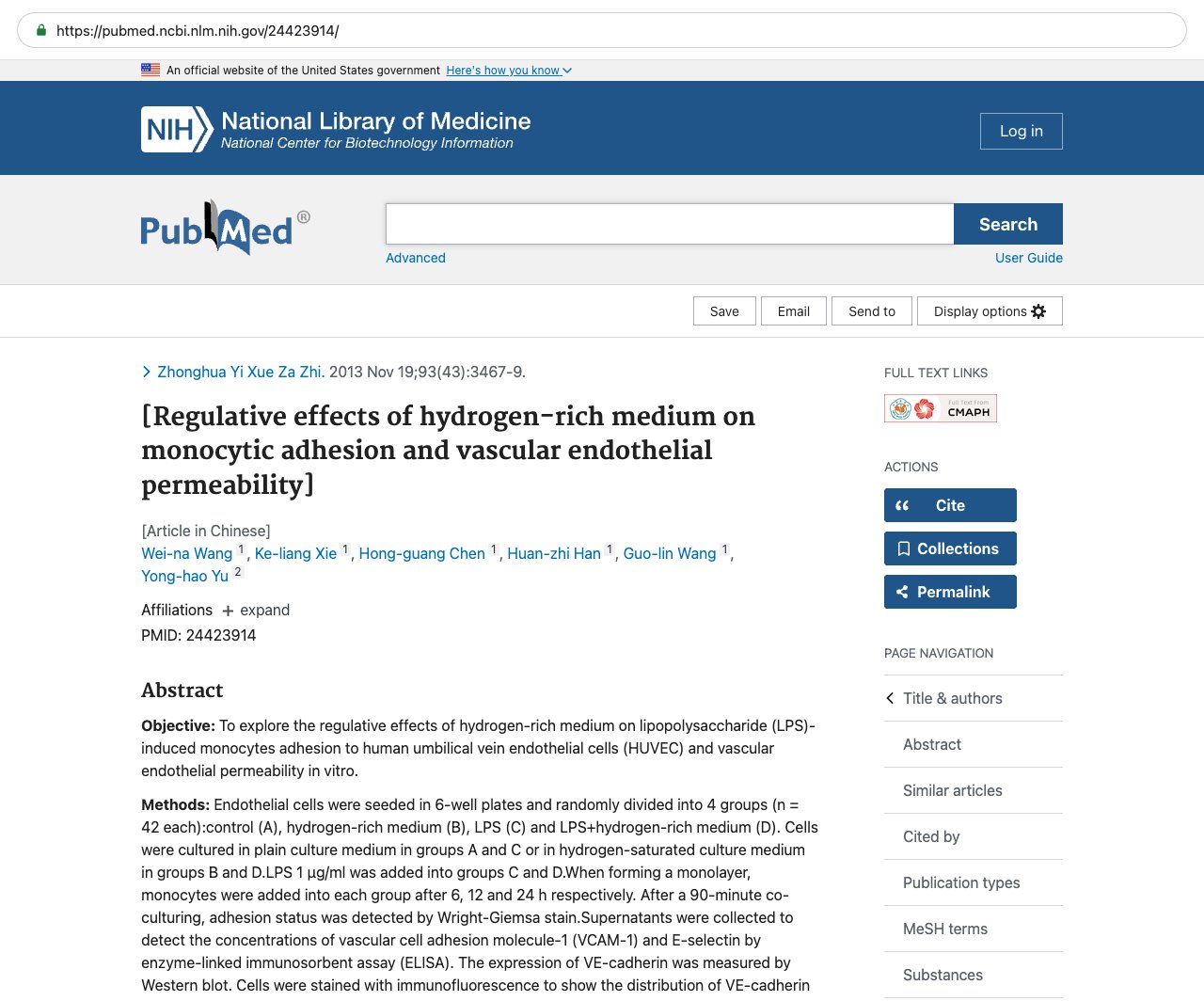
This page mirrors the published abstract (© the authors / publisher) for reference and citation. The canonical source is the PubMed record linked above. This is not medical advice.