2013 · Wang et al. — A surface-eroding poly(1,3-trimethylene carbonate) coating for fully biodegradable magnesium-based stent applications.
Super-Abstract
This materials science study investigated a biodegradable polymer coating (PTMC) for magnesium-based cardiovascular stents — aiming to control corrosion and improve biocompatibility. Molecular hydrogen appears in this study only as a by-product of magnesium corrosion, not as a therapeutic agent. The study is not a hydrogen therapy trial; it is an in-vitro and in-vivo materials engineering study.
Commentary
Magnesium-based implants corrode in the body and release hydrogen gas as a corrosion by-product — a well-known challenge in biodegradable implant design. The authors tested a PTMC (poly(1,3-trimethylene carbonate)) surface-eroding coating to slow down this corrosion. Key findings: the PTMC coating reduced corrosion current density by orders of magnitude, decreased platelet adhesion and haemolysis, maintained structural integrity after 16 weeks subcutaneous implantation in rats, and — importantly — showed that „excessive inflammation, necrosis and hydrogen gas accumulation were not observed.“ In other words, H₂ appears here as something to be avoided (unsafe accumulation), not as a therapeutic. This paper has been indexed in the H₂ medical database presumably due to keyword overlap; its direct relevance to molecular hydrogen therapy is marginal.
Key quotes
- „Excessive inflammation, necrosis and hydrogen gas accumulation were not observed.“ — H₂ appears as a safety parameter (by-product to control), not a therapeutic agent
- „The PTMC coating effectively protected the corrosion of the Mg alloy in the dynamic degradation test.“ — core finding: coating reduces Mg corrosion (and thus H₂ by-product)
- „It is concluded that PTMC is a promising candidate for a surface-eroding coating applied to Mg-based implants.“ — materials science conclusion — unrelated to H₂ therapy
Our assessment
This is a materials science / biomedical engineering study — not a hydrogen therapy study. Molecular hydrogen is mentioned only as a corrosion by-product of biodegradable magnesium, and its absence (no accumulation) is framed as a positive safety outcome. Honest note: this paper is likely catalogued here due to H₂ keyword indexing; its relevance to therapeutic H₂ research is indirect at most. The materials findings are technically credible for stent development, but readers seeking H₂ therapy evidence should look elsewhere.
Study design
- Type: in-vitro and in-vivo materials study · Model: PTMC-coated Mg alloy; in vitro: corrosion/haemocompatibility tests; in vivo: subcutaneous implantation in rats (16 weeks), vascular implantation (52 weeks)
- H₂ relevance: H₂ gas appears as a by-product of Mg corrosion — the coating aims to prevent unsafe accumulation, not to deliver therapeutic H₂
- Result: PTMC coating reduced corrosion by orders of magnitude, reduced platelet adhesion and haemolysis, showed surface-erosion behaviour, no excessive H₂ accumulation or necrosis observed
Abstract
Biodegradable magnesium-based materials have a high potential for cardiovascular stent applications; however, there exist concerns on corrosion control and biocompatibility. A surface-eroding coating of poly(1,3-trimethylene carbonate) (PTMC) on magnesium (Mg) alloy was studied, and its dynamic degradation behavior, electrochemical corrosion, hemocompatibility and histocompatibility were investigated. The PTMC coating effectively protected the corrosion of the Mg alloy in the dynamic degradation test. The corrosion current density of the PTMC-coated alloy reduced by three orders and one order of magnitude compared to bare and poly(ε-caprolactone) (PCL)-coated Mg alloy, respectively. Static and dynamic blood tests in vitro indicated that significantly fewer platelets were adherent and activated, and fewer erythrocytes attached on the PTMC-coated surface and showed less hemolysis than on the controls. The PTMC coating after 16 weeks' subcutaneous implantation in rats maintained ~55% of its original thickness and presented a homogeneously flat surface demonstrating surface erosion, in contrast to the PCL coated control, which exhibited non-uniform bulk erosion. The Mg alloy coated with PTMC showed less volume reduction and fewer corrosion products as compared to the controls after 52 weeks in vivo. Excessive inflammation, necrosis and hydrogen gas accumulation were not observed. The homogeneous surface erosion of the PTMC coating from exterior to interior (surface-eroding behavior) and its charge neutral degradation products contribute to its excellent protective performance. It is concluded that PTMC is a promising candidate for a surface-eroding coating applied to Mg-based implants.
Source & links
Screenshot of the PubMed page
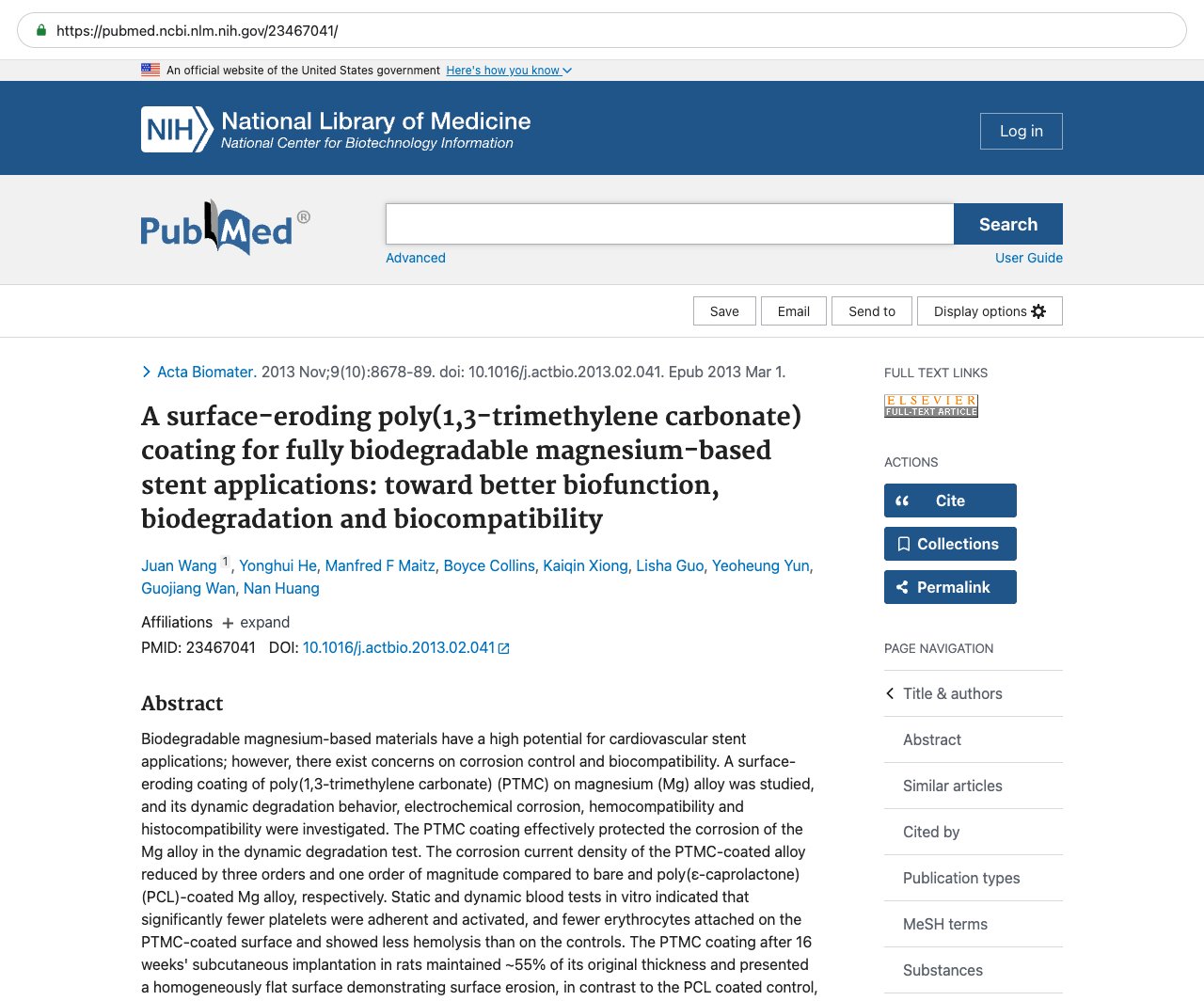
This page mirrors the published abstract (© the authors / publisher) for reference and citation. The canonical source is the PubMed record linked above. This is not medical advice.