2015 · Wang et al. — Michael acceptor in gambogic acid — Its role and application for potent antitumor agents.
Super-Abstract
Gambogic acid (GA), a natural compound with broad anti-cancer activity, contains a highly reactive Michael acceptor at its C-10 position that limits clinical use by reacting non-selectively with biological nucleophiles. Two chemical modification strategies are evaluated to reduce this reactivity while preserving anticancer potency — one strategy proved more promising than the other. This is a purely cell-based in-vitro study with no molecular hydrogen (H₂) involvement.
Commentary
Gambogic acid is a natural xanthone from the resin of Garcinia hanburyi with demonstrated antiproliferative activity against multiple cancer cell lines. Its clinical application is hampered by the reactive Michael acceptor at C-10, which can form non-specific adducts with cellular nucleophiles. This study systematically explores two modification strategies: Strategy A (increasing steric hindrance at C-10) abolished both the Michael reactivity and the anticancer activity, confirming that the electrophilic centre is essential for efficacy. Strategy B (replacing the C-6 hydroxyl that forms an intramolecular hydrogen bond with C-8 carbonyl) significantly reduced electrophilicity while retaining antiproliferative activity — a more useful result for drug development. This paper has no connection to molecular hydrogen (H₂) biology; „hydrogen bond“ here is a standard chemical concept.
Key quotes
- „the 6-OH forms an intramolecular hydrogen bond with 8-CO, which can make the 9, 10 double bond more reactive to nucleophiles.“ — structural basis of GA's problematic reactivity: an intramolecular hydrogen bond activates the Michael acceptor
- „Results showed the electrophilicity of C-10 disappeared as well as the antiproliferation activity against cancer cell lines by introducing a methyl group at C-10.“ — Strategy A: removing reactivity also removed anticancer activity — a dead end
- „Strategy B showed that the electrophilicity of C-10 was reduced dramatically while maintained the activity by replacement of the hydroxyl of C-6 with neutral or basic groups.“ — Strategy B: the more promising approach — lower reactivity, preserved efficacy
Our assessment
This is an in-vitro medicinal chemistry study focused on optimising a natural antitumor compound. The results are relevant to oncology drug design but have no connection to molecular hydrogen (H₂) therapy. The paper appears in H₂ research databases due to keyword overlap with „hydrogen bond,“ a universal chemical concept entirely unrelated to dissolved molecular H₂. Findings are preliminary: cell-line efficacy does not predict clinical outcomes, and no animal studies are included.
Study design
- Type: in-vitro medicinal chemistry study · Model: cancer cell lines (antiproliferation assays) · H₂ relevance: none (hydrogen bond = standard chemistry only)
- Strategies tested: A — methyl group at C-10 (steric hindrance); B — C-6 hydroxyl substitution with neutral/basic groups · Result: Strategy A abolished both reactivity and activity; Strategy B preserved activity while markedly reducing electrophilicity
Abstract
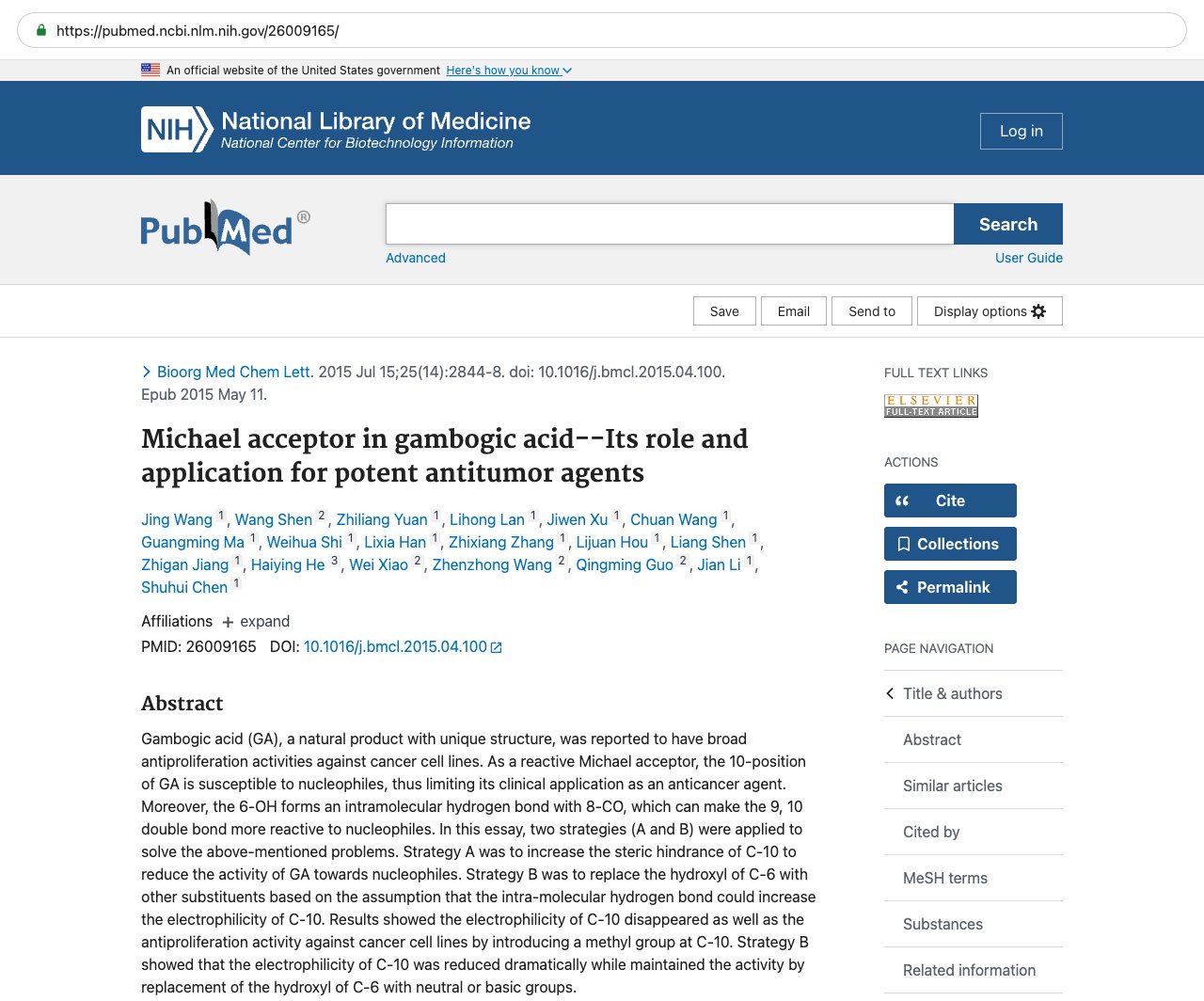
Gambogic acid (GA), a natural product with unique structure, was reported to have broad antiproliferation activities against cancer cell lines. As a reactive Michael acceptor, the 10-position of GA is susceptible to nucleophiles, thus limiting its clinical application as an anticancer agent. Moreover, the 6-OH forms an intramolecular hydrogen bond with 8-CO, which can make the 9, 10 double bond more reactive to nucleophiles. In this essay, two strategies (A and B) were applied to solve the above-mentioned problems. Strategy A was to increase the steric hindrance of C-10 to reduce the activity of GA towards nucleophiles. Strategy B was to replace the hydroxyl of C-6 with other substituents based on the assumption that the intra-molecular hydrogen bond could increase the electrophilicity of C-10. Results showed the electrophilicity of C-10 disappeared as well as the antiproliferation activity against cancer cell lines by introducing a methyl group at C-10. Strategy B showed that the electrophilicity of C-10 was reduced dramatically while maintained the activity by replacement of the hydroxyl of C-6 with neutral or basic groups.
Source & links
Screenshot of the PubMed page
This page mirrors the published abstract (© the authors / publisher) for reference and citation. The canonical source is the PubMed record linked above. This is not medical advice.