2020 · Wang — NIR-Driven Water Splitting H₂ Production Nanoplatform for H₂-Mediated Cascade-Amplifying Synergetic Cancer Therapy
Super-Abstract
This in-vitro and animal study presents a complex nanoparticle system that generates H₂ gas inside tumour cells via near-infrared (NIR) laser-driven water splitting, combining hydrogen gas therapy with photodynamic therapy, photothermal therapy, and chemodynamic therapy in a cascade approach against cancer. All results are preclinical; this is highly specialised nano-oncology engineering with no direct relevance to drinking hydrogen water or H₂ inhalation. (ACS Applied Materials & Interfaces, 2020.)
Commentary
This study is an excellent example of the expanding field of nano-oncology that exploits molecular hydrogen as a reactive oxygen species (ROS) modulator within engineered cancer-killing systems. The core innovation is a core-shell nanoparticle (UCC: NaGdF₄:Yb,Tm/g-C₃N₄/Cu₃P inside a folic-acid-modified ZIF-8 shell) that achieves four simultaneous therapeutic mechanisms upon 980 nm laser irradiation: H₂ production via water splitting, ROS generation, photothermal conversion, and copper-mediated Fenton chemodynamic therapy. The integration of glutathione (GSH) depletion from the tumour microenvironment is particularly clever. However, the gap between such engineered nanoparticle systems and clinical oncology practice is enormous — these are proof-of-concept studies requiring extensive development before human use.
Key quotes
- „the high diffusivity and low solubility of hydrogen make it difficult to accumulate in local lesions.“ — an honest statement of H₂'s pharmacological limitation in conventional delivery
- „Upon 980 nm laser irradiation, CSNPs exhibit a high production capacity of H2 and active oxygen species (ROS), as well as an appropriate photothermal conversion temperature.“ — the multimodal activation: single laser triggers H₂ production, ROS, and heat simultaneously
- „GSH also can reduce Cu(II) to Cu(I), ensuring a continuous Fenton reaction.“ — tumour microenvironment exploitation: cancer's own glutathione drives the Fenton reaction
Our assessment
This is an in-vitro and animal (murine) preclinical study in the highly specialised field of nano-oncology. The H₂ here is generated inside tumour cells via engineered nanoparticles and NIR laser — a completely different context from therapeutic H₂ supplementation. No human data exist and no conclusions about H₂ health benefits in general can be drawn from this work. The multi-modal cancer therapy concept is scientifically sophisticated, but clinical translation of complex nanoparticle systems historically faces major hurdles in toxicology, manufacturing, and regulatory approval.
Study design
- Type: in-vitro + in-vivo (murine) nano-oncology study · System: NaGdF₄:Yb,Tm/g-C₃N₄/Cu₃P core-shell nanoparticles (UCC/ZIF-8/folic acid) · H₂ delivery: in-situ photocatalytic water splitting within tumour cells upon 980 nm NIR laser irradiation
- Result: simultaneous H₂ production, ROS generation, photothermal conversion, and Fenton CDT demonstrated in vitro and in murine models; acid-responsive ZIF-8 shell enables tumour-selective release; GSH depletion by TME amplifies therapeutic effect
Abstract
As a newly emerging treatment strategy for many diseases, hydrogen therapy has attracted a lot of attention because of its excellent biosafety. However, the high diffusivity and low solubility of hydrogen make it difficult to accumulate in local lesions. Herein, we develop a H2 self-generation nanoplatform by in situ water splitting driven by near-infrared (NIR) laser. In this work, core-shell nanoparticles (CSNPs) of NaGdF4:Yb,Tm/g-C3N4/Cu3P (UCC) nanocomposites as core encapsulated with zeolitic imidazolate framework-8 (ZIF-8) modified with folic acid as shell are designed and synthesized. Due to the acid-responsive ZIF-8 shell, enhanced permeability and retention (EPR) effect, and folate receptor-mediated endocytosis, CSNPs are selectively captured by tumor cells. Upon 980 nm laser irradiation, CSNPs exhibit a high production capacity of H2 and active oxygen species (ROS), as well as an appropriate photothermal conversion temperature. Furthermore, rising temperature increases the Fenton reaction rate of Cu(I) with H2O2 and strengthens the curative effect of chemodynamic therapy (CDT). The excess glutathione (GSH) in tumor microenvironment (TME) can deplete positive holes produced in the valence band of g-C3N4 in the g-C3N4/Cu3P Z-scheme heterojunction. GSH also can reduce Cu(II) to Cu(I), ensuring a continuous Fenton reaction. Thus, a NIR-driven H2 production nanoplatform is constructed for H2-mediated cascade-amplifying multimodal synergetic therapy.
Source & links
Screenshot of the PubMed page
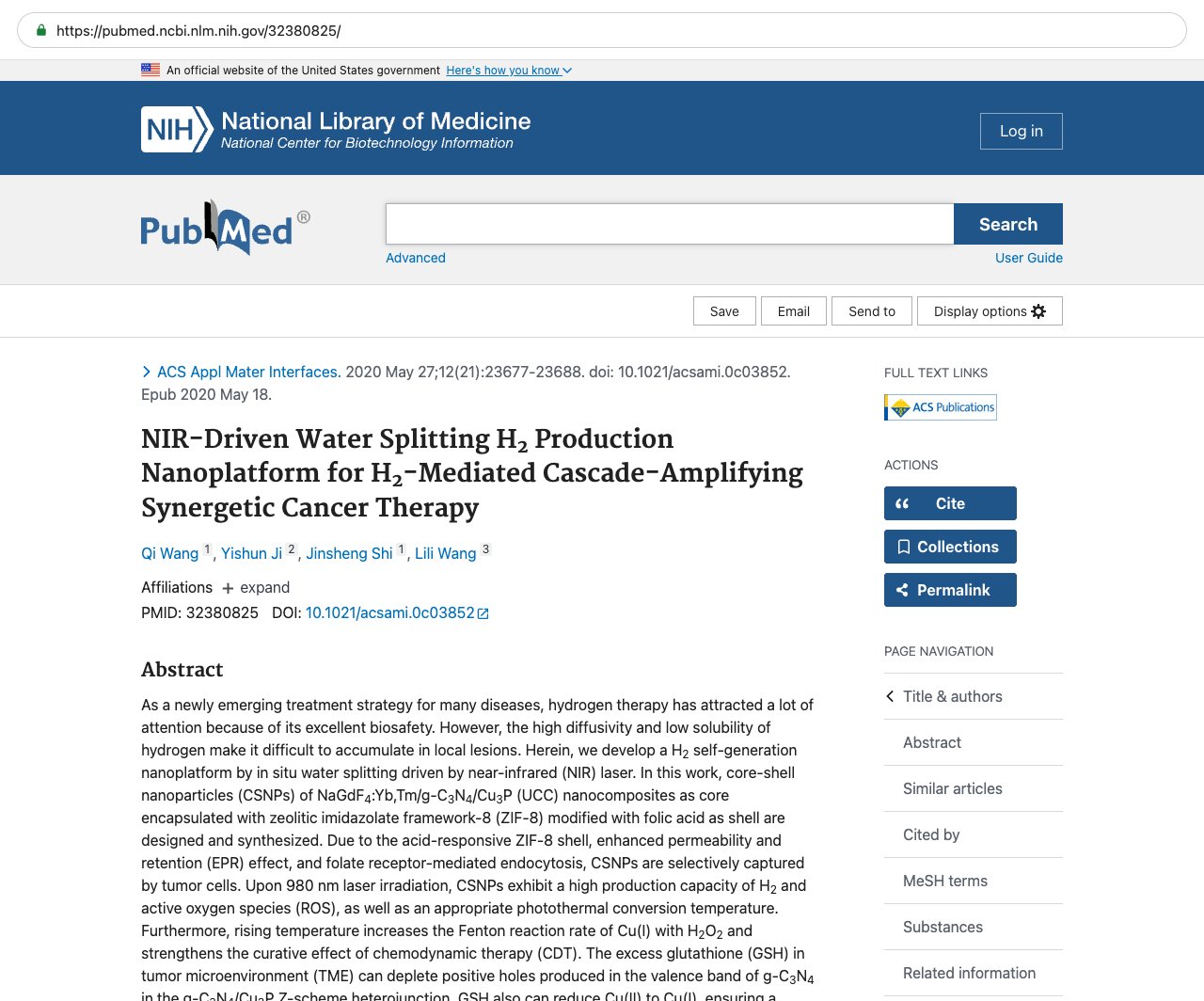
This page mirrors the published abstract (© the authors / publisher) for reference and citation. The canonical source is the PubMed record linked above. This is not medical advice.