2024 · Khiji — The Therapeutic Application of Hydrogen in Cancer: The Potential and Challenges
Super-Abstract
Cancer is frequently associated with oxidative stress and chronic inflammation, and this review examines molecular hydrogen (H₂) as a candidate supportive therapy that could help prevent cancer recurrence and reduce treatment side effects. Preclinical studies show H₂ can enhance the effectiveness of conventional treatments in several cancer types. However, the authors explicitly state that further clinical trials are needed to clarify safety, optimal dosage, and mechanisms before H₂ can be recommended clinically. This is a literature review.
Commentary
H₂'s properties — antioxidant, anti-inflammatory, anti-apoptotic — are theoretically attractive in oncology for two distinct reasons: first, reducing the oxidative-stress microenvironment that promotes tumour growth; and second, mitigating the oxidative side-effects of chemotherapy and radiotherapy on healthy tissue. This review surveys preclinical evidence across several cancer types and notes that clinical safety and tolerability data, while limited, are generally favourable. However, the review explicitly calls for improved understanding of mechanisms, better administration protocols, and properly powered clinical trials before H₂ therapy can be positioned as a validated cancer adjunct. The authors avoid overclaiming: H₂ is described as ‚innovative and promising', not as proven.
Key quotes
- „Through its ability to mitigate oxidative damage, modulate inflammatory responses, and sustain cellular viability, hydrogen demonstrates significant potential in preventing cancer recurrence and improving treatment outcomes.“ — rationale for H₂ as a potential oncological support agent
- „Preclinical studies have shown the efficacy of hydrogen therapy in several cancer types, highlighting its ability to enhance the effectiveness of conventional treatments while reducing associated side effects.“ — scope of preclinical evidence — multiple cancer types
- „further clinical trials are still needed to explore its safety profile and capacity.“ — honest call for more rigorous clinical investigation
Our assessment
This is a narrative review presenting a balanced overview of H₂'s potential in oncology. The mechanistic rationale is scientifically coherent, and the preclinical evidence is multi-cancer and broadly consistent. However, clinical evidence is described as limited, and the review itself calls for additional trials. H₂ as a cancer therapy adjunct remains investigational — it should not be presented as an established treatment. The authors' conclusion that H₂ is ‚innovative and promising' accurately reflects the current evidence level.
Study design
- Type: narrative review · n: n/a (literature synthesis across multiple cancer types) · H₂ delivery: unspecified (multiple modalities referenced in the literature reviewed)
- Result: no pooled effect sizes; preclinical evidence across cancer types suggests H₂ enhances conventional treatment efficacy and reduces side effects; clinical safety described as generally favourable but clinical trial base is limited
Abstract
Hydrogen therapy has emerged as a possible approach for both preventing and treating cancer. Cancers are often associated with oxidative stress and chronic inflammation. Hydrogen, with its unique physiological functions and characteristics, exhibits antioxidant, anti-inflammatory, and anti-apoptotic properties, making it an attractive candidate for cancer treatment. Through its ability to mitigate oxidative damage, modulate inflammatory responses, and sustain cellular viability, hydrogen demonstrates significant potential in preventing cancer recurrence and improving treatment outcomes. Preclinical studies have shown the efficacy of hydrogen therapy in several cancer types, highlighting its ability to enhance the effectiveness of conventional treatments while reducing associated side effects. Furthermore, hydrogen therapy has been found to be safe and well-tolerated in clinical settings. Nonetheless, additional investigations are necessary to improve a comprehensive understanding of the mechanisms underlying hydrogen's therapeutic potential and refine the administration and dosage protocols. However, further clinical trials are still needed to explore its safety profile and capacity. In aggregate, hydrogen therapy represents an innovative and promising treatment for several malignancies.
Source & links
Screenshot of the PubMed page
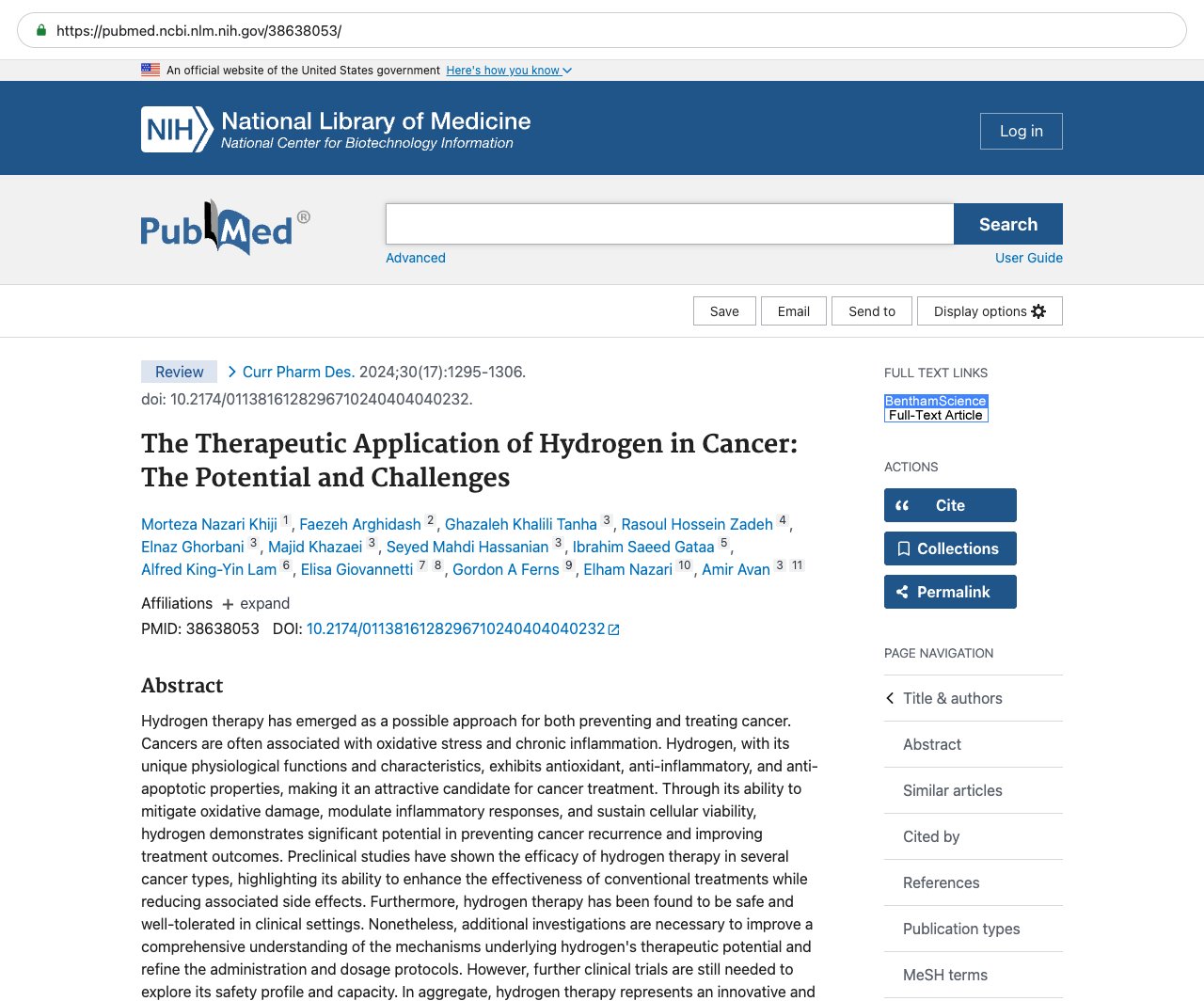
This page mirrors the published abstract (© the authors / publisher) for reference and citation. The canonical source is the PubMed record linked above. This is not medical advice.