2025 Zhong nan da xue xue bao. Yi xue ban = Journal of Central South University. Medical sciences Review / Meta-analysis Unspecified
2025 · Xie — Mechanisms and Protective Strategies for Astronaut Skin Injury in Deep Space Environments
Super-Abstract
This review summarises the current understanding of how deep space conditions — microgravity, ionising radiation, lunar dust, and microbiome disruption — damage astronaut skin, and what engineering and biomedical strategies are being developed to protect it. Hydrogen-rich shielding materials are mentioned as one component of multi-layer spacesuit design, not as a therapeutic agent. The paper calls for personalised, intelligent health monitoring systems for future deep space missions. (Journal of Central South University. Medical Sciences, 2025.)
Commentary
This is a narrative review covering the intersection of aerospace medicine and dermatology. The skin threats in deep space are real and serious: ionising cosmic radiation damages DNA and impairs wound healing; microgravity causes fluid shifts that affect skin hydration and circulation; lunar dust is highly abrasive and chemically reactive; and the sterile space environment disrupts the skin microbiome. The protective strategies reviewed range from engineering (spacesuit design including hydrogen-rich and boron-containing radiation-shielding materials) to biomedical (functional hydrogels, antimicrobial dressings, traditional Chinese medicine-derived compounds, microbiome interventions). The mention of „hydrogen-rich materials“ refers to shielding — hydrogenated polymers that slow high-energy particles — not to H₂ gas therapy. This is a literature overview with no original experimental data.
Key quotes
- „From the engineering protection perspective, optimization of multi-layer composite spacesuit structures, the use of hydrogen-rich and boron-containing shielding materials, as well as cabin temperature-humidity regulation and debris-resistant technologies, have greatly enhanced environmental defense capacity.“ — note: 'hydrogen-rich materials' here = radiation shielding polymers, not H₂ gas therapy
- „functional hydrogels, antimicrobial dressings, and active compounds derived from traditional Chinese medicine have demonstrated remarkable potential in repairing the skin barrier, modulating immunity, and providing antioxidant defense.“ — the biomedical protective interventions reviewed
- „Future research should focus on elucidating the interactive mechanisms among the space environment, skin, and immune barrier, while exploring intelligent monitoring and nanotechnology-based protection strategies.“ — the research agenda proposed by the authors
Our assessment
This is a narrative review — a literature synthesis, not an experimental study or clinical trial. It provides useful context about skin health challenges in deep space, but no original data are presented and no conclusions about H₂ therapy efficacy can be drawn. The reference to hydrogen-rich materials is to radiation physics and spacesuit engineering, not to hydrogen medicine. The review is a useful map of a niche research area but should be interpreted as a field overview, not as evidence for any specific intervention.
Study design
- Type: narrative review · n: n/a (literature synthesis) · H₂ relevance: hydrogen-rich shielding materials in spacesuit engineering (radiation physics context, not H₂ therapy)
- Result: no pooled effect sizes; overview of multi-dimensional skin protection strategies for deep space; calls for intelligent monitoring and nanotechnology-based approaches
Abstract
With the continuous advancement of deep space exploration missions, maintaining astronaut skin health has become a critical medical issue affecting the safety and effectiveness of long-duration missions. Deep space environmental stressors, including microgravity, ionizing radiation, lunar dust exposure, and microbiome dysbiosis, can synergistically disrupt the skin barrier structure, leading to immune homeostasis imbalance and impaired wound healing. In recent years, research on skin protection in deep space has gradually evolved into a systematic "multi-dimensional integrated protective" framework. From the engineering protection perspective, optimization of multi-layer composite spacesuit structures, the use of hydrogen-rich and boron-containing shielding materials, as well as cabin temperature-humidity regulation and debris-resistant technologies, have greatly enhanced environmental defense capacity. From the biomedical protection perspective, functional hydrogels, antimicrobial dressings, and active compounds derived from traditional Chinese medicine have demonstrated remarkable potential in repairing the skin barrier, modulating immunity, and providing antioxidant defense. Meanwhile, the development of skin microecological interventions and wearable physiological monitoring systems has fostered a trend toward personalized health management. Future research should focus on elucidating the interactive mechanisms among the space environment, skin, and immune barrier, while exploring intelligent monitoring and nanotechnology-based protection strategies. Establishing a predictive and preventive skin health safeguarding system will provide comprehensive medical support for future deep space missions.
Source & links
Screenshot of the PubMed page
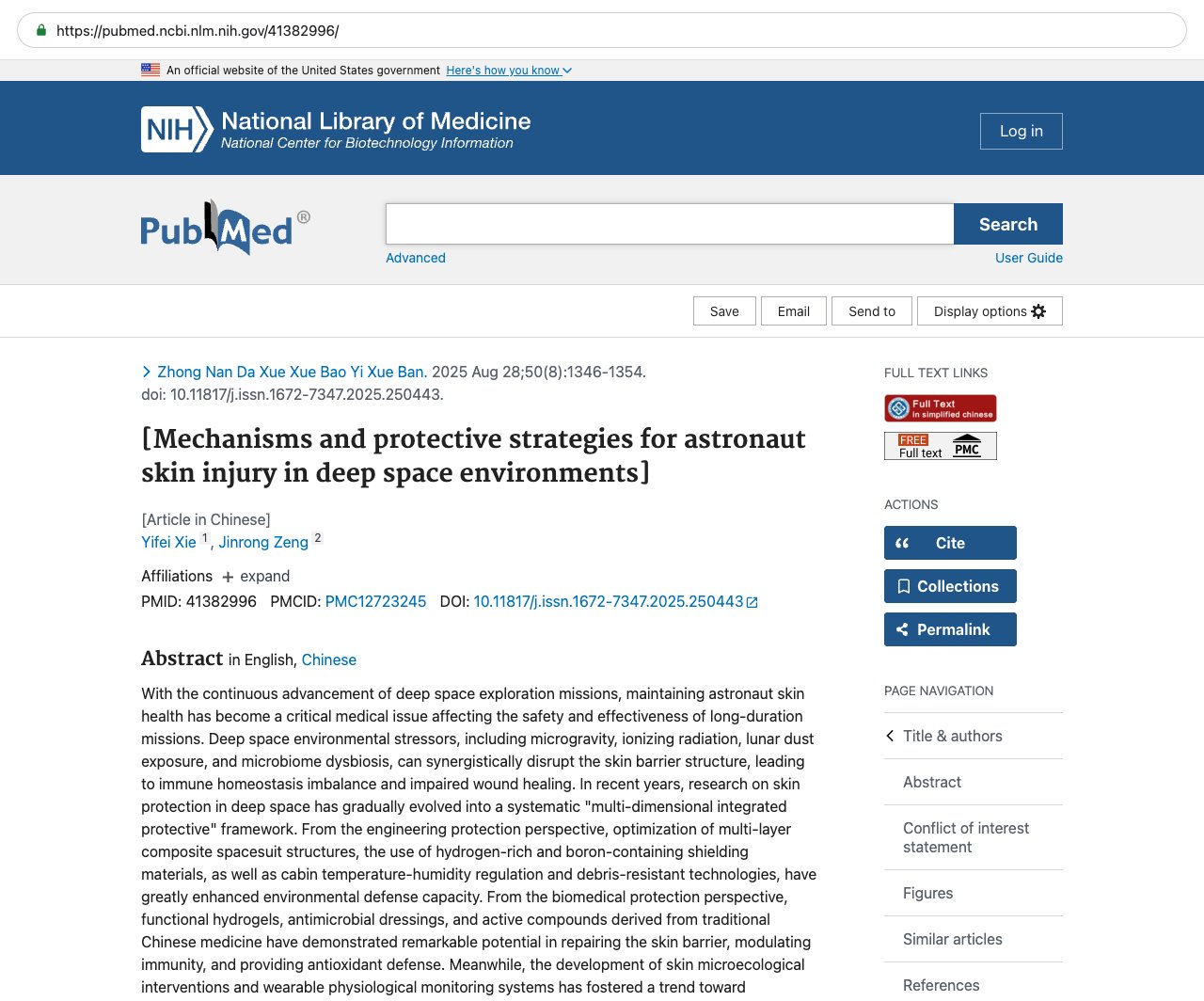
This page mirrors the published abstract (© the authors / publisher) for reference and citation. The canonical source is the PubMed record linked above. This is not medical advice.