2020 · Wang — Prospects of molecular hydrogen in perioperative neuroprotection from basic research to clinical application
Super-Abstract
This systematic review summarizes why molecular hydrogen is being researched as neuroprotection around surgery: antioxidant, anti-inflammatory, antiapoptotic and mitochondria-protective effects. Clinical efficacy, however, remains uncertain because large randomized trials are missing. (Current Opinion in Anaesthesiology, 2020 — review.)
Commentary
This work is a systematic review from an anesthesiology specialist journal, and it is honest in both directions — which is why it is valuable for us. The topic is perioperative neuroprotection, i.e. protecting the brain around operations, where complications frequently occur. Various gaseous molecules have been studied for this, and molecular hydrogen has received particular attention. The authors compile the basic and animal-experimental evidence: H₂ acts antioxidatively, anti-inflammatorily, inhibits programmed cell death, and protects the mitochondria — exactly the mechanisms that play a role in nerve damage. That is the good news. The honest news sits right next to it: the preventive and therapeutic effect in humans remains uncertain, and the lack of large randomized controlled trials delays clinical application. What it means: H₂ is mechanistically highly plausible in neuroprotection but not yet clinically proven. This is exactly the dual message to convey — enthusiasm for the mechanism, restraint on patient benefit. As a review it provides no new data itself but contextualizes.
Key quotes
- „molecular hydrogen, which has emerged as a novel and potential therapy for perioperative neuroprotection, has received much attention.“ — H₂ as a new candidate in perioperative neuroprotection
- „Fundamental and clinical evidence supports the antioxidant, antiinflammation, antiapoptosis and mitochondrial protective effects of hydrogen in the pathophysiology of nervous system diseases.“ — the mechanisms that make H₂ plausible
- „The clinically preventive and therapeutic effects of hydrogen on different neural diseases, however, remain uncertain, and the lack of support by large randomized controlled trials has delayed its clinical application.“ — the honest caveat: clinical benefit still unproven
Our assessment
A well-citable review for the mechanistic contextualization of H₂ in the neurological setting — and a model example of honest communication, because the source itself names the lack of large RCTs. Usable for us as a serious piece of evidence that the antioxidant/anti-inflammatory mechanisms of H₂ are taken seriously even in anesthesiology literature — but explicitly without a promise of patient benefit in neuroprotection. Limitation, stated honestly: it is a review (evidence level 4) and provides no original data; the statements rest predominantly on basic and animal research; clinical proof in humans is still missing per the authors themselves. The source thus clearly meets the inclusion criterion („H₂ is the clear focus“) — the entire review revolves around molecular hydrogen.
Study design
- Type: systematic review · n: n/a (summarizing literature work) · Duration: n/a · H₂ delivery: across sources (predominantly preclinical; inhalation/H₂ water depending on the referenced primary study)
- Key statements: documented mechanisms (antioxidant, anti-inflammatory, antiapoptotic, mitochondria-protective); clinical efficacy in perioperative neuroprotection still uncertain for lack of large RCTs (no original p-values)
Abstract
PURPOSE OF REVIEW: The current systematic review summarizes recent, basic clinical achievements regarding the neuroprotective effects of molecular hydrogen in distinct central nervous system conditions. RECENT FINDINGS: Perioperative neuroprotection remains a major topic of clinical anesthesia. Various gaseous molecules have previously been explored as a feasible therapeutic option in neurological disorders. Among them, molecular hydrogen, which has emerged as a novel and potential therapy for perioperative neuroprotection, has received much attention. SUMMARY: Fundamental and clinical evidence supports the antioxidant, antiinflammation, antiapoptosis and mitochondrial protective effects of hydrogen in the pathophysiology of nervous system diseases. The clinically preventive and therapeutic effects of hydrogen on different neural diseases, however, remain uncertain, and the lack of support by large randomized controlled trials has delayed its clinical application.
Source & links
Screenshot of the PubMed page
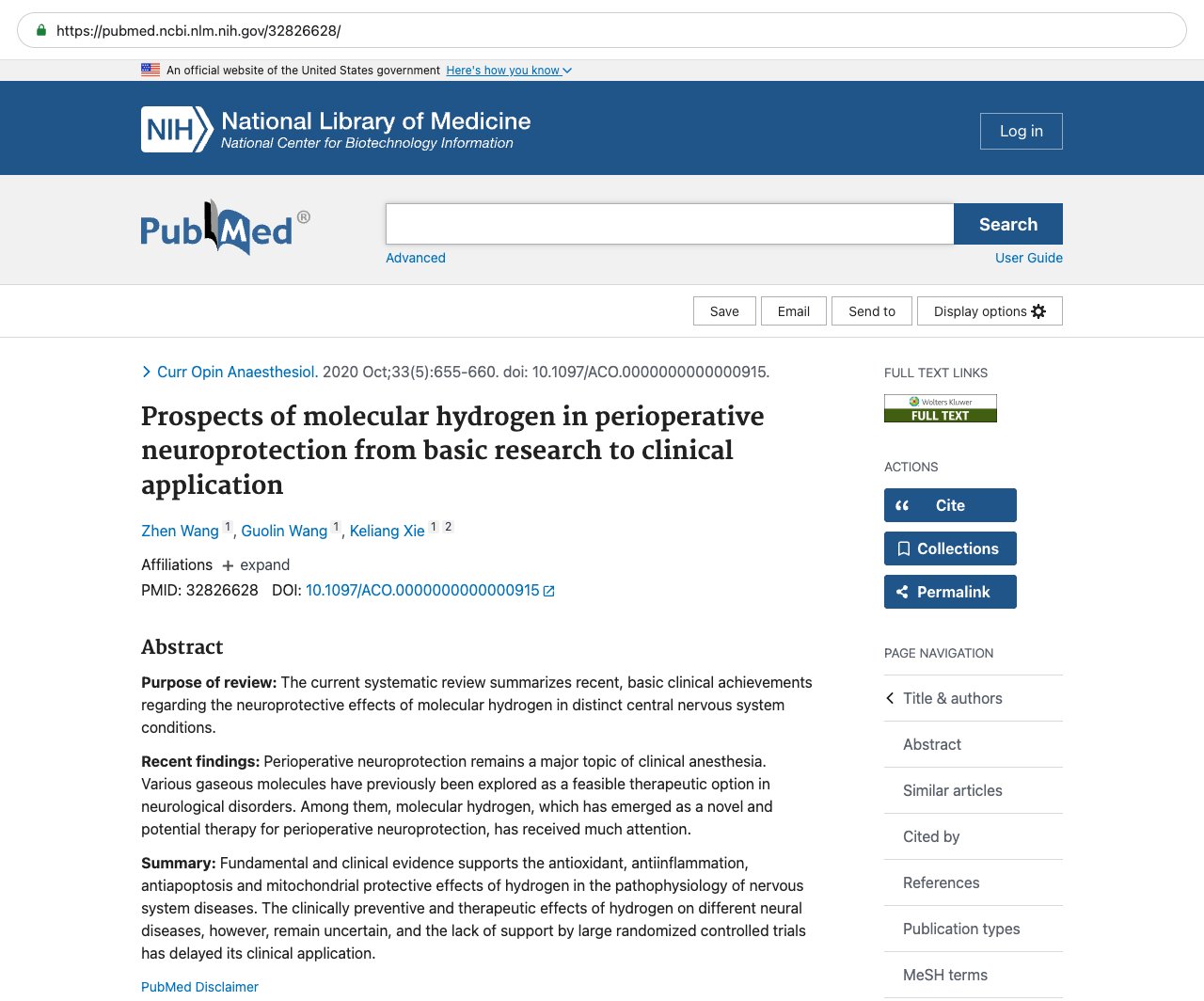
This page mirrors the published abstract (© the authors / publisher) for reference and citation. The canonical source is the PubMed record linked above. This is not medical advice.