2025 Journal of pediatric health care : official publication of National Association of Pediatric Nurse Associates & Practitioners Pilot / Observational Human H₂ therapy Drinking (HRW)
2025 · Wong et al. — Nano-Bubble Hydrogen Water in Wet-Wrap Dressing Improves the Severity of Pediatric Patients With Atopic Dermatitis
Super-Abstract
In 20 children with atopic dermatitis, wet-wrap dressings soaked in nano-bubble hydrogen water significantly reduced erythema, dryness, and total skin severity scores compared to baseline; in a split-body sub-study (8 patients), hydrogen-water-treated limbs improved significantly more than limbs treated with plain water. (Journal of Pediatric Health Care, 2025.)
Commentary
Atopic dermatitis in children is a major dermatological burden — chronic, itchy, often poorly controlled, and associated with significant impact on quality of life. Current treatment relies heavily on topical corticosteroids and calcineurin inhibitors, both of which carry risks with long-term use. The idea of using hydrogen water as a low-risk adjunct in wet-wrap therapy is clinically sensible: wet-wrap dressing is already an established method for severe flares, and replacing saline with hydrogen water requires no additional procedure. This study's great strength is the split-body design in 8 of the 20 patients — this internal control elegantly eliminates inter-individual variability and provides the most convincing evidence of a directional H₂ effect. The outcome measures (erythema and dryness from a validated severity score) reach statistical significance (p = 0.01 and p = 0.002 respectively). <strong>Limitations:</strong> the sample is small, the study is not blinded (patients and clinicians know which limb receives which dressing), and the study does not report follow-up beyond the treatment period — so durability of benefit is unknown.
Key quotes
- „HW wet-wrap significantly reduced erythema (0.5 ± 0.69, p = .01), dryness (0.7 ± 0.57, p = .002), and total score (1.55 ± 1.64, p < .0001), while pure water showed no significant changes.“ — the primary efficacy finding with statistical values
- „HW-treated limbs improved more than pure water-treated limbs.“ — the split-body comparison — the most internally controlled finding
- „HW wet-wrap therapy is a safe, effective adjunct for pediatric AD, improving erythema, dryness, and hydration while limiting systemic side effects.“ — the authors' positive conclusion about the therapeutic approach
Our assessment
A small but methodologically thoughtful study with a built-in split-body control design in a subset of patients. The statistically significant improvements in erythema and dryness in a paediatric population, with no reported adverse effects, are clinically encouraging. Limitations: n = 20 (split-body n = 8), no blinding, no long-term follow-up, no patient-reported itch or quality-of-life outcomes, concurrent topical therapy not described. The safety profile and non-invasive application route make this a low-risk candidate for a larger randomised controlled trial in paediatric atopic dermatitis.
Study design
- Type: clinical intervention study with split-body substudy · n: 20 children with atopic dermatitis (split-body: n = 8) · H₂ delivery: sterile gauze soaked in nano-bubble hydrogen water applied as wet-wrap dressing
- Result (full cohort, n = 20): significant reduction in erythema (p = 0.01), dryness (p = 0.002), and total severity score (p < 0.0001) vs. baseline
- Result (split-body, n = 8): H₂-water-treated limbs showed significantly greater improvement than plain-water-treated limbs on the same patient
Abstract
INTRODUCTION: Atopic dermatitis (AD) is a chronic inflammatory skin condition in which reactive oxygen species (ROS) contribute to its pathogenesis. Hydrogen water (HW), with potent antioxidant properties, may counteract ROS and improve AD symptoms. This study assessed the clinical efficacy of nano-HW wet-wrap dressing in AD. METHOD: Twenty AD patients received wet-wrap therapy using sterile gauze soaked in nano-bubble HW. In eight patients, a split-body design was used: one limb with nano-HW, the other with pure water. RESULTS: HW wet-wrap significantly reduced erythema (0.5 ± 0.69, p = .01), dryness (0.7 ± 0.57, p = .002), and total score (1.55 ± 1.64, p < .0001), while pure water showed no significant changes. HW-treated limbs improved more than pure water-treated limbs. DISCUSSION: HW wet-wrap therapy is a safe, effective adjunct for pediatric AD, improving erythema, dryness, and hydration while limiting systemic side effects.
Source & links
Screenshot of the PubMed page
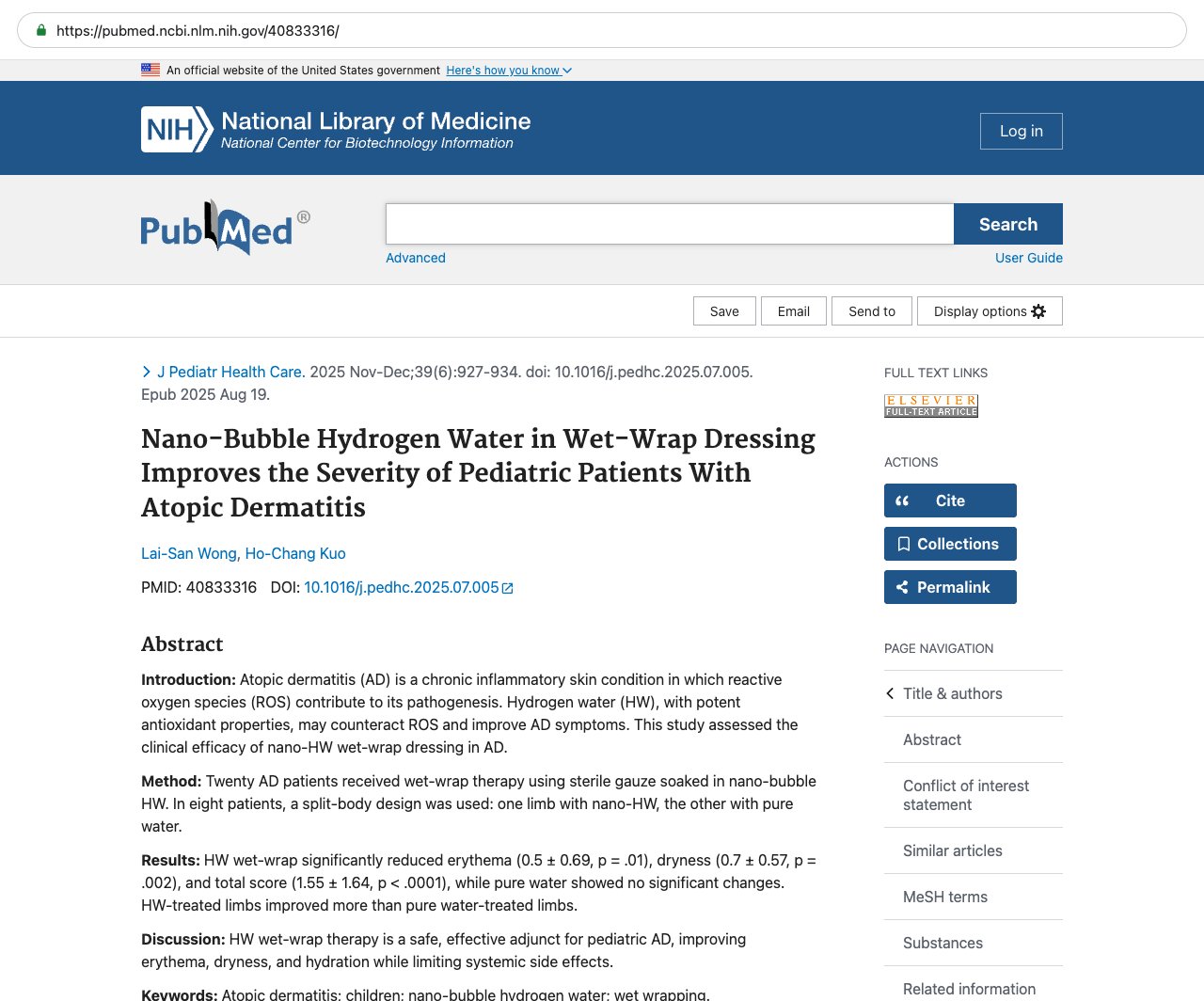
This page mirrors the published abstract (© the authors / publisher) for reference and citation. The canonical source is the PubMed record linked above. This is not medical advice.