2025 · Wang et al. — Hydrogen-Oxygen Mixture Inhalation as an Adjunctive Treatment to Home-Based Exercise in Older Patients with Knee Osteoarthritis: An Open-Label, Blinded-Endpoint, Randomized Controlled Trial
Super-Abstract
In 121 older adults with knee osteoarthritis on a 12-week home exercise programme, adding hydrogen-oxygen inhalation for 60 minutes a day over 2 weeks showed no statistically significant difference in the WOMAC total score at week 12 (mean difference −5.2, P = 0.140). Both groups improved, and the authors report a significant group-by-time interaction. They conclude that inhalation eased symptoms and improved function during the first 2 weeks, but the abstract gives no figures for that period. The Chair Stand Test, Timed Up and Go, SF-36 health survey, exercise adherence and adverse events did not differ between groups at week 12. (Frontiers in Pharmacology, 2025.)
Commentary
Knee osteoarthritis causes disability and lower quality of life, and few studies have looked at hydrogen for it. In this open-label randomised trial with blinded endpoint assessment, older patients with knee osteoarthritis were assigned to Group H or Group C. Both groups followed a 12-week home-based exercise programme with knee-joint exercises and health education. Group H also inhaled a hydrogen-oxygen mixture for 60 minutes a day over 2 weeks. Group C received no inhalation, so there was no placebo gas. The abstract does not state the hydrogen share of the gas. The 121 participants had a mean age of 81.2 years, and 80.2% were women. The primary outcome was the WOMAC osteoarthritis index. Secondary outcomes were inflammation levels (hs-CRP, NLR, PLR, LMR), the Chair Stand Test (CST), the Timed Up and Go test (TUG), the SF-36 health survey, the Exercise Adherence Rating Scale (EARS) and adverse events.
Key quotes
- „The between-group mean difference in the WOMAC total score was -5.2 (95% CI -12.1 to 1.7, P = 0.140) at week 12“ — the primary outcome: no significant difference between the groups at week 12
- „No significant differences were observed between both groups at week 12 in CST, TUG, SF-36 scores, EARS scores, or the incidence of adverse events.“ — secondary outcomes and safety: no between-group differences at week 12
- „Although clinical significance was not achieved, H2-O2 inhalation alleviated KOA symptoms and enhanced functional activity in elderly patients undergoing the HBE program during the initial 2 weeks. However, its sustained effects on improving KOA symptoms were not observed.“ — the authors' conclusion: possible short-term relief, no lasting effect
Our assessment
This is a randomised trial with blinded outcome assessment in a very old, mostly female group. Its primary endpoint at week 12 showed no statistically significant difference, and the authors state that clinical significance was not reached. The group-by-time interaction and the authors' reading of an early benefit during the 2 weeks of inhalation rest on time points the abstract does not report in figures. They remain a hypothesis. Limitations: the design was open label without a placebo gas, so participants knew whether they inhaled hydrogen, which matters for a self-reported score such as WOMAC. Inhalation covered only 2 of the 12 weeks. The hydrogen share of the gas is not given. Results for the inflammation markers are not reported in the abstract, nor are the group sizes or the number of dropouts.
Study design
- Type: open-label, blinded-endpoint, randomised controlled trial, 12 weeks · n: 121 enrolled (mean age 81.2 years, 80.2% women; group sizes not stated in the abstract) · H₂ delivery: inhaled hydrogen-oxygen mixture, 60 minutes a day for 2 weeks, added to home-based exercise (gas composition not stated in the abstract)
- Comparator: the same home-based exercise programme alone, without inhalation
- Result: primary endpoint (WOMAC total at week 12) between-group mean difference −5.2 (95% CI −12.1 to 1.7), P = 0.140, not significant. Change from baseline −22.9 in Group H and −19.4 in Group C (both P < 0.001). Group-by-time interaction P < 0.001. No differences at week 12 in CST, TUG, SF-36, EARS or adverse events
Abstract
OBJECTIVE: Knee osteoarthritis (KOA) is a degenerative joint condition, leading to disability and diminished quality of life. Molecular hydrogen has been proven to have antioxidant and anti-inflammatory properties, but few studies have investigated its effects on osteoarthritis. Our study aims to assess the therapeutic potential of hydrogen-oxygen mixture (H2-O2) inhalation for KOA. METHODS: In this randomized controlled trial, eligible elderly KOA patients were randomly assigned to either Group H or Group C. Both groups participated in a 12-week home-based exercise (HBE) program, which included knee-joint exercises and health education. Group H additionally received H2-O2 inhalation for 60 min per day over 2 weeks, while Group C did not. The primary outcome was measured using Western Ontario and McMaster Universities Osteoarthritis Index (WOMAC). Secondary outcomes included inflammation levels (hs-CRP, NLR, PLR, LMR), Chair Stand Test (CST), Timed Up and Go (TUG), 36-item short-form health survey (SF-36), Exercise Adherence Rating Scale (EARS), and adverse events. RESULTS: A total of 121 subjects were enrolled, with an average age of 81.2 years, and 80.2% were female. The between-group mean difference in the WOMAC total score was -5.2 (95% CI -12.1 to 1.7, P = 0.140) at week 12, with Group H showing an improvement of -22.9 (95% CI -26.3 to -19.6, P < 0.001) and Group C showing an improvement of -19.4 (95% CI -22.7 to -16.0, P < 0.001) compared to baseline, revealing a significant group × time interaction (F (3, 356.034) = 14.425, P < 0.001). No significant differences were observed between both groups at week 12 in CST, TUG, SF-36 scores, EARS scores, or the incidence of adverse events. CONCLUSION: Although clinical significance was not achieved, H2-O2 inhalation alleviated KOA symptoms and enhanced functional activity in elderly patients undergoing the HBE program during the initial 2 weeks. However, its sustained effects on improving KOA symptoms were not observed.
Source & links
Screenshot of the PubMed page
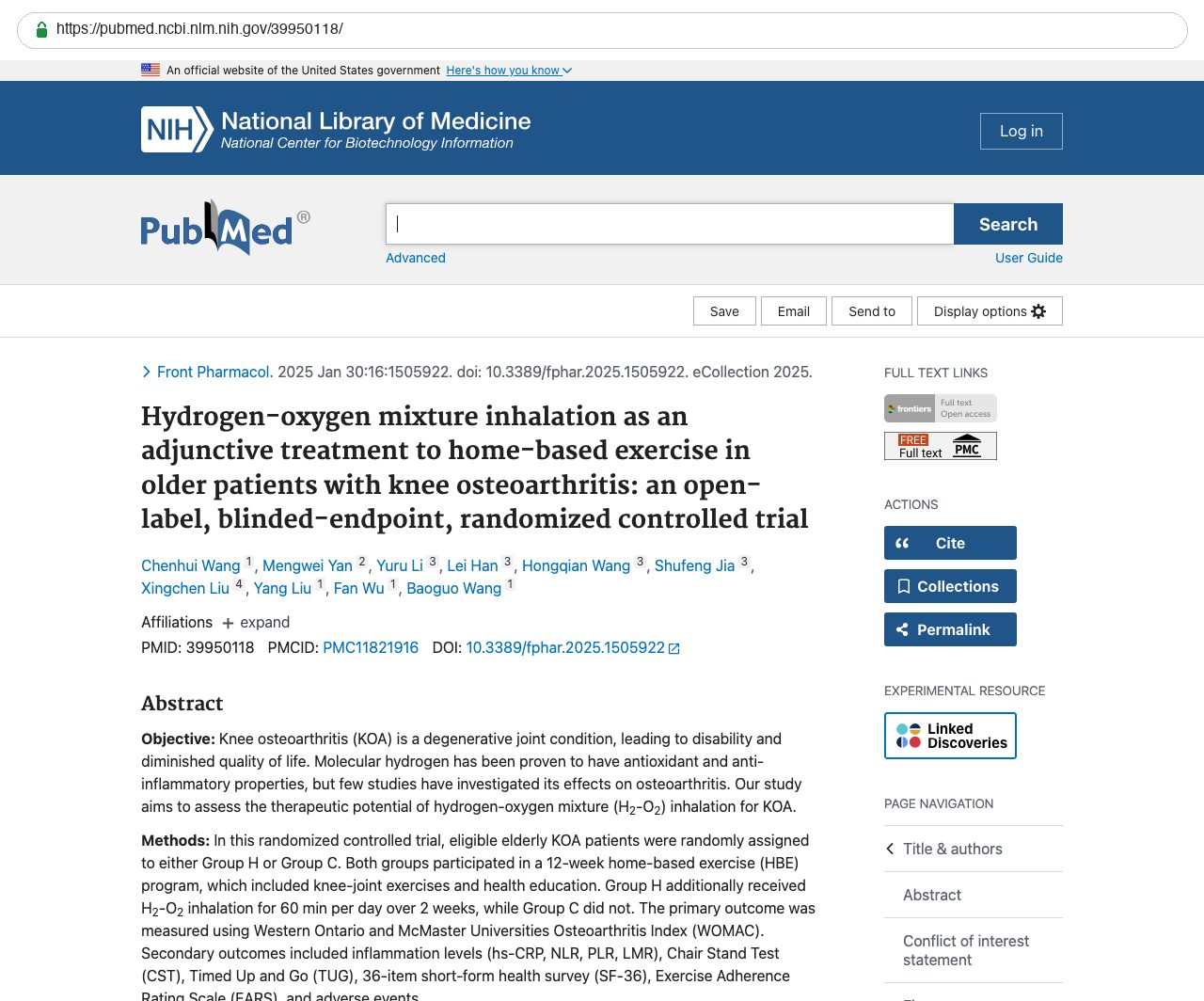
This page mirrors the published abstract (© the authors / publisher) for reference and citation. The canonical source is the PubMed record linked above. This is not medical advice.