1992 · Wong — A New Zinc Product for the Reduction of Water in Physiological Fluids to Hydrogen Gas for ²H/¹H Isotope Ratio Measurements
Super-Abstract
This methodological study describes a new zinc-based reagent for converting water in physiological fluids to hydrogen gas for deuterium/hydrogen (²H/¹H) isotope ratio analysis — enabling accurate, convenient measurement of total body water and metabolic turnover rates in nutritional research. No abstract is publicly available; details are accessible via the original publication. (European Journal of Clinical Nutrition, 1992.)
Commentary
This is an analytical chemistry and isotope methodology paper — not a hydrogen therapy study. The „hydrogen gas” here is produced from water samples for mass spectrometric analysis; it is not molecular H₂ used therapeutically. The ²H/¹H isotope ratio in body water is a standard tool in nutrition science (doubly-labeled water studies, total body water measurements). The zinc reagent described offers an alternative to platinum catalyst methods for converting water to H₂ gas prior to isotope ratio mass spectrometry (IRMS). No abstract is available in the database; a full assessment requires the original publication.
Key quotes
- „A new zinc product for the reduction of water in physiological fluids to hydrogen gas for 2H/1H isotope ratio measurements.“ — title only — no abstract available; the application is isotope measurement, not H₂ therapy
Our assessment
This is a methodological / analytical chemistry paper on stable isotope analysis — not a hydrogen therapy study. Hydrogen gas is generated here solely as an analytical intermediate for mass spectrometric measurement of deuterium enrichment in body water. No implications for therapeutic molecular H₂ exist in this work. Its value is in nutritional and metabolic research methodology. Researchers seeking clinical evidence on H₂ therapy will find this paper entirely unrelated.
Study design
- Type: methodological study (analytical chemistry / stable isotope mass spectrometry) · Model: physiological fluid water samples · H₂ delivery: not applicable — H₂ generated analytically from water samples, not administered therapeutically
- Result: no abstract available — refer to original publication in European Journal of Clinical Nutrition (1992)
Source & links
Screenshot of the PubMed page
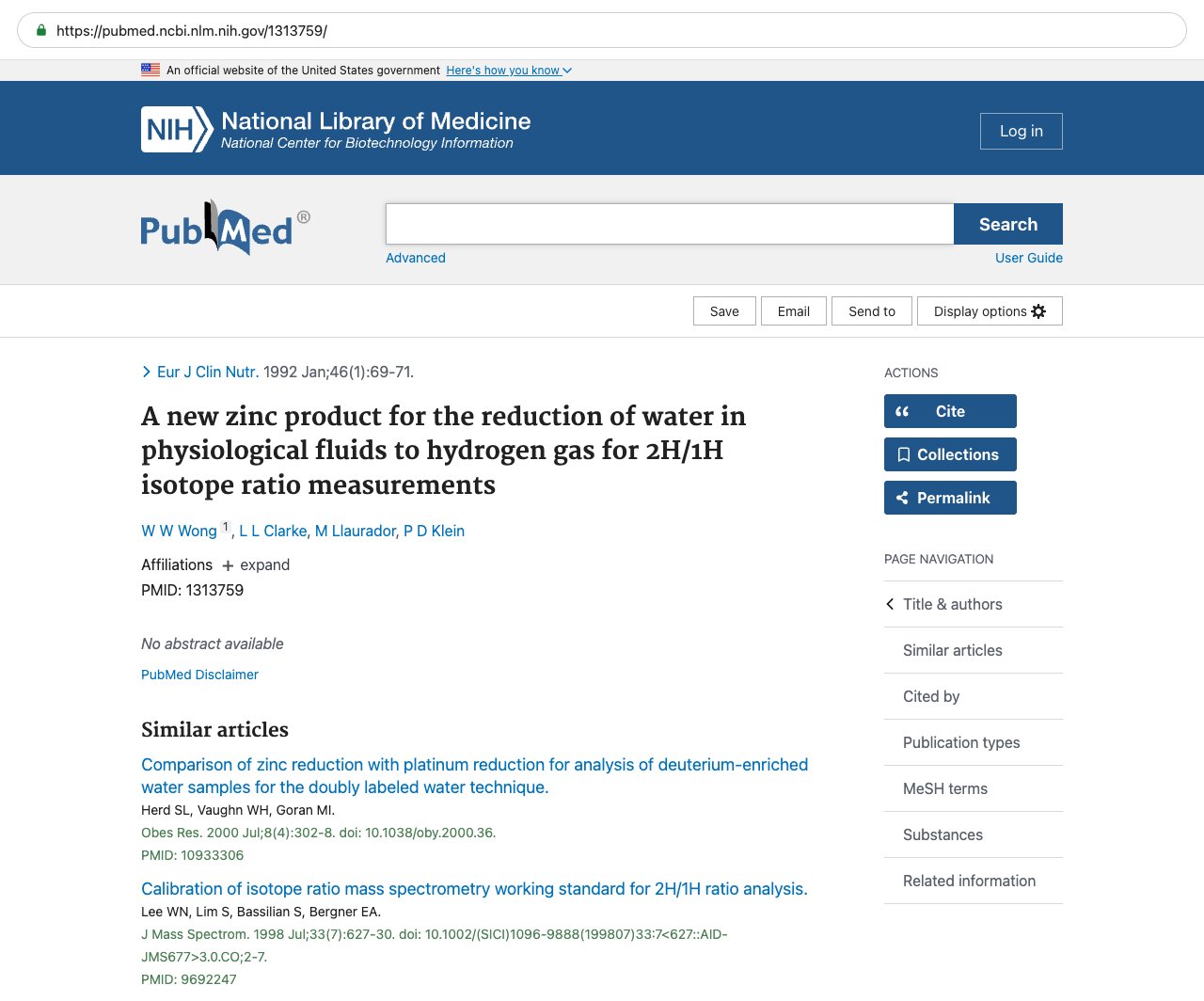
This page mirrors the published abstract (© the authors / publisher) for reference and citation. The canonical source is the PubMed record linked above. This is not medical advice.