2010 · Wong — A biodegradable polymer-based coating to control the performance of magnesium alloy orthopaedic implants.
Super-Abstract
This in-vitro and in-vivo study developed a biodegradable polymer coating for magnesium alloy bone implants to control their corrosion rate and reduce the accumulation of hydrogen gas during degradation. Uncoated magnesium implants corrode quickly and release H₂ gas in tissue — a clinical safety concern. The polymer coating slowed degradation, maintained bone mechanical properties, and in animal tests produced more new bone growth. Note: this paper is not about H₂ therapy — H₂ appears here as an unwanted by-product of implant corrosion.
Commentary
This is a biomedical engineering study in orthopaedics, not a study of molecular hydrogen as a health intervention. Magnesium and its alloys are attractive as biodegradable bone implants because they biodegrade naturally and are mechanically similar to cortical bone. The key problem is that magnesium corrodes too fast in physiological conditions, generating H₂ gas accumulation in tissue — which causes adverse reactions. The polycaprolactone (PCL) coating developed in this paper controls corrosion rate and eliminates H₂ accumulation. The in-vitro results showed good cytocompatibility; the in-vivo study in an animal model confirmed slower degradation and better new bone formation for coated vs. uncoated implants. H₂ here is a safety hazard to be engineered away, not a therapeutic agent.
Key quotes
- „The high corrosion rate and accumulation of hydrogen gas upon degradation hinders its clinical application.“ — H₂ framed as a problem — the opposite of therapeutic use
- „Histological analysis indicated no inflammation, necrosis or hydrogen gas accumulation on either of the samples during degradation.“ — the safety endpoint: absence of H₂ accumulation as a positive outcome
- „Higher volumes of new bone were observed on the polymer-coated samples.“ — the key efficacy finding: polymer coating improved bone regeneration in vivo
Our assessment
This is a biomedical engineering study on orthopaedic implant materials — not a study of therapeutic molecular hydrogen. H₂ appears in this paper exclusively as an unwanted corrosion by-product that the researchers aimed to eliminate. The study is technically sound in its own domain (materials science, implant biocompatibility) and its presence in an H₂ database is an indexing artefact. No conclusions about H₂ as a health therapy can be drawn from this publication.
Study design
- Type: in-vitro + in-vivo animal study · Model: eGFP and SaOS-2 osteoblasts (in vitro); animal implant model (in vivo) · H₂ relevance: H₂ as corrosion by-product to be suppressed, not therapeutic agent
- Result: PCL-coated magnesium alloys showed controlled degradation, maintained mechanical properties, good cytocompatibility, higher new bone formation, and no H₂ gas accumulation compared to uncoated controls
Abstract
Magnesium and its alloys may potentially be applied as degradable metallic materials in orthopaedic implantations due to their degradability and resemblance to human cortical bone. However, the high corrosion rate and accumulation of hydrogen gas upon degradation hinders its clinical application. In this study, we adopt a new approach to control the corrosion rate by coating a controllable polymeric membrane fabricated by polycaprolactone and dichloromethane onto magnesium alloys, in which the pore size was controlled during the manufacturing process. The addition of the polymeric membrane was found to reduce the degradation rate of magnesium, and the bulk mechanical properties were shown to be maintained upon degradation. The in-vitro studies indicated good cytocompatibility of eGFP and SaOS-2 osteoblasts with the polymer-coated samples, which was not observed for the uncoated samples. The in-vivo study indicated that the uncoated sample degraded more rapidly than that of the polymer-coated samples. Although new bone formation was found on both samples, as determined by Micro-CT, higher volumes of new bone were observed on the polymer-coated samples. Histological analysis indicated no inflammation, necrosis or hydrogen gas accumulation on either of the samples during degradation. Collectively, these data suggest that the use of polymeric membrane may be potentially applied for future clinical use.
Source & links
Screenshot of the PubMed page
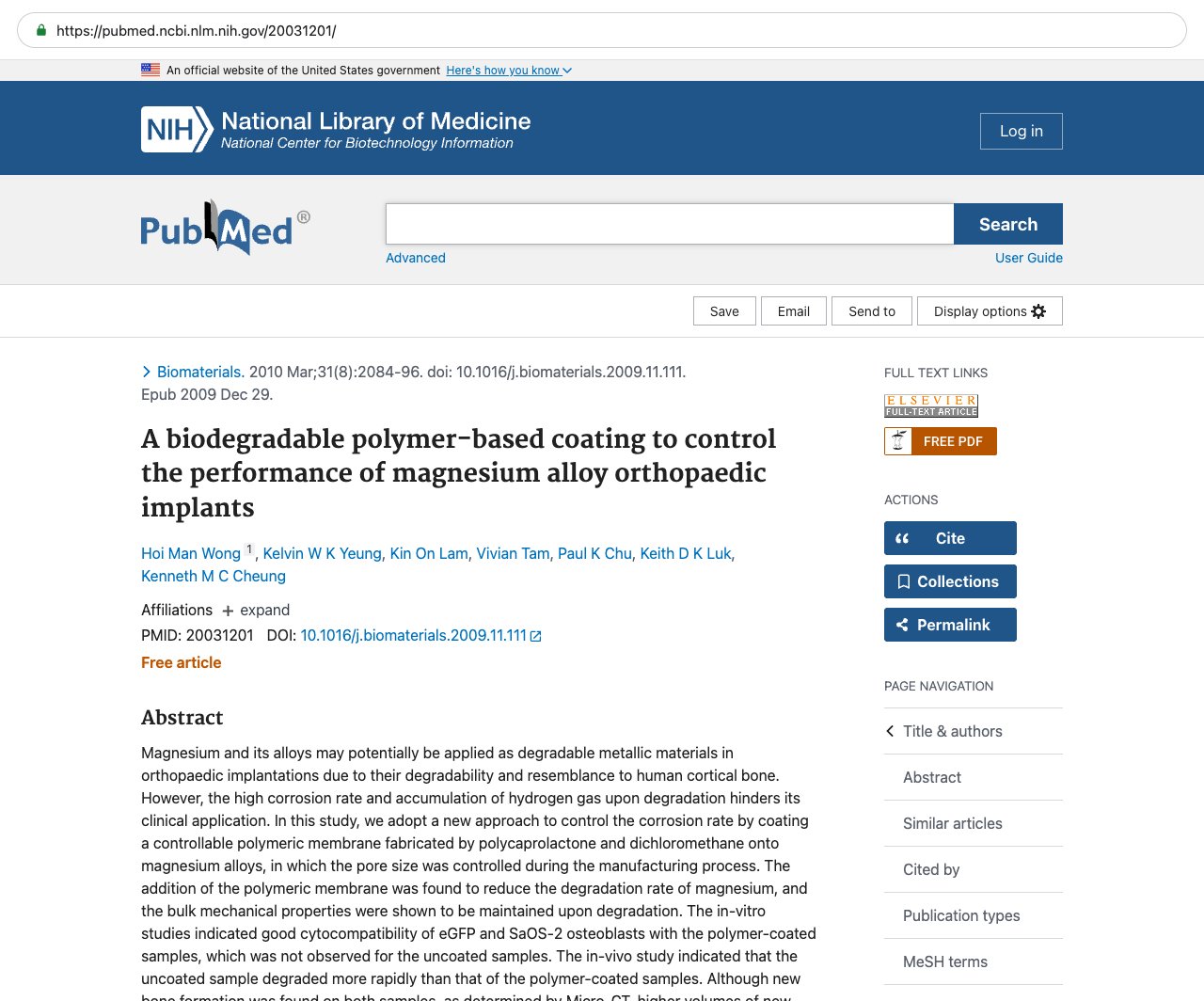
This page mirrors the published abstract (© the authors / publisher) for reference and citation. The canonical source is the PubMed record linked above. This is not medical advice.