2025 · Maier — Biomechanical Analysis of Biodegradable Magnesium, Zinc, and Polylactide Pins for Fixation of Radial Head Fractures
Super-Abstract
Biodegradable magnesium and zinc pins outperformed polylactide pins in laboratory biomechanical testing for radial head fracture fixation, with magnesium pins showing the highest stiffness and lowest fracture displacement. This in-vitro study on synthetic bone models compares three materials — but hydrogen gas formation from dissolving magnesium implants is flagged as a known concern requiring further investigation. (Journal of Orthopaedic Surgery and Research, 2025.)
Commentary
This paper is not primarily a hydrogen therapy study — it is a biomechanical engineering study of biodegradable orthopaedic implants. Its relevance to H₂ biology is indirect: magnesium implants produce hydrogen gas as a byproduct of their in-vivo degradation, which has raised both safety concerns and speculative therapeutic interest in orthopaedic literature. The study finds that magnesium pins provide superior fixation stability compared to polylactide (a common clinical material) and zinc pins. Zinc pins emerge as a promising middle-ground option. Critically, the study uses composite synthetic radii (artificial bone models), not cadaveric or living tissue — a significant limitation for predicting clinical outcomes. The authors acknowledge that in-vivo, cadaveric, and clinical studies are still required. The hydrogen gas formation from magnesium degradation is mentioned but not studied as a therapeutic variable here.
Key quotes
- „Magnesium pins (MP) provide superior stability but exhibit inconsistent resorption and relevant hydrogen gas formation.“ — the known clinical limitation of magnesium implants — H₂ gas is a side-effect, not the therapy
- „MPs demonstrated the highest primary stability, followed by ZPs and PPs under both transverse and axial loading.“ — the biomechanical hierarchy of the three implant materials
- „Further in-vivo, cadaveric, and clinical studies are necessary to confirm long-term outcomes and biological integration.“ — the authors' honest caveat about the limits of synthetic-model testing
Our assessment
This is an in-vitro biomechanical study on synthetic bone models — not a clinical or biological H₂ study. The connection to hydrogen is that magnesium implants produce H₂ gas during degradation, but this study does not investigate any therapeutic effect of that hydrogen. Its findings are relevant to orthopaedic implant materials research. Conclusions about H₂ as a therapy cannot be drawn from this work.
Study design
- Type: in-vitro biomechanical study · Model: standardised Mason type II radial head fractures in composite synthetic radii · H₂ relevance: indirect — magnesium implants produce H₂ gas during degradation (known side-effect, not studied as therapy here)
- Result: magnesium pins: highest stiffness and lowest fracture displacement; zinc pins: comparable performance to magnesium in load-to-failure; polylactide pins: lowest stability across all measures; differences statistically significant (p < 0.05 to p < 0.001)
Abstract
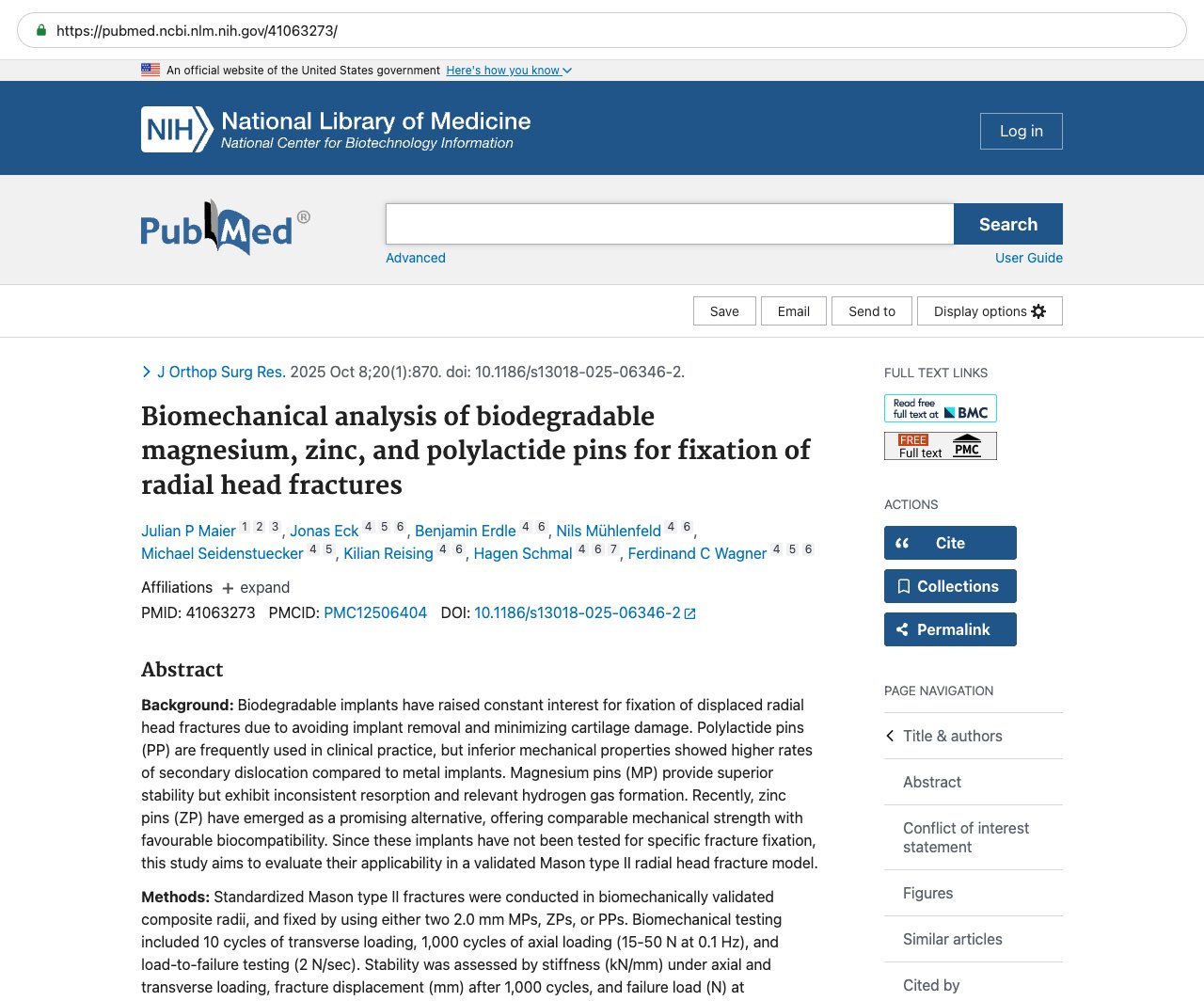
BACKGROUND: Biodegradable implants have raised constant interest for fixation of displaced radial head fractures due to avoiding implant removal and minimizing cartilage damage. Polylactide pins (PP) are frequently used in clinical practice, but inferior mechanical properties showed higher rates of secondary dislocation compared to metal implants. Magnesium pins (MP) provide superior stability but exhibit inconsistent resorption and relevant hydrogen gas formation. Recently, zinc pins (ZP) have emerged as a promising alternative, offering comparable mechanical strength with favourable biocompatibility. Since these implants have not been tested for specific fracture fixation, this study aims to evaluate their applicability in a validated Mason type II radial head fracture model. METHODS: Standardized Mason type II fractures were conducted in biomechanically validated composite radii, and fixed by using either two 2.0 mm MPs, ZPs, or PPs. Biomechanical testing included 10 cycles of transverse loading, 1,000 cycles of axial loading (15-50 N at 0.1 Hz), and load-to-failure testing (2 N/sec). Stability was assessed by stiffness (kN/mm) under axial and transverse loading, fracture displacement (mm) after 1,000 cycles, and failure load (N) at dislocation ≥ 2 mm. RESULTS: MPs demonstrated the highest primary stability, followed by ZPs and PPs under both transverse (PP: 0.36 ± 0.08 kN/mm vs. MP: 1.30 ± 0.31 kN/mm, p < .001; vs. ZP: 0.87 ± 0.33 kN/mm, p = .012) and axial loading (PP: 0.43 ± 0.10 kN/mm vs. MP: 1.25 ± 0.31 kN/mm, p < .001; vs. ZP: 0.77 ± 0.18 kN/mm, p = .035). Fracture displacement after 1,000 cycles was lower with MPs and ZPs than PPs (PP: 0.038 ± 0.009 mm vs. MP: 0.013 ± 0.003 mm, p < .001; vs. ZP: 0.022 ± 0.007 mm, p = .003). MPs (282 ± 26 N) showed the highest load-to-failure at 2 mm dislocation, followed by ZPs (261 ± 38 N) and PPs (215 ± 53 N) (PP vs. MP: p = .032; PP vs. ZP: p = .164; MP vs. ZP p = .650). CONCLUSION: In this biomechanical model of Mason type II radial head fractures, biodegradable magnesium and zinc pins demonstrated superior primary stability and load-bearing capacity compared to polylactide implants. MP showed the highest stiffness and lowest fracture displacement, while ZP achieved comparable performance in fracture stabilization. These findings suggest that zinc-based implants could offer a clinically valuable alternative for radial head fracture fixation, potentially reducing complications seen with the other implants. Further in-vivo, cadaveric, and clinical studies are necessary to confirm long-term outcomes and biological integration. LEVEL OF EVIDENCE: Basic Science Study.
Source & links
Screenshot of the PubMed page
This page mirrors the published abstract (© the authors / publisher) for reference and citation. The canonical source is the PubMed record linked above. This is not medical advice.