2019 · Wu — Hydrogen Gas from Inflammation Treatment to Cancer Therapy
Super-Abstract
This review surveys the emerging field of molecular hydrogen (H₂) therapy, from its anti-inflammatory mechanisms to its potential role in cancer treatment, with special focus on how nanomaterials can deliver H₂ more precisely to target sites. The authors argue that nanocarrier-mediated H₂ delivery and in-situ H₂ generation by nanogenerators could overcome the poor targeting of systemic H₂ gas administration. (ACS Nano, 2019.)
Commentary
Wu et al. provide a perspective-style review in ACS Nano — one of the most prestigious nanoscience journals. The paper covers: (1) the known mechanisms of H₂ therapy (selective scavenging of hydroxyl radicals and peroxynitrite, anti-inflammatory signalling, anti-apoptotic effects); (2) current delivery modalities (drinking H₂-rich water, inhalation, saline injection) and their limitations (poor targeting, rapid diffusion); and (3) how engineered nanomaterials — both as carriers and as in-situ generators — could improve H₂ localisation at pathological sites, particularly tumors. The review is forward-looking and notes that the anti-tumor mechanisms of H₂ remain incompletely understood. It is a literature synthesis, not a new experiment, and the field of H₂ nanomedicine is still at an early stage with mostly preclinical evidence.
Key quotes
- „H2 therapy is a highly promising strategy against several diseases due to its inherent biosafety.“ — authors' overall assessment: safety profile as a key advantage
- „the current H2 treatment modalities rely predominantly on the systemic administration of the gas, resulting in poor targeting and utilization“ — identified limitation of conventional H₂ delivery methods
- „although H2 has significant anti-tumor effects, the underlying mechanisms have not yet been elucidated“ — honest gap: anti-cancer mechanisms of H₂ not yet understood
Our assessment
This is a review article (ev=4) — it synthesises existing literature rather than presenting new experimental data. As a perspective in ACS Nano it is influential and well-written. Honest assessment: the anti-tumor effects of H₂ described are based predominantly on animal and cell-culture data; no clinical trials in cancer patients are cited. The review's greatest value is conceptual — it frames nanomaterial-assisted H₂ delivery as a research direction. The authors acknowledge mechanistic gaps. The „highly promising“ framing should be read as a research aspiration, not as established clinical efficacy.
Study design
- Type: narrative/perspective review · n: n/a (literature analysis) · H₂ delivery: multiple modalities reviewed (H₂-rich water, inhalation, saline, nanocarriers, nanogenerators)
- Scope: H₂ mechanisms (anti-oxidant, anti-inflammatory, anti-apoptotic), delivery limitations, nanocarrier strategies for cancer targeting
- Result: no pooled effect sizes; conclusion: nanomaterial-mediated H₂ delivery can improve targeting; anti-tumor mechanisms not yet fully elucidated; clinical translation remains a challenge
Abstract
Hydrogen (H2) therapy is a highly promising strategy against several diseases due to its inherent biosafety. However, the current H2 treatment modalities rely predominantly on the systemic administration of the gas, resulting in poor targeting and utilization. Furthermore, although H2 has significant anti-tumor effects, the underlying mechanisms have not yet been elucidated. Due to their ultrasmall size, nanomaterials are highly suitable drug-delivery systems with a myriad of biomedical applications. Nanocarrier-mediated H2 delivery, as well as in situ production of H2 by nanogenerators, can significantly improve targeted accumulation of the gas and accelerate the therapeutic effects. In addition, nanomaterials can be further modified to enhance passive or active accumulation at the target site. In this Perspective, we summarize the mechanism of H2 therapy and describe possibilities for combining H2 therapy with nanomaterials. We also discuss the current challenges of H2 therapy and provide some insights into this burgeoning field.
Source & links
Screenshot of the PubMed page
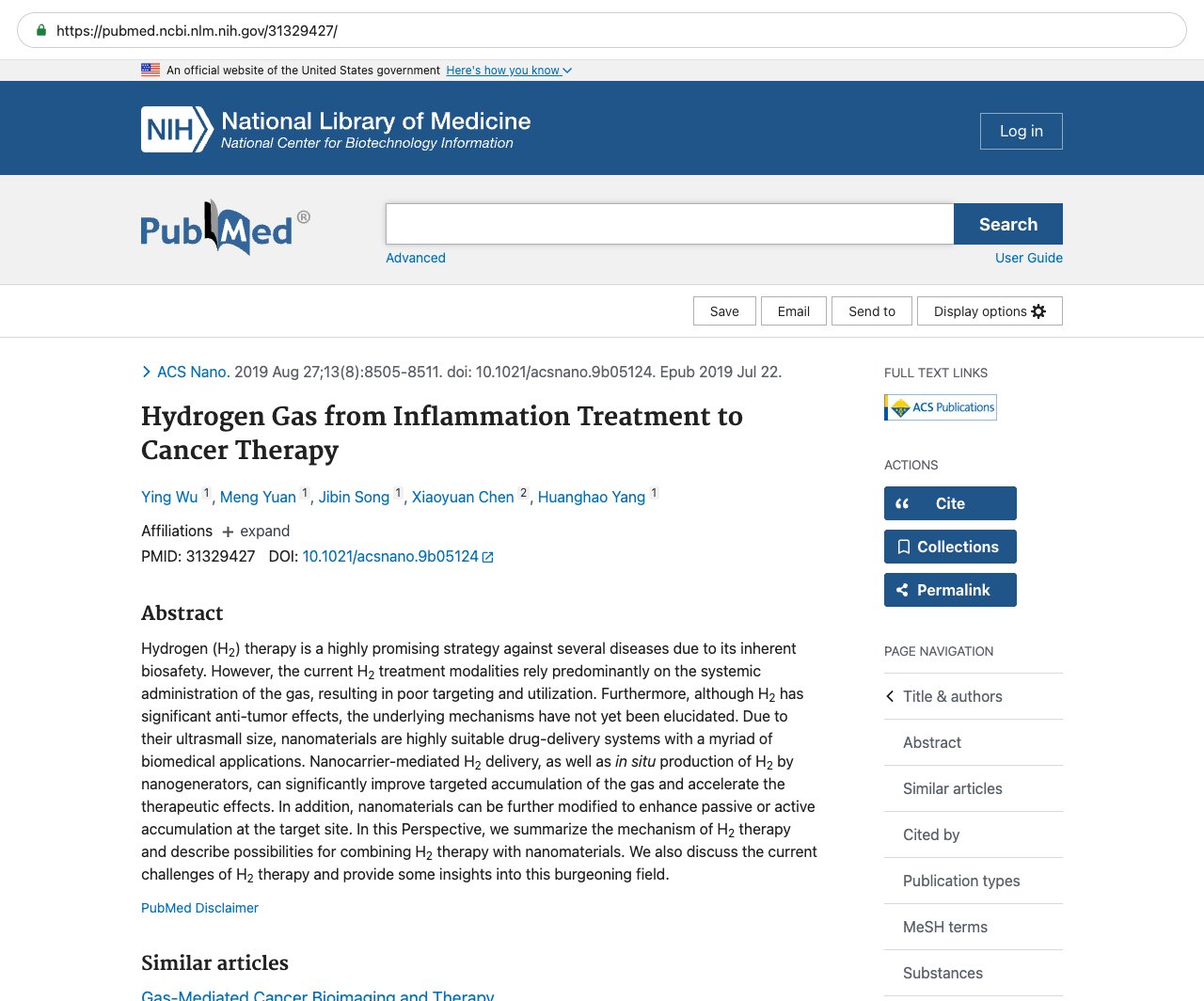
This page mirrors the published abstract (© the authors / publisher) for reference and citation. The canonical source is the PubMed record linked above. This is not medical advice.