2023 · Wu et al. — Molecular Hydrogen: An Emerging Therapeutic Medical Gas for Brain Disorders
Super-Abstract
This wide-ranging review in Molecular Neurobiology surveys the evidence for hydrogen therapy across eight major brain disorders — including Alzheimer's disease, Parkinson's disease, ischemic stroke, traumatic brain injury, neonatal hypoxic-ischemic encephalopathy, depression, anxiety, and multiple sclerosis. H₂'s primary neuroprotective mechanisms are antioxidant activity (neutralising hydroxyl radicals and peroxynitrite) and anti-neuroinflammatory effects. The review also discusses delivery routes, remaining knowledge gaps, and future directions. This is a literature synthesis, not a new experimental study.
Commentary
The 2007 landmark paper demonstrating that H₂ reduced hydroxyl radical and peroxynitrite levels in ischemic stroke marked a turning point for the field, and this 2023 review from Wu et al. shows how far the neurological evidence base has grown in the intervening fifteen years. The breadth of brain disorders covered reflects the fundamental nature of oxidative stress and neuroinflammation as cross-cutting pathological mechanisms — if H₂ modulates both, it could theoretically benefit many conditions simultaneously. The review notes that human clinical data now exist for several of these conditions, particularly stroke and neonatal hypoxia, though they remain preliminary and small-scale. The honest conclusion the authors draw is that understanding the exact molecular target — what does H₂ actually bind to in neurons — and identifying optimal doses and delivery timing remain the field's central open questions. This is a scientifically careful review that neither overclaims nor dismisses.
Key quotes
- „Since the landmark finding reported in 2007 found that hydrogen reduced the levels of peroxynitrite anions and hydroxyl free radicals in ischemic stroke, molecular hydrogen's antioxidative and anti-inflammatory effects have aroused widespread interest.“ — the historical anchor: the 2007 Nature Medicine paper that launched modern H₂ neuroscience
- „hydrogen therapy via different routes of administration exhibits great therapeutic potential for a wide range of brain disorders, including Alzheimer's disease, neonatal hypoxic-ischemic encephalopathy, depression, anxiety, traumatic brain injury, ischemic stroke, Parkinson's disease, and multiple sclerosis.“ — the scope of brain conditions with preclinical or early clinical H₂ evidence
- „understanding the exact molecular target, finding novel routes, and determining the optimal dosage for hydrogen administration is critical for future studies and applications.“ — the authors' own summary of what the field still needs to resolve
Our assessment
A comprehensive and scientifically grounded review of H₂ therapy across the full spectrum of major brain disorders. The historical framing (from the 2007 landmark to 2023 evidence) is valuable, and the coverage of multiple delivery routes and specific conditions is thorough. Honest limitation: this is a review article, not new experimental evidence. For most brain disorders discussed, human clinical evidence remains limited and preliminary. The molecular target of H₂ in neural tissue has not been definitively identified — a fundamental gap the authors themselves acknowledge. The review is an excellent entry point to the field, not a definitive clinical proof of efficacy.
Study design
- Type: comprehensive narrative review · n: n/a (literature synthesis) · H₂ delivery: multiple routes reviewed (inhalation, HRW, IV saline, others)
- Brain disorders covered: Alzheimer's, Parkinson's, ischemic stroke, TBI, neonatal hypoxic-ischemic encephalopathy, depression, anxiety, multiple sclerosis
- Result: broad preclinical evidence base; emerging human data in selected conditions (stroke, neonatal HIE); molecular target and optimal dosing remain open research questions
Abstract
Oxidative stress and neuroinflammation are the main physiopathological changes involved in the initiation and progression of various neurodegenerative disorders or brain injuries. Since the landmark finding reported in 2007 found that hydrogen reduced the levels of peroxynitrite anions and hydroxyl free radicals in ischemic stroke, molecular hydrogen's antioxidative and anti-inflammatory effects have aroused widespread interest. Due to its excellent antioxidant and anti-inflammatory properties, hydrogen therapy via different routes of administration exhibits great therapeutic potential for a wide range of brain disorders, including Alzheimer's disease, neonatal hypoxic-ischemic encephalopathy, depression, anxiety, traumatic brain injury, ischemic stroke, Parkinson's disease, and multiple sclerosis. This paper reviews the routes for hydrogen administration, the effects of hydrogen on the previously mentioned brain disorders, and the primary mechanism underlying hydrogen's neuroprotection. Finally, we discuss hydrogen therapy's remaining issues and challenges in brain disorders. We conclude that understanding the exact molecular target, finding novel routes, and determining the optimal dosage for hydrogen administration is critical for future studies and applications.
Source & links
Screenshot of the PubMed page
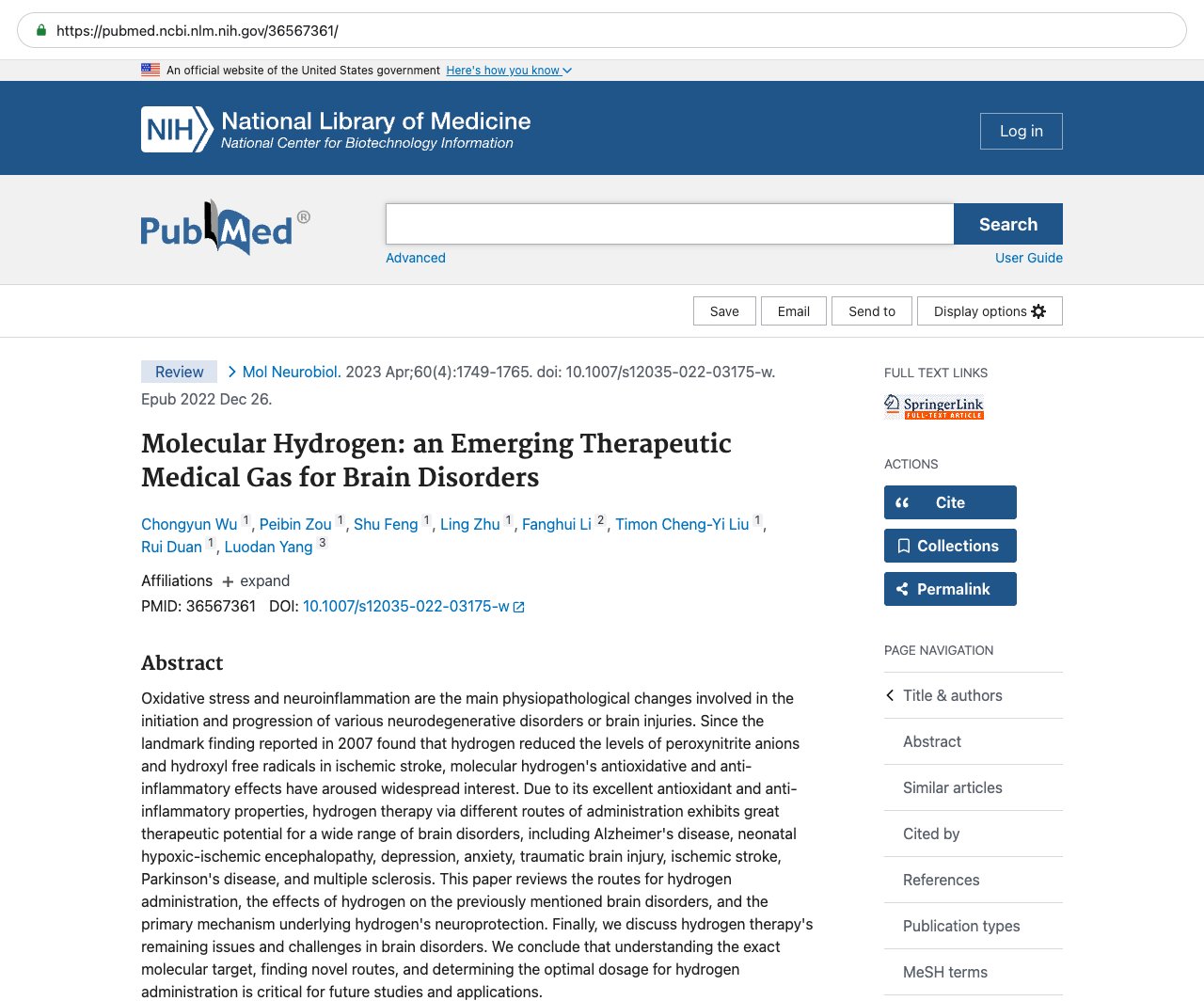
This page mirrors the published abstract (© the authors / publisher) for reference and citation. The canonical source is the PubMed record linked above. This is not medical advice.