2024 · Wu — Evolution of Therapeutic Strategy Based on Oxidant-Antioxidant Balance for Fuchs Endothelial Corneal Dystrophy
Super-Abstract
Fuchs endothelial corneal dystrophy (FECD) — the most common primary corneal endothelial disease worldwide — is closely linked to oxidative stress and antioxidant imbalance. This review outlines therapeutic strategies aimed at restoring this balance, including gene therapy, small molecules, biologics, and non-pharmacological approaches such as hydrogen therapy and near-infrared light. Given the limited availability of donor corneas, non-surgical treatments are urgently needed. This is a literature review, not a clinical trial.
Commentary
FECD is a slowly progressive disorder in which corneal endothelial cells — which cannot regenerate — are lost, eventually leading to corneal oedema and vision impairment. The pathogenesis implicates mitochondrial ROS production and disrupted antioxidant defences. This review synthesises the evidence for oxidant-antioxidant imbalance as a therapeutic target in FECD, cataloguing both established and experimental approaches. Hydrogen therapy is mentioned as one of several non-drug interventions alongside gene therapy and near-infrared light — it is not the primary focus of the paper. The depth of H₂-specific analysis is therefore limited relative to a dedicated H₂ review. The paper's strength lies in providing a clinical overview of FECD pathogenesis and the full landscape of non-surgical intervention strategies.
Key quotes
- „Corneal endothelial cells exhibit susceptibility to oxidative stress, suggesting a nuanced relationship between oxidant-antioxidant imbalance and FECD pathogenesis, irrespective of FECD genotype.“ — why oxidative stress is central to FECD regardless of genetic cause
- „This encompasses traditional antioxidants, small molecule compounds, biologics, and diverse non-drug therapies, such as gene-related therapy, hydrogen therapy and near infrared light therapy.“ — H₂ therapy listed among non-surgical interventions for FECD
- „Given the constrained availability of corneal transplants, exploration into non-surgical interventions becomes crucial.“ — clinical urgency motivating the search for non-surgical therapies
Our assessment
This is a narrative review of FECD therapeutics. H₂ appears as one item in a broader treatment catalogue and is not evaluated in depth with clinical data. The paper usefully contextualises the oxidative-stress basis of FECD and the unmet need for non-surgical options. For evidence specific to H₂ in FECD or corneal disease, dedicated studies or trials would need to be consulted — this review does not provide them.
Study design
- Type: narrative review · n: n/a (literature analysis) · H₂ delivery: hydrogen therapy mentioned as a non-drug modality (specific form not specified)
- Result: no pooled effect sizes; H₂ included in a taxonomy of non-surgical oxidant-antioxidant-targeted therapies for FECD; no dedicated H₂ efficacy data presented
Abstract
Fuchs endothelial corneal dystrophy (FECD) stands as the most prevalent primary corneal endothelial dystrophy worldwide, posing a significant risk to corneal homeostasis and clarity. Corneal endothelial cells exhibit susceptibility to oxidative stress, suggesting a nuanced relationship between oxidant-antioxidant imbalance and FECD pathogenesis, irrespective of FECD genotype. Given the constrained availability of corneal transplants, exploration into non-surgical interventions becomes crucial. This encompasses traditional antioxidants, small molecule compounds, biologics, and diverse non-drug therapies, such as gene-related therapy, hydrogen therapy and near infrared light therapy. This review concentrates on elucidating the mechanisms behind oxidant-antioxidant imbalance and the evolution of strategies to restore oxidant-antioxidant balance in FECD. It provides a comprehensive overview of both conventional and emerging therapeutic approaches, offering valuable insights for the advancement of non-surgical treatment modalities. The findings herein might establish a robust foundation for future research and the therapeutic strategy of FECD.
Source & links
Screenshot of the PubMed page
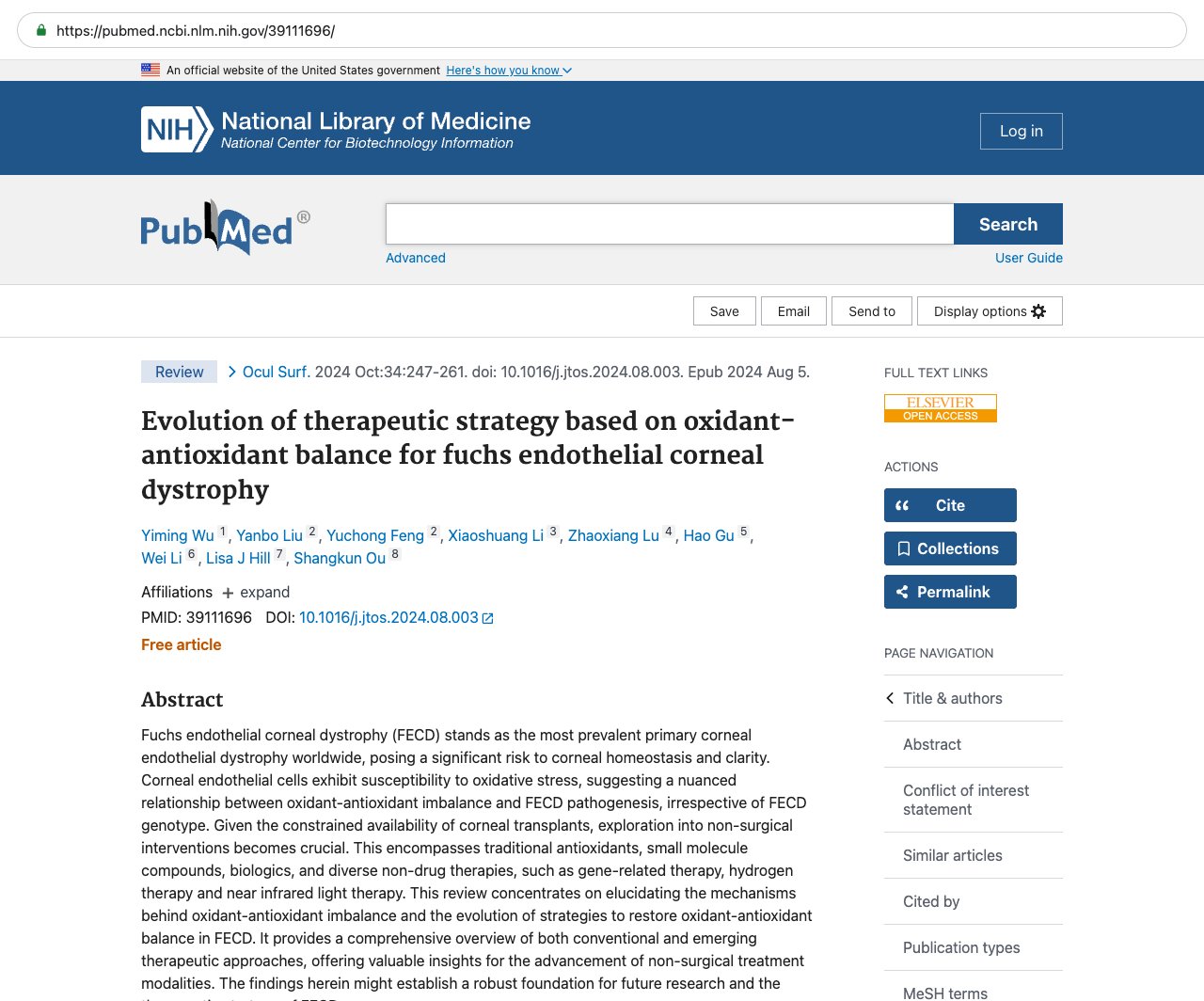
This page mirrors the published abstract (© the authors / publisher) for reference and citation. The canonical source is the PubMed record linked above. This is not medical advice.