2022 · Xiao et al. — Red Tide Short-Time Prediction Using GRU Network Model Based on Multi-Feature Factors: A Case Study in Xiamen Sea Area
Super-Abstract
This study uses machine learning — specifically a Gated Recurrent Unit (GRU) neural network — to predict red tide events in a Chinese coastal region up to 6 hours in advance, achieving accuracy rates above 92%. Among the most influential predictive factors identified are chlorophyll-a, dissolved oxygen, and the potential of hydrogen (pH). The research is an environmental monitoring and forecasting study, unrelated to therapeutic hydrogen applications. (Marine Environmental Research, 2022.)
Commentary
This paper is a marine environmental science and machine learning study focused on the early warning of harmful algal blooms (red tides) in Xiamen Bay, China. The connection to molecular hydrogen is purely indirect: pH (potential of hydrogen) appears as one of several ocean-water variables fed into the predictive model. The paper contains no research on hydrogen therapy, hydrogen-rich water, or any health-related application of H₂. It is a solid piece of applied ML for environmental monitoring but does not belong in a clinical or biological hydrogen research context.
Key quotes
- „The distinguishing factors which have the most significant influence on red tide prediction in Xiamen are chlorophyll-a, dissolved oxygen, saturated dissolved oxygen, potential of hydrogen, and water temperature.“ — the key environmental variables selected by Pearson correlation for the prediction model — pH here refers to ocean water acidity, not therapeutic hydrogen
- „The convergence speed of the Gated Recurrence Unit (GRU) prediction model based on the main feature factor proposed in this paper was faster and obtained the expected result, and the accuracy rates of the buoys are above 92%.“ — the machine learning model's predictive performance for red tide events
- „The research shows the feasibility to use GRU network model to predict the occurrence of red tide with multi-feature factors as input parameters.“ — the main conclusion: GRU networks can effectively predict red tides from multi-sensor ocean data
Our assessment
This is a theory/computational study (environmental informatics). It has no relevance to molecular hydrogen therapy or health research. The term „hydrogen” in the dataset refers solely to the pH scale (potential of hydrogen) as an ocean-chemistry measurement variable. The study is technically sound for its domain but is out of scope for any H₂-medicine database. Honest note: This study appears here due to keyword matching on „hydrogen” in its methods fields, not because it researches H₂ as a therapeutic or biological agent.
Study design
- Type: computational/modelling study (environmental informatics) · n: ocean monitoring data from Xiamen, 2009–2017 · H₂ relevance: none — „hydrogen” refers to pH (potential of hydrogen) as a water-chemistry variable
- Result: GRU neural network achieves >92% prediction accuracy for red tide occurrence up to 6 hours ahead; chlorophyll-a and dissolved oxygen are the strongest predictors
Abstract
Red tide caused severe impacts on marine fisheries, ecology, economy and human life safety. The formation mechanism of the red tide is rather complicated; thus, red tide prediction and forecasting have long been a research hotspot around the globe. This study collected ocean monitoring data before and after the occurrence of red tides in Xiamen sea area from 2009 to 2017. The Pearson correlation coefficient method was used to obtain the associated factors of red tide occurrence, including water temperature, saturated dissolved oxygen, dissolved oxygen, chlorophyll-aand potential of hydrogen. Then, we built a short-time red tide prediction model based on the combination of multiple feature factors. chlorophyll-a, dissolved oxygen, saturated dissolved oxygen, potential of hydrogen, water temperature, salinity, turbidity, wind speed, wind direction and Air pressure were used as the input variables, building a short-time prediction model based on the combination of multiple feature factors to forecast red tide in the next 6 h by using the monitoring data. The accuracy of different forecast models with different feature combinations was compared. Results show that the distinguishing factors which have the most significant influence on red tide prediction in Xiamen are chlorophyll-a, dissolved oxygen, saturated dissolved oxygen, potential of hydrogen, and water temperature. the convergence speed of the Gated Recurrence Unit (GRU) prediction model based on the main feature factor proposed in this paper was faster and obtained the expected result, and the accuracy rates of the buoys are above 92%. The research shows the feasibility to use GRU network model to predict the occurrence of red tide with multi-feature factors as input parameters. the paper provides an effective method for the red tide early warning in Xiamen sea area.
Source & links
Screenshot of the PubMed page
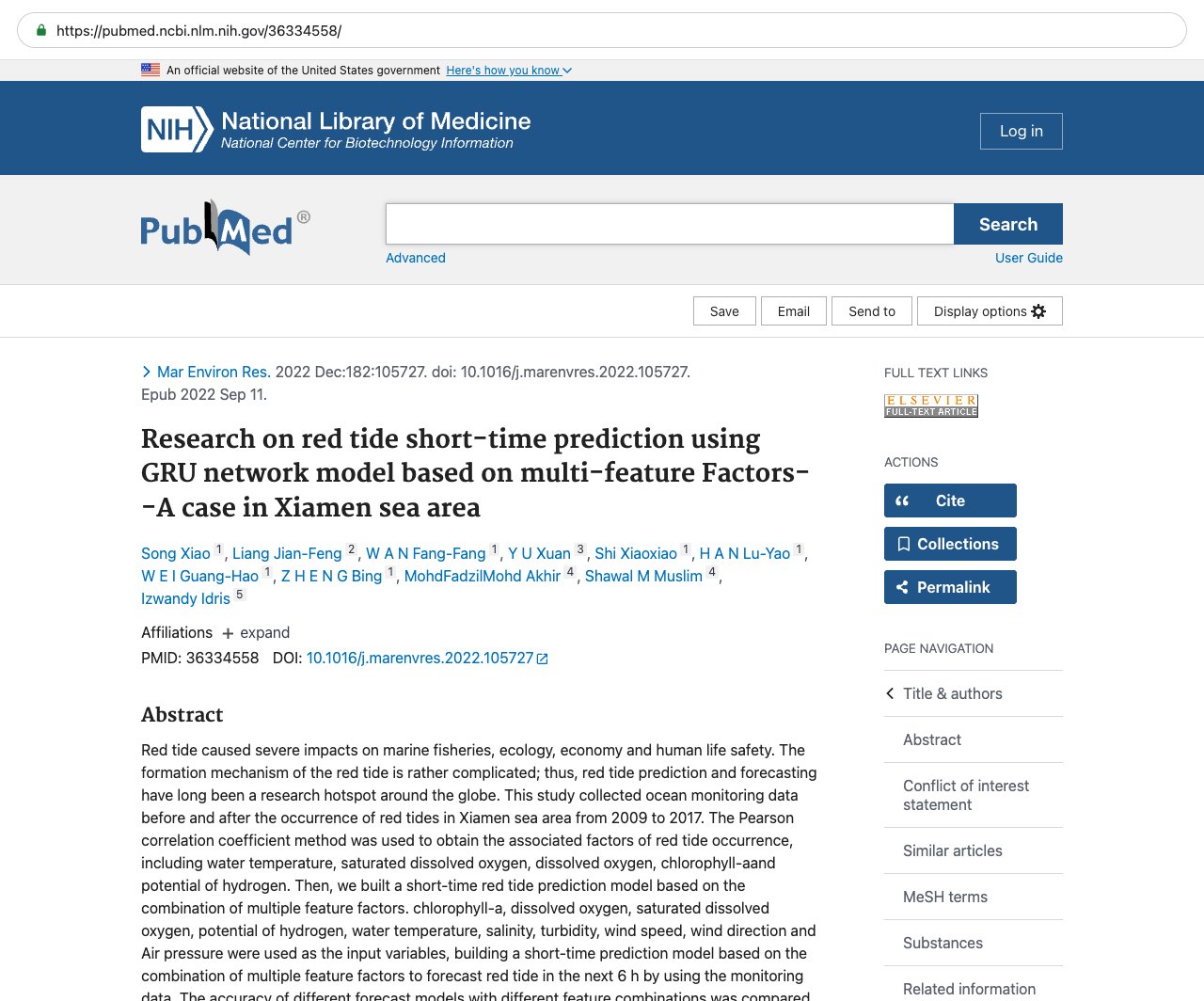
This page mirrors the published abstract (© the authors / publisher) for reference and citation. The canonical source is the PubMed record linked above. This is not medical advice.