2025 · Brandi — Molecular hydrogen therapy: A „democratic” emerging strategy against aging and age-related diseases
Super-Abstract
Aging is the primary risk factor for cardiovascular disease, neurodegeneration, metabolic conditions, and cancer — this review proposes that molecular hydrogen, owing to its antioxidant, anti-inflammatory, and senescence-regulating properties, may offer a widely accessible strategy for slowing age-related processes. The authors call the potential „democratic” due to H₂'s low cost, lack of toxicity, and pleiotropic activity, while acknowledging that the evidence base is still limited. (Ageing Research Reviews, 2025.)
Commentary
The biology of aging converges on several hallmarks: oxidative stress, chronic low-grade inflammation (inflammaging), cellular senescence, telomere attrition, dysregulated nutrient sensing, and mitochondrial dysfunction. This review maps H₂'s documented effects against each of these hallmarks, drawing primarily on animal studies, in-vitro work, and a limited number of human trials. The authors are honest that evidence for H₂ specifically in aging contexts is sparse and that current knowledge „is still limited.” The term „democratic” refers to accessibility — H₂ therapy via hydrogen-rich water or inhalation is relatively cheap compared to pharmaceutical interventions, and lacks the known toxicities of many pharmacological anti-aging candidates. The review also covers intestinal eubiosis restoration as a potential benefit — an emerging area of H₂ research. Limitations of most cited studies (small n, short duration, animal models) are implicitly acknowledged through the framing, though not always explicitly quantified.
Key quotes
- „its administration may be able to affect different hallmarks of these processes.“ — measured claim: H₂ may — not certainly does — affect aging hallmarks
- „The „democratic” characteristics of H2 rely on its potential widespread use due to its pleiotropic activity, the lack of toxicities and low costs.“ — the accessibility argument: why H₂ could be broadly applicable
- „the studies investigating the role of H2 in slowing-down aging and age-related diseases are still limited“ — honest caveat directly from the authors: evidence is still sparse
Our assessment
This is a narrative review covering a broad and heterogeneous literature. It makes a useful conceptual argument that H₂'s known properties align with multiple aging hallmarks, but the available human data on aging-specific endpoints are limited. Most cited evidence is from animal or cell models. The „democratic” framing is engaging but should not obscure the early stage of the evidence base. The review is appropriately cautious in its wording and does not overstate clinical applicability. It is best read as a conceptual orientation paper, not as confirmation of anti-aging efficacy in humans.
Study design
- Type: narrative review · n: n/a (literature synthesis) · H₂ delivery: hydrogen-rich water, hydrogen gas inhalation (as in cited source studies)
- Result: narrative synthesis; H₂ proposed to address oxidative stress, inflammaging, cellular senescence, and gut dysbiosis — hallmarks of aging; evidence base predominantly preclinical; human data limited; no toxicity signals identified in cited literature
Abstract
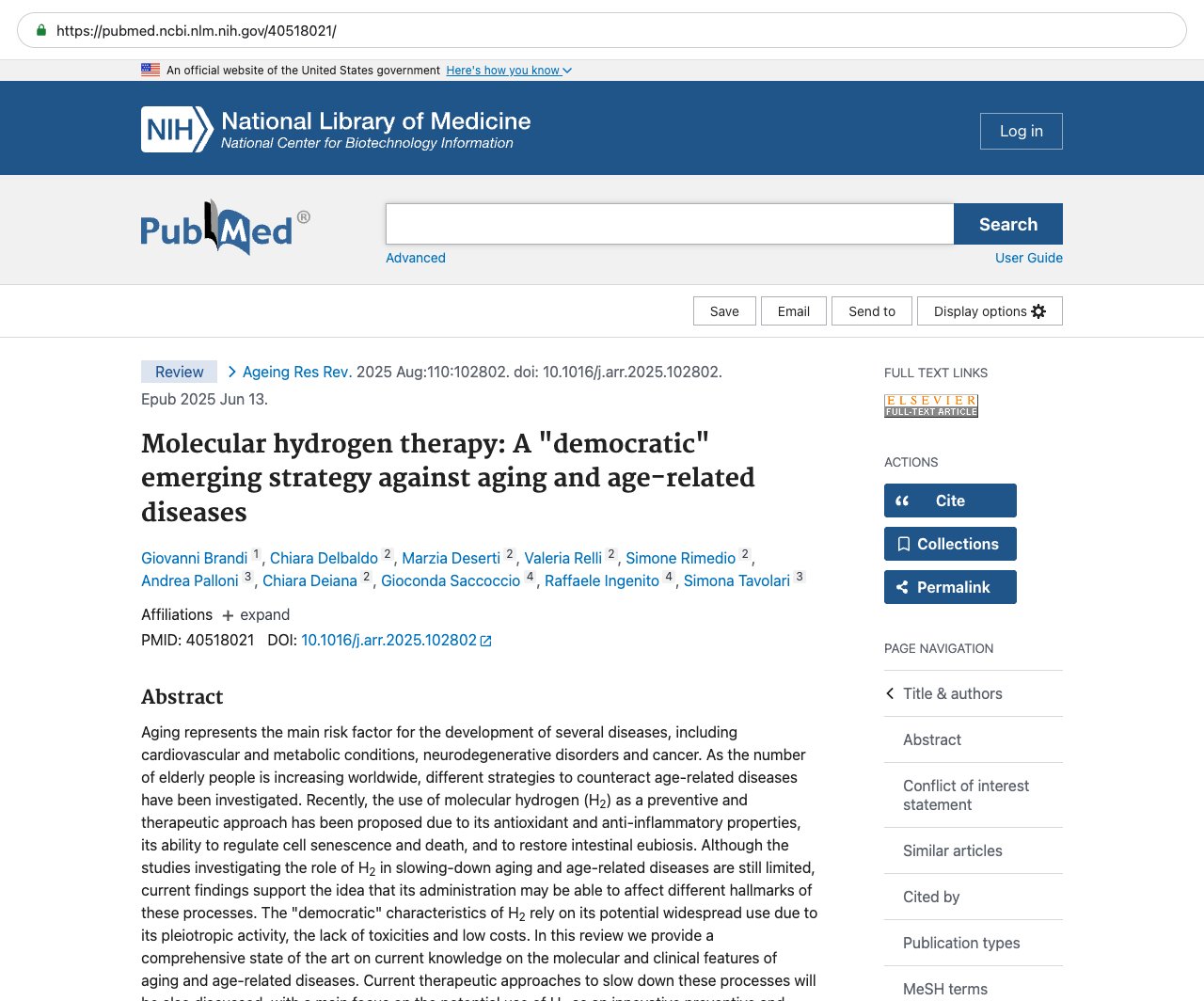
Aging represents the main risk factor for the development of several diseases, including cardiovascular and metabolic conditions, neurodegenerative disorders and cancer. As the number of elderly people is increasing worldwide, different strategies to counteract age-related diseases have been investigated. Recently, the use of molecular hydrogen (H2) as a preventive and therapeutic approach has been proposed due to its antioxidant and anti-inflammatory properties, its ability to regulate cell senescence and death, and to restore intestinal eubiosis. Although the studies investigating the role of H2 in slowing-down aging and age-related diseases are still limited, current findings support the idea that its administration may be able to affect different hallmarks of these processes. The "democratic" characteristics of H2 rely on its potential widespread use due to its pleiotropic activity, the lack of toxicities and low costs. In this review we provide a comprehensive state of the art on current knowledge on the molecular and clinical features of aging and age-related diseases. Current therapeutic approaches to slow down these processes will be also discussed, with a main focus on the potential use of H2 as an innovative preventive and therapeutic strategy.
Source & links
Screenshot of the PubMed page
This page mirrors the published abstract (© the authors / publisher) for reference and citation. The canonical source is the PubMed record linked above. This is not medical advice.