2021 · Slezak et al. — Oxidative Stress and Pathways of Molecular Hydrogen Effects in Medicine
Super-Abstract
This review explains why molecular hydrogen (H₂) has unique advantages over conventional antioxidants: it selectively neutralises the most damaging reactive oxygen species while leaving beneficial ones intact. H₂ acts not only as a direct radical scavenger but also through multiple signalling pathways — including Nrf2, NF-κB, p53, and MAPK — affecting oxidative stress, inflammation, apoptosis, and metabolism. (Current Pharmaceutical Design, 2021.)
Commentary
This mechanistically focused review addresses a central question in H₂ research: why does a simple inert gas have such broad biological effects? Slezak and colleagues argue that H₂'s selectivity is key — unlike most antioxidants which indiscriminately quench ROS, H₂ preferentially scavenges hydroxyl radicals (·OH) and peroxynitrite (ONOO⁻), the most cytotoxic species, while sparing superoxide (O₂·⁻) and hydrogen peroxide (H₂O₂) that serve physiological signalling roles. The review maps H₂ effects across the Keap1-Nrf2-ARE pathway (cellular redox regulation and stress adaptation), the autophagy-apoptosis axis (via mTOR, MAPKs, p53), and the NF-κB inflammatory pathway. This mechanistic map is offered as an explanation for H₂'s „almost universal pluripotent therapeutic potential” — a phrase that should be read critically: it reflects the breadth of observed associations across disease models, not established clinical efficacy across all those indications. This is a narrative review of preclinical and some clinical literature.
Key quotes
- „H2 may be superior to conventional antioxidants, since it can selectively reduce ●OH radicals while preserving important ROS that are otherwise used for normal cellular signaling.“ — the selectivity argument: H₂ is precise where broad antioxidants are blunt
- „The Keap1-Nrf2-ARE signaling pathway, which can be activated by H2, plays a critical role in regulating cellular redox balance, metabolism, and inducing adaptive responses against cellular stress.“ — key molecular pathway activated by H₂
- „The pleiotropic effects of molecular hydrogen on various proteins, molecules and signaling pathways can at least partly explain its almost universal pluripotent therapeutic potential.“ — broad mechanistic summary — cautiously worded
Our assessment
A well-structured mechanistic synthesis that clearly articulates why H₂'s radical selectivity is biologically meaningful. This is a review paper — not a clinical trial. The mechanistic pathways described are plausible and supported by the primary literature cited, but establishing clinical efficacy from mechanism alone is a further step. The phrase „almost universal pluripotent therapeutic potential” is attention-grabbing; it reflects an observed pattern across many disease models, not proven clinical outcomes across all. Readers should note that H₂ effects on signalling pathways are often demonstrated in cell and animal studies — human translation requires case-by-case clinical validation.
Study design
- Type: narrative review · n: n/a (literature synthesis) · H₂ delivery: not specified (mechanism review, multiple routes in source studies)
- Result: narrative map of H₂ mechanisms: selective ·OH/ONOO⁻ scavenging; Keap1-Nrf2-ARE activation; modulation of autophagy-apoptosis axis; NF-κB and MAPK pathway effects
Abstract
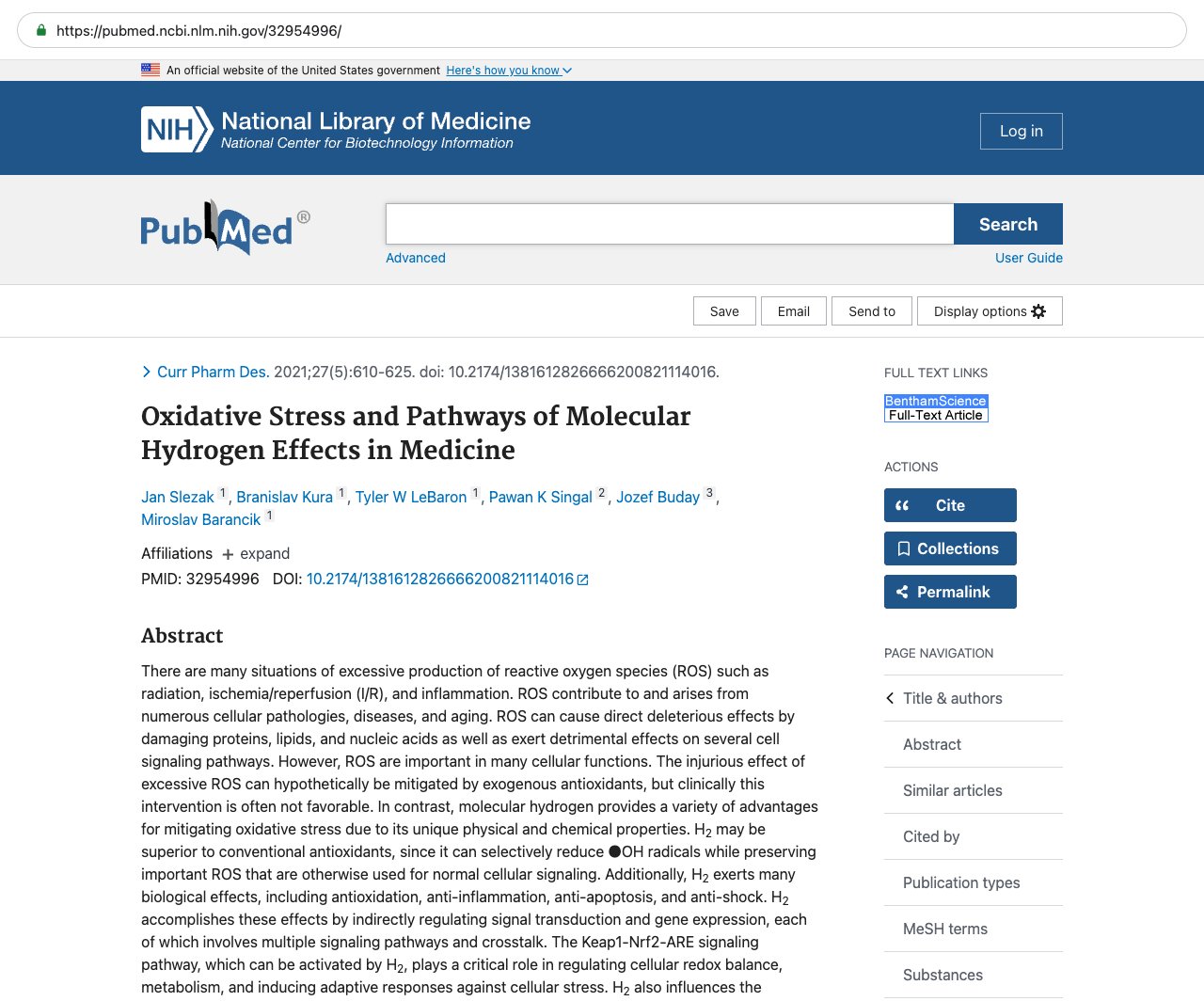
There are many situations of excessive production of reactive oxygen species (ROS) such as radiation, ischemia/reperfusion (I/R), and inflammation. ROS contribute to and arises from numerous cellular pathologies, diseases, and aging. ROS can cause direct deleterious effects by damaging proteins, lipids, and nucleic acids as well as exert detrimental effects on several cell signaling pathways. However, ROS are important in many cellular functions. The injurious effect of excessive ROS can hypothetically be mitigated by exogenous antioxidants, but clinically this intervention is often not favorable. In contrast, molecular hydrogen provides a variety of advantages for mitigating oxidative stress due to its unique physical and chemical properties. H2 may be superior to conventional antioxidants, since it can selectively reduce ●OH radicals while preserving important ROS that are otherwise used for normal cellular signaling. Additionally, H2 exerts many biological effects, including antioxidation, anti-inflammation, anti-apoptosis, and anti-shock. H2 accomplishes these effects by indirectly regulating signal transduction and gene expression, each of which involves multiple signaling pathways and crosstalk. The Keap1-Nrf2-ARE signaling pathway, which can be activated by H2, plays a critical role in regulating cellular redox balance, metabolism, and inducing adaptive responses against cellular stress. H2 also influences the crosstalk among the regulatory mechanisms of autophagy and apoptosis, which involve MAPKs, p53, Nrf2, NF-κB, p38 MAPK, mTOR, etc. The pleiotropic effects of molecular hydrogen on various proteins, molecules and signaling pathways can at least partly explain its almost universal pluripotent therapeutic potential.
Source & links
Screenshot of the PubMed page
This page mirrors the published abstract (© the authors / publisher) for reference and citation. The canonical source is the PubMed record linked above. This is not medical advice.