2013 · Yang et al. — Molecular hydrogen protects human lymphocyte AHH-1 cells against 12C6+ heavy ion radiation.
Super-Abstract
In a cell culture experiment, molecular hydrogen (H₂) reduced reactive oxygen species (ROS), attenuated apoptosis, and alleviated cell cycle arrest in human lymphocyte cells exposed to heavy-ion radiation — a type of ionising radiation used in cancer radiotherapy and relevant to space travel. This is an in-vitro study; the results cannot be directly transferred to humans or clinical radiation settings.
Commentary
Heavy-ion radiation (here: ¹²C⁶⁺ carbon ions) produces dense ionisation tracks and generates high levels of ROS, including hydroxyl radicals — precisely the species that H₂ is thought to selectively neutralise. The authors used H₂-saturated cell culture medium and measured intracellular ROS (HPF and H2DCFH-DA fluorescent probes), apoptosis (Annexin V/PI staining, Hoechst), cell cycle (PI staining), and caspase-3 activation (Western blot). All endpoints showed protective effects of H₂. The mechanistic story — H₂ reduces •OH, which reduces caspase-3 activation, which reduces apoptosis — is plausible and internally consistent. However, the study tests only one cell line (AHH-1, a human B-lymphoblastoid line), one H₂ concentration (saturation under 0.4 MPa), and one radiation dose. Whether these findings hold in vivo — where radiation hits diverse tissues, where H₂ pharmacokinetics differ, and where radiation-induced immune modulation plays a role — is unknown.
Key quotes
- „H(2) reduced ROS level in Human lymphocyte AHH-1 cells as well as in the radiolysis of water.“ — core mechanism: H₂ scavenges radiation-induced free radicals
- „H(2) attenuated (12)C(6+) radiation-induced cell apoptosis and also alleviated radiation-induced G2/M cell cycle arrest.“ — two key cellular protective effects observed
- „these data showed that H(2) attenuated (12)C(6+) radiation-induced cell apoptosis through reducing the ROS level and modulating apoptotic molecules, thus indicating the potential of H(2) as a safe and effective radioprotectant.“ — authors' conclusion — potential, not proven clinical efficacy
Our assessment
An in-vitro cell study — no animal data, no human data. The experimental design is technically solid for the cell biology level, and the protective effects of H₂ against radiation-induced ROS are plausible. However, results from a single human cell line under saturated H₂ conditions provide very limited evidence for any clinical application. Honest limitation: radioprotection in a living organism is vastly more complex; cell line studies do not capture tissue pharmacokinetics, systemic immune responses, or DNA repair in the context of normal tissue heterogeneity. The conclusion that H₂ is a „safe and effective radioprotectant“ is premature at this stage — it is an interesting mechanistic observation worthy of further animal and eventually human study.
Study design
- Type: in-vitro cell study · Model: human lymphocyte AHH-1 cell line · H₂ delivery: H₂-saturated RPMI 1640 medium (0.4 MPa saturation pressure)
- Radiation: ¹²C⁶⁺ heavy-ion beam (relevant for radiotherapy and space radiation) · Endpoints: intracellular ROS (HPF, H2DCFH-DA), apoptosis (Annexin V/PI, Hoechst), cell cycle (PI/FACS), caspase-3 (Western blot)
- Result: H₂ significantly reduced ROS, apoptosis, and G2/M arrest; caspase-3 activation inhibited; all effects in single cell line, single H₂ concentration
Abstract
PURPOSE: To investigate the potential protective role of molecular hydrogen (H(2)) against (12)C(6+) heavy ion radiation, which is a major hazard for space travel and has been also widely used in heavy ion radiotherapy. MATERIALS AND METHODS: H(2) was dissolved in Roswell Park Memorial Institute (RPMI) 1640 medium under high pressure (0.4 Mpa) to a saturated level by using an apparatus produced by our department. A 2-[6-(4'-hydroxy) phenoxy-3H-xanthen-3-on-9-yl] benzoate (HPF) probe and a 2',7'-Dichlorodihydrofluorescein diacetate (H2DCFH-DA) fluorescent dye were used to measure the intracellular reactive oxygen species (ROS) level. Cell apoptosis were determined by double-staining with Annexin V-fluorescein isothiocyanate (Annexin V-FITC) and propidium iodide (PI) as well as a Hoechst 33342 staining method alternatively. Subsequently, cell cycle analysis was performed using a PI staining method and the expression of apoptotic protein was examined by Western blot. RESULTS: In this study, we demonstrated H(2) reduced ROS level in Human lymphocyte AHH-1 cells as well as in the radiolysis of water. Our data also showed H(2) attenuated (12)C(6+) radiation- induced cell apoptosis and also alleviated radiation-induced G2/M cell cycle arrest. Heavy ion radiation-induced Caspase 3 activation was also inhibited by H(2) treatment. CONCLUSION: In conclusion, these data showed that H(2) attenuated (12)C(6+) radiation-induced cell apoptosis through reducing the ROS level and modulating apoptotic molecules, thus indicating the potential of H(2) as a safe and effective radioprotectant.
Source & links
Screenshot of the PubMed page
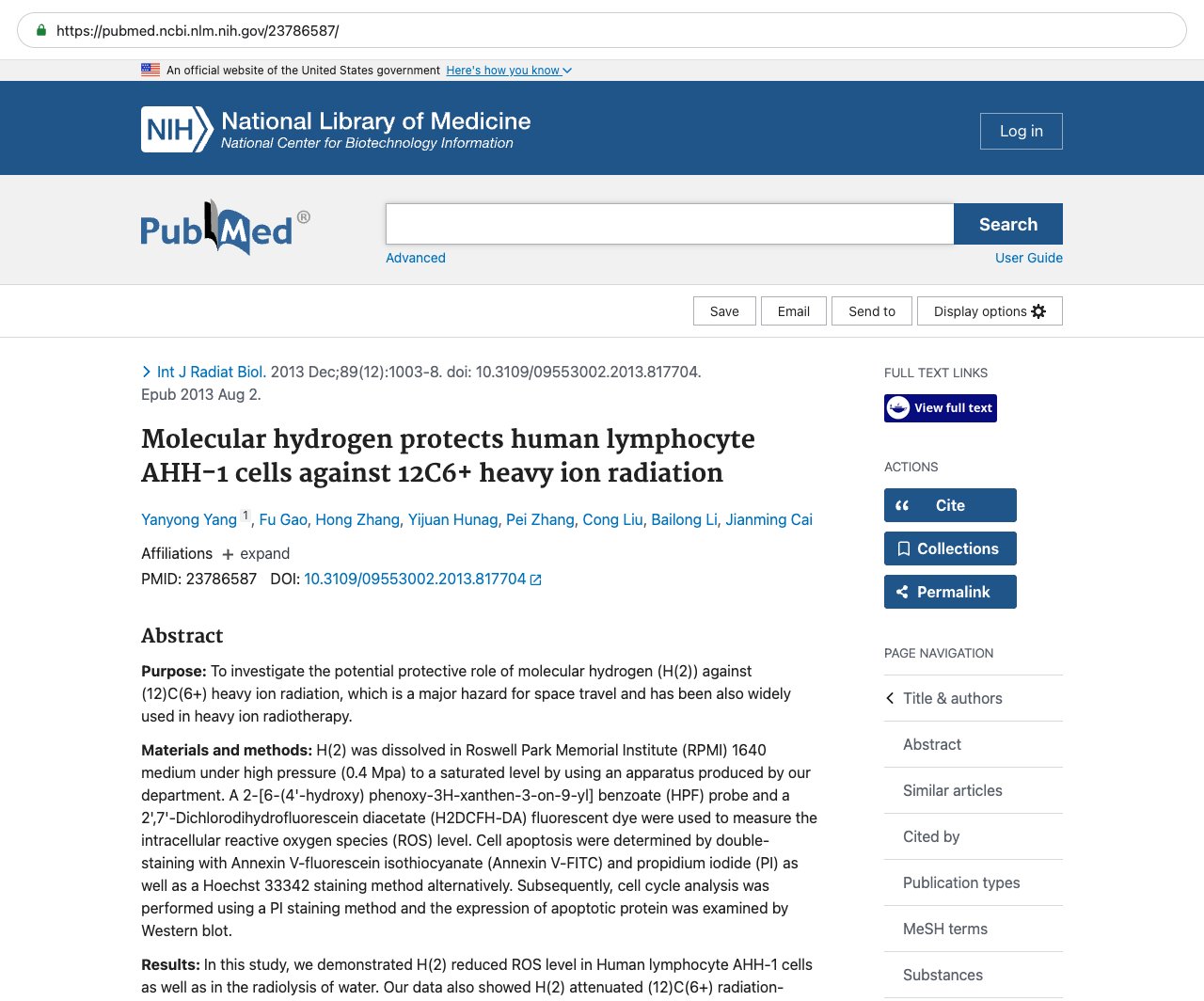
This page mirrors the published abstract (© the authors / publisher) for reference and citation. The canonical source is the PubMed record linked above. This is not medical advice.