2016 · Yang — Optically-Induced Cell Fusion on Cell Pairing Microstructures
Super-Abstract
This bioengineering paper reports a new technique called optically-induced cell fusion (OICF) that uses light-patterned virtual electrodes on a photoconductive film to selectively fuse paired cells with high efficiency. The only connection to „hydrogen” is that the photoconductive film is made of „hydrogen-rich amorphous silicon” — a semiconductor material — which has no relationship to molecular hydrogen (H₂) as a biological or therapeutic agent. (Scientific Reports, 2016.)
Commentary
Cell fusion is used in biomedical research for applications such as hybridoma production (for monoclonal antibody manufacturing), cancer immunotherapy, and cell reprogramming. Traditional methods suffer from low selectivity and random cell pairing. This paper describes a microfluidic/optical approach: by projecting light patterns onto a hydrogen-rich amorphous silicon (a-Si:H) photoconductive film coated on an ITO (indium-tin-oxide) glass slide and applying an alternating current field, „virtual” electrodes can be generated that selectively fuse only chosen cell pairs. The reported efficiency is 57% cell pairing and 87% fusion efficiency at 20 V and 10 kHz. The phrase „hydrogen-rich amorphous silicon” refers to the semiconductor material a-Si:H, in which hydrogen atoms are incorporated into the silicon lattice to passivate dangling bonds and improve electronic properties — entirely unrelated to molecular hydrogen as a health-relevant gas. This paper has no relevance to H₂ supplementation or hydrogen therapy.
Key quotes
- „By projecting light patterns onto a photoconductive film (hydrogen-rich, amorphous silicon) coated on an indium-tin-oxide (ITO) glass while an alternating current electrical field was applied between two such ITO glass slides, „virtual” electrodes could be generated that could selectively fuse pairing cells.“ — the operational principle of OICF — the only mention of 'hydrogen-rich' refers to amorphous silicon semiconductor material
- „At 10 kHz, a 57% cell paring rate and an 87% fusion efficiency were successfully achieved at a driving voltage of 20 V(pp).“ — key performance metrics of the new cell fusion technique
- „Unstable cell contact and random cell pairings have limited efficiency and yields when utilizing traditional methods.“ — the limitation that OICF addresses compared to conventional approaches
Our assessment
This is a bioengineering / microfluidics technology paper with no relevance to molecular hydrogen (H₂) as a biological or therapeutic agent. The term „hydrogen-rich” in this context refers to a semiconductor material (hydrogenated amorphous silicon, a-Si:H) used as a photoconductive layer. This paper provides no evidence relevant to H₂ health research. It appears in this database due to keyword indexing overlap.
Study design
- Type: in-vitro bioengineering / microfluidics study · Model: cell pairing on a-Si:H photoconductive ITO microstructures; AC electrical field + optical patterning · H₂ context: none — „hydrogen-rich” refers to a-Si:H semiconductor material only
- Result: 57% cell pairing rate; 87% fusion efficiency at 20 V / 10 kHz; selective fusion within a cell group demonstrated; new technique for biomedical cell fusion applications
Abstract
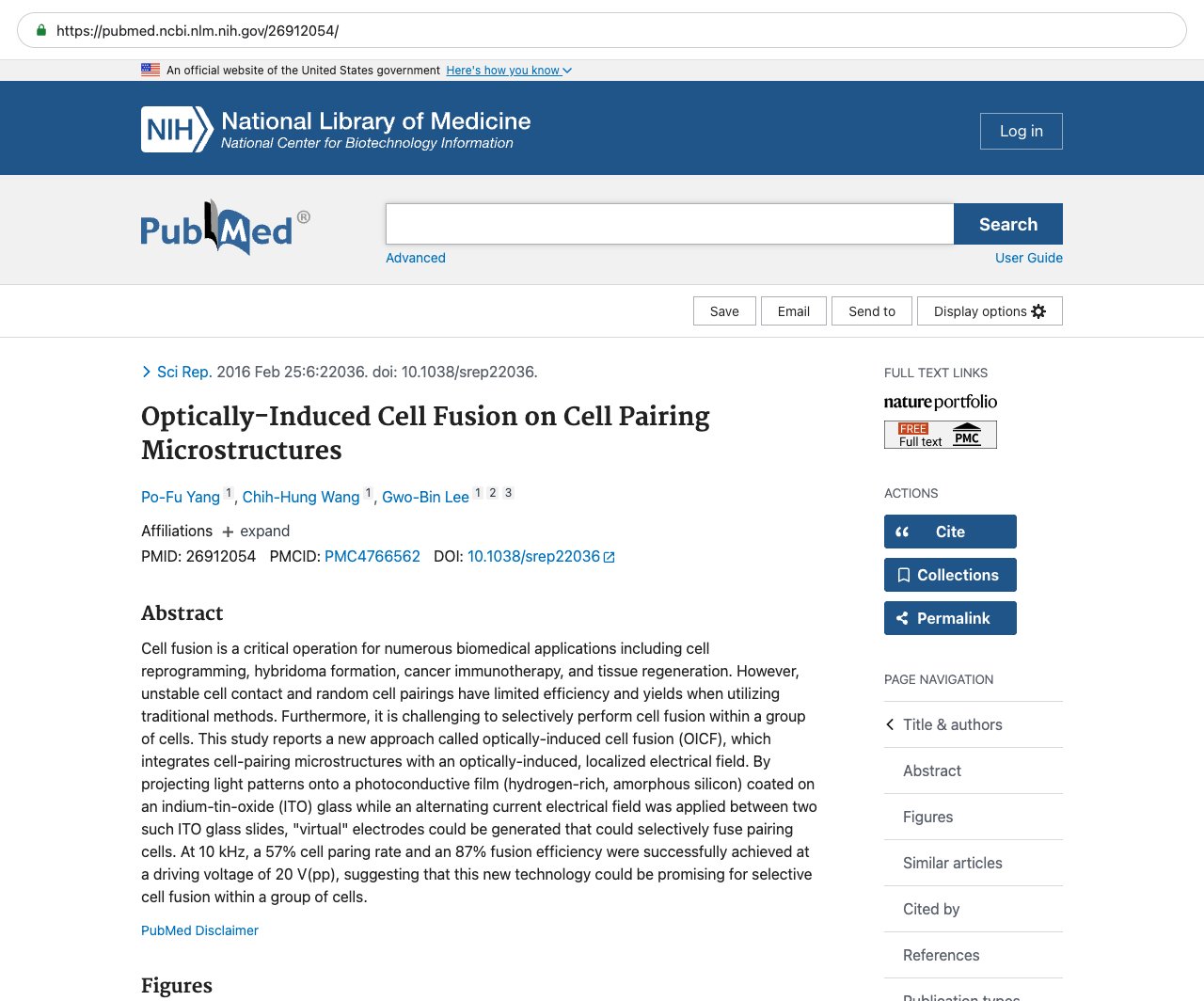
Cell fusion is a critical operation for numerous biomedical applications including cell reprogramming, hybridoma formation, cancer immunotherapy, and tissue regeneration. However, unstable cell contact and random cell pairings have limited efficiency and yields when utilizing traditional methods. Furthermore, it is challenging to selectively perform cell fusion within a group of cells. This study reports a new approach called optically-induced cell fusion (OICF), which integrates cell-pairing microstructures with an optically-induced, localized electrical field. By projecting light patterns onto a photoconductive film (hydrogen-rich, amorphous silicon) coated on an indium-tin-oxide (ITO) glass while an alternating current electrical field was applied between two such ITO glass slides, "virtual" electrodes could be generated that could selectively fuse pairing cells. At 10 kHz, a 57% cell paring rate and an 87% fusion efficiency were successfully achieved at a driving voltage of 20 V(pp), suggesting that this new technology could be promising for selective cell fusion within a group of cells.
Source & links
Screenshot of the PubMed page
This page mirrors the published abstract (© the authors / publisher) for reference and citation. The canonical source is the PubMed record linked above. This is not medical advice.