2022 · Yang — Magnesium galvanic cells produce hydrogen and modulate the tumor microenvironment to inhibit cancer growth
Super-Abstract
Researchers implanted a magnesium-platinum galvanic rod directly into tumors in animal models; the resulting continuous hydrogen production suppressed tumor growth by disrupting mitochondrial function and neutralizing the acidic tumor environment. The approach was tested in murine tumor models, patient-derived xenografts, and rabbit VX2 tumors — all preclinical. This is an animal study; results cannot be directly transferred to humans. (Nature Communications, 2022.)
Commentary
The central challenge in hydrogen-based cancer research has been sustained, localized H₂ delivery inside a tumor. Inhalation or drinking hydrogen-rich water dilutes H₂ systemically; the concentration reaching any given tumor is low. This study addresses that limitation with an implantable galvanic cell: a magnesium rod coated with platinum nanoparticles. In aqueous tumor tissue, the Mg-Pt galvanic couple accelerates water corrosion of magnesium, continuously generating H₂ in situ. The simultaneous formation of Mg(OH)₂ raises local pH, counteracting the typically acidic tumor microenvironment (TME), which normally promotes invasion and immune evasion. In mouse models, the implanted rod inhibited tumor growth and extended survival. Patient-derived xenografts (PDX) — human tumor tissue transplanted into immunocompromised mice — and rabbit VX2 tumors showed similar inhibition. Despite the multi-model corroboration, this remains entirely preclinical: no human safety or efficacy data exist, and implantable cancer devices require extensive clinical development before any translational conclusions can be drawn.
Key quotes
- „H2 molecules can be generated within the tumor, which induces mitochondrial dysfunction and intracellular redox homeostasis destruction.“ — the proposed mechanism: in-situ H₂ disrupts tumor cell energy metabolism
- „the Mg(OH)2 residue can neutralize the acidic tumor microenvironment (TME).“ — secondary effect: alkalizing the tumor milieu
- „Our research suggests that the galvanic cells for hydrogen therapy based on implantable metals may be a safe and effective cancer treatment.“ — authors' cautious conclusion — purely preclinical
Our assessment
An innovative animal study exploring implantable hydrogen delivery for oncology. The multi-model approach (mouse, PDX, rabbit) strengthens internal consistency, but all results are preclinical. Human translation requires safety studies, surgical feasibility work, and clinical trials that do not yet exist. The concept is promising as a research direction; it is not a ready therapy.
Study design
- Type: preclinical animal study (in-vivo + in-vitro) · Models: murine subcutaneous tumor models, patient-derived xenografts (PDX) in mice, VX2 tumors in rabbits · H₂ delivery: implantable Mg-Pt galvanic rod generating H₂ continuously in situ
- Result: MgG rod implantation inhibited tumor growth across all three models; proposed mechanism: mitochondrial dysfunction + intracellular redox disruption + TME alkalinization by Mg(OH)₂
Abstract
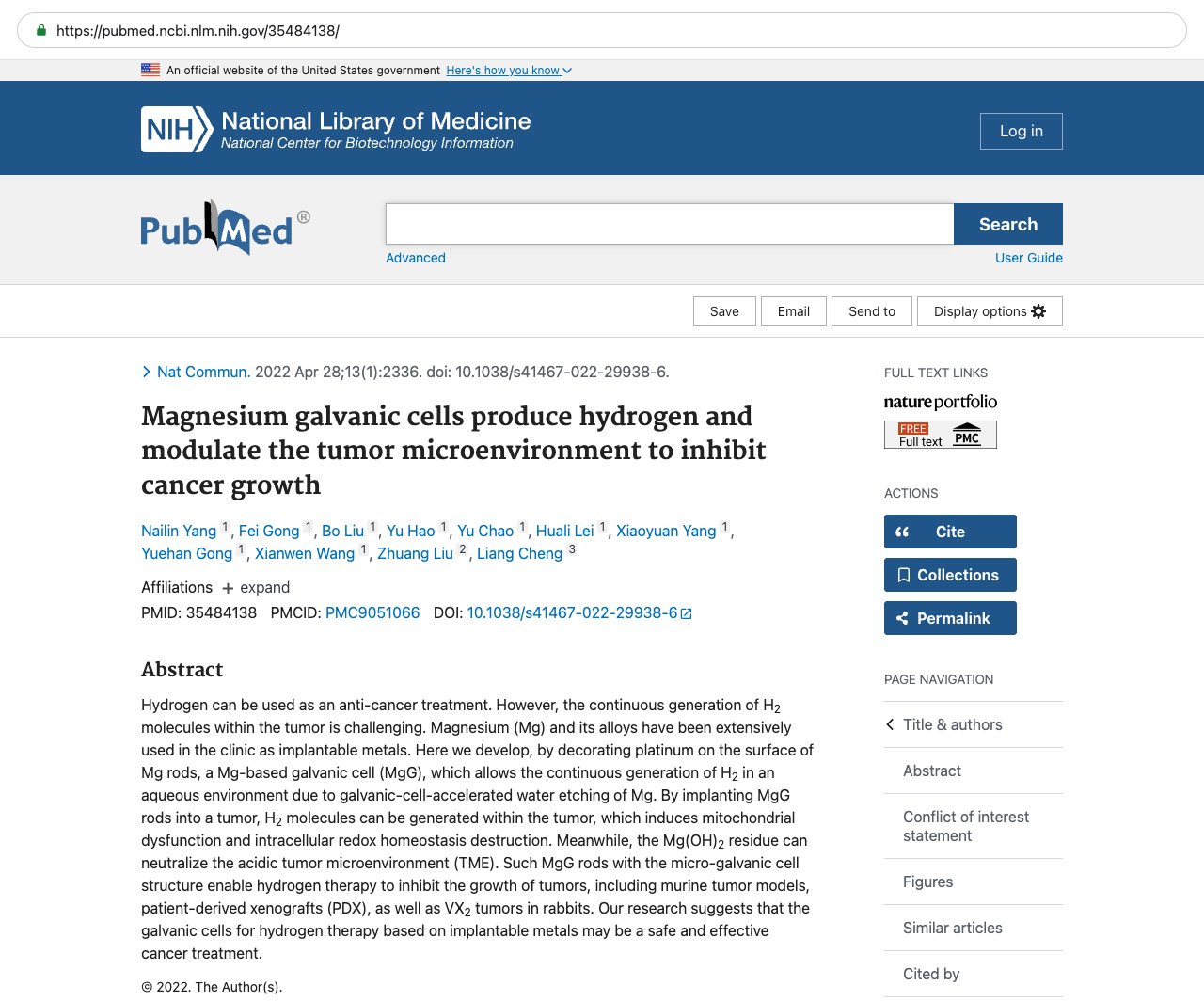
Hydrogen can be used as an anti-cancer treatment. However, the continuous generation of H2 molecules within the tumor is challenging. Magnesium (Mg) and its alloys have been extensively used in the clinic as implantable metals. Here we develop, by decorating platinum on the surface of Mg rods, a Mg-based galvanic cell (MgG), which allows the continuous generation of H2 in an aqueous environment due to galvanic-cell-accelerated water etching of Mg. By implanting MgG rods into a tumor, H2 molecules can be generated within the tumor, which induces mitochondrial dysfunction and intracellular redox homeostasis destruction. Meanwhile, the Mg(OH)2 residue can neutralize the acidic tumor microenvironment (TME). Such MgG rods with the micro-galvanic cell structure enable hydrogen therapy to inhibit the growth of tumors, including murine tumor models, patient-derived xenografts (PDX), as well as VX2 tumors in rabbits. Our research suggests that the galvanic cells for hydrogen therapy based on implantable metals may be a safe and effective cancer treatment.
Source & links
Screenshot of the PubMed page
This page mirrors the published abstract (© the authors / publisher) for reference and citation. The canonical source is the PubMed record linked above. This is not medical advice.