2026 · Yang — Molecular hydrogen suppresses gut inflammation and pyroptosis in ulcerative colitis through promoting PKM2 lactylation to block NLRP3 inflammasome activation.
Super-Abstract
Molecular hydrogen (H₂) reduces intestinal inflammation and cell death (pyroptosis) in ulcerative colitis by promoting a post-translational modification of the enzyme PKM2 — called lactylation — which in turn prevents the NLRP3 inflammasome from triggering inflammatory cascades. This mechanism was demonstrated in human colonic cells, mouse models of colitis, and colon tissue from UC patients. All evidence is preclinical; no human intervention trial is reported. (International Immunopharmacology, 2026.)
Commentary
This study uncovers a previously unknown molecular mechanism by which H₂ may dampen gut inflammation: by promoting lactylation of pyruvate kinase M2 (PKM2), a metabolic enzyme, which then physically binds to and inhibits the NLRP3 inflammasome — a key driver of inflammatory cell death (pyroptosis). The novelty lies in the lactylation angle, which connects metabolic reprogramming and immune regulation in an unexpected way. The study uses a well-established UC mouse model (DSS-induced) and validates the PKM2 lactylation finding in actual colon tissue from UC patients, lending the results some translational relevance. However, the ultimate therapeutic claims rest on animal models and cell lines — a human RCT showing clinical improvement in UC patients from H₂ therapy does not yet exist.
Key quotes
- „Molecular hydrogen alleviated cell viability inhibition and cytokines production in HCoEpiC cells, and suppressed gut injury, inflammation, pyroptosis and NLRP3 inflammasome activation in mice.“ — core result: H₂ reduces inflammation and pyroptosis in both cell and animal models
- „PKM2 lactylation was down-regulated in colon tissues of UC patients.“ — key human tissue finding: low PKM2 lactylation observed in UC — supports the proposed mechanism
- „The lactylation inhibitor, sodium oxamate, abolished molecular hydrogen-mediated protective effects on UC.“ — causal confirmation: H₂'s benefits depend specifically on PKM2 lactylation
Our assessment
A mechanistically innovative preclinical paper that proposes a concrete, testable pathway connecting H₂, metabolic enzyme lactylation, and NLRP3-driven gut inflammation. The use of human colon tissue samples (from UC patients vs. healthy controls) to validate the PKM2 lactylation deficit adds credibility beyond pure animal work. Limitations to state honestly: no human clinical trial; DSS-induced colitis in mice does not fully replicate the complexity of human UC; the study does not test long-term administration or dose-response for H₂; and the lactylation mechanism, while novel, requires independent replication. Bottom line: compelling mechanistic hypothesis for H₂ in UC — not yet clinical evidence.
Study design
- Type: preclinical mechanistic study (in-vitro + in-vivo + human tissue) · n: HCoEpiC cells (in-vitro); DSS-induced colitis mice (in-vivo); colon tissue from UC patients and healthy volunteers (ex-vivo) · H₂ delivery: hydrogen-rich medium (in-vitro cells); hydrogen-rich water, HRW (in-vivo mice)
- Result: H₂ reduced cytokine production, pyroptosis, and NLRP3 activation; promoted PKM2 lactylation; PKM2 physically bound NLRP3 to suppress inflammasome; effect abolished by sodium oxamate (lactylation inhibitor) — confirming mechanism specificity
Abstract
BACKGROUND: Molecular hydrogen is considered to be able to alleviate the progression of ulcerative colitis (UC), whose underlying molecular mechanism remains largely unclear. METHODS: Lipopolysaccharide (LPS)/adenosine triphosphate (ATP)-stimulated human colonic epithelial cells (HCoEpiC) were used to mimic UC model in vitro and were treated with hydrogen-rich medium (HRM). Dextran sulfate sodium (DSS)-induced mice were used to construct UC model in vivo and were administrated by hydrogen-rich water (HRW). Colon tissues from UC patients and healthy volunteers were collected. Release of inflammatory cytokines was detected by ELISA. Cell viability, gut pathological impairment and pyroptosis were assessed by CCK-8 assay, HE staining and transmission electron microscope (TEM). The protein expressions of NLRP3 inflammasome and pyruvate kinase M2 (PKM2) were analyzed by western blot. The interaction between NLRP3 and PKM2 was verified by co-immunoprecipitation (Co-IP) assay. RESULTS: Molecular hydrogen alleviated cell viability inhibition and cytokines production in HCoEpiC cells, and suppressed gut injury, inflammation, pyroptosis and NLRP3 inflammasome activation in mice. PKM2 lactylation was down-regulated in colon tissues of UC patients. Molecular hydrogen treatment promoted PKM2 lactylation without affecting total PKM2 expression. The lactylation inhibitor, sodium oxamate, abolished molecular hydrogen-mediated protective effects on UC. Additionally, molecular hydrogen facilitated the combination between PKM2 and NLRP3 to down-regulate inflammasome activation. This binding between PKM2 and NLRP3 was abolished by disrupting PKM2 lactylation. Furthermore, the structural interaction between lactylated PKM2 and NLRP3 was predicted. CONCLUSION: Molecular hydrogen can promote PKM2 lactylation to restrain NLRP3 inflammasome-mediated pyroptosis and inflammation, thus ameliorating UC progression.
Source & links
Screenshot of the PubMed page
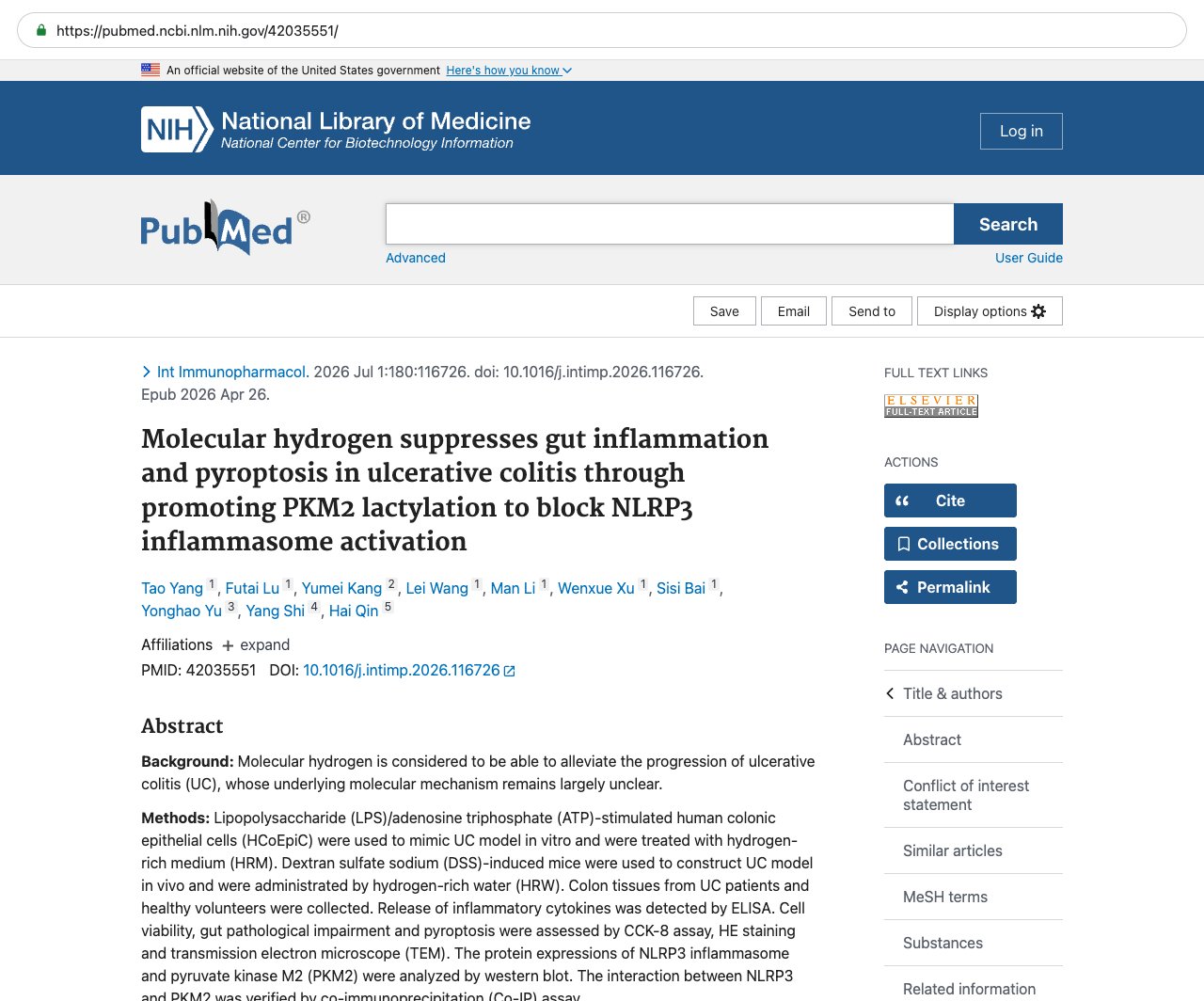
This page mirrors the published abstract (© the authors / publisher) for reference and citation. The canonical source is the PubMed record linked above. This is not medical advice.