2008 · Ye — Inhibitory effect of electrolyzed reduced water on tumor angiogenesis.
Super-Abstract
This in-vitro study found that electrolyzed reduced water (ERW) reduced VEGF (vascular endothelial growth factor) gene expression and protein secretion in a human lung adenocarcinoma cell line, and inhibited in vitro formation of vascular tubules. ERW scavenged intracellular hydrogen peroxide and suppressed the ERK signaling pathway, which regulates VEGF expression. (Biological and Pharmaceutical Bulletin, 2008.)
Commentary
Angiogenesis — the formation of new blood vessels — is a critical process that tumors exploit to grow and spread. VEGF is the master regulator of tumor angiogenesis, and suppressing it is a major strategy in oncology. This in-vitro study shows that ERW (which contains dissolved H₂) can reduce VEGF expression in a lung cancer cell line by reducing intracellular oxidative stress (H₂O₂) and inhibiting the ERK signaling pathway. The findings are mechanistically coherent: oxidative stress promotes VEGF via ROS-mediated signaling, so an antioxidant like ERW/H₂ could plausibly reduce this. However, this is a cell culture study only. The A549 lung adenocarcinoma cell line is a standard lab model, not a human tumor in a living organism. Whether ERW can reach tumor sites in vivo, at sufficient concentrations to affect VEGF signaling, without off-target effects, is unknown. No animal or clinical studies are cited. This is a hypothesis-generating preclinical finding.
Key quotes
- „Electrolyzed reduced water (ERW) produced near the cathode during the electrolysis of water scavenged intracellular H(2)O(2) and decreased the release of H(2)O(2) from a human lung adenocarcinoma cell line, A549, and down-regulated both VEGF transcription and protein secretion in a time-dependent manner.“ — the main finding: ERW reduces oxidative stress and VEGF in cancer cells
- „only PD98059 blocks VEGF expression, suggesting an important role for ERK1/2 in regulating VEGF expression in A549 cells.“ — the signaling pathway: ERK1/2 mediates VEGF expression and is inhibited by ERW
- „ERW counteracted the effect of A549 cell-conditioned medium and decreased total tube length (p<0.01). The present study demonstrated that ERW down-regulated VEGF gene transcription and protein secretion through inactivation of ERK.“ — functional angiogenesis assay: ERW reduced tube formation in vitro
Our assessment
This is an in-vitro (cell culture) study. The anti-angiogenic findings are mechanistically plausible and internally consistent, but cannot be extrapolated to cancer treatment in humans. Cell culture experiments with cancer lines routinely overestimate therapeutic effects. The critical question — whether ERW/H₂ can reduce tumor angiogenesis in a living organism at therapeutic concentrations — remains unanswered. The study is a useful preclinical signal warranting further investigation.
Study design
- Type: in-vitro study (cell culture + tube formation assay) · Model: A549 human lung adenocarcinoma cells; human umbilical vein endothelial cells (tubule formation assay) · H₂ source: electrolyzed reduced water (ERW) from cathode-side electrolysis
- Result: ERW scavenged intracellular H₂O₂, downregulated VEGF transcription and protein via ERK inhibition, reduced in vitro tubule total length (p<0.01)
Abstract
Vascular endothelial growth factor (VEGF) is a key mediator of tumor angiogenesis. Tumor cells are exposed to higher oxidative stress compared to normal cells. Numerous reports have demonstrated that the intracellular redox (oxidation/reduction) state is closely associated with the pattern of VEGF expression. Electrolyzed reduced water (ERW) produced near the cathode during the electrolysis of water scavenged intracellular H(2)O(2) and decreased the release of H(2)O(2) from a human lung adenocarcinoma cell line, A549, and down-regulated both VEGF transcription and protein secretion in a time-dependent manner. To investigate the signal transduction pathway involved in regulating VEGF expression, mitogen-activated kinase (MAPK) specific inhibitors, SB203580 (p38 MAPK inhibitor), PD98059 (ERK1/2 inhibitor) and JNKi (c-Jun N-terminal protein kinase inhibitor) were applied. The results showed that only PD98059 blocks VEGF expression, suggesting an important role for ERK1/2 in regulating VEGF expression in A549 cells. As well, ERW inhibited the activation of extracellular signal-regulated kinase (ERK) in a time-dependent manner. Co-culture experiments to analyze in vitro tubule formation assay revealed that A549 cell-derived conditioned medium significantly stimulated the formation of vascular tubules in all analyzed parameters; tubule total area, tubule junction, number of tubules, and total tubule length. ERW counteracted the effect of A549 cell-conditioned medium and decreased total tube length (p<0.01). The present study demonstrated that ERW down-regulated VEGF gene transcription and protein secretion through inactivation of ERK.
Source & links
Screenshot of the PubMed page
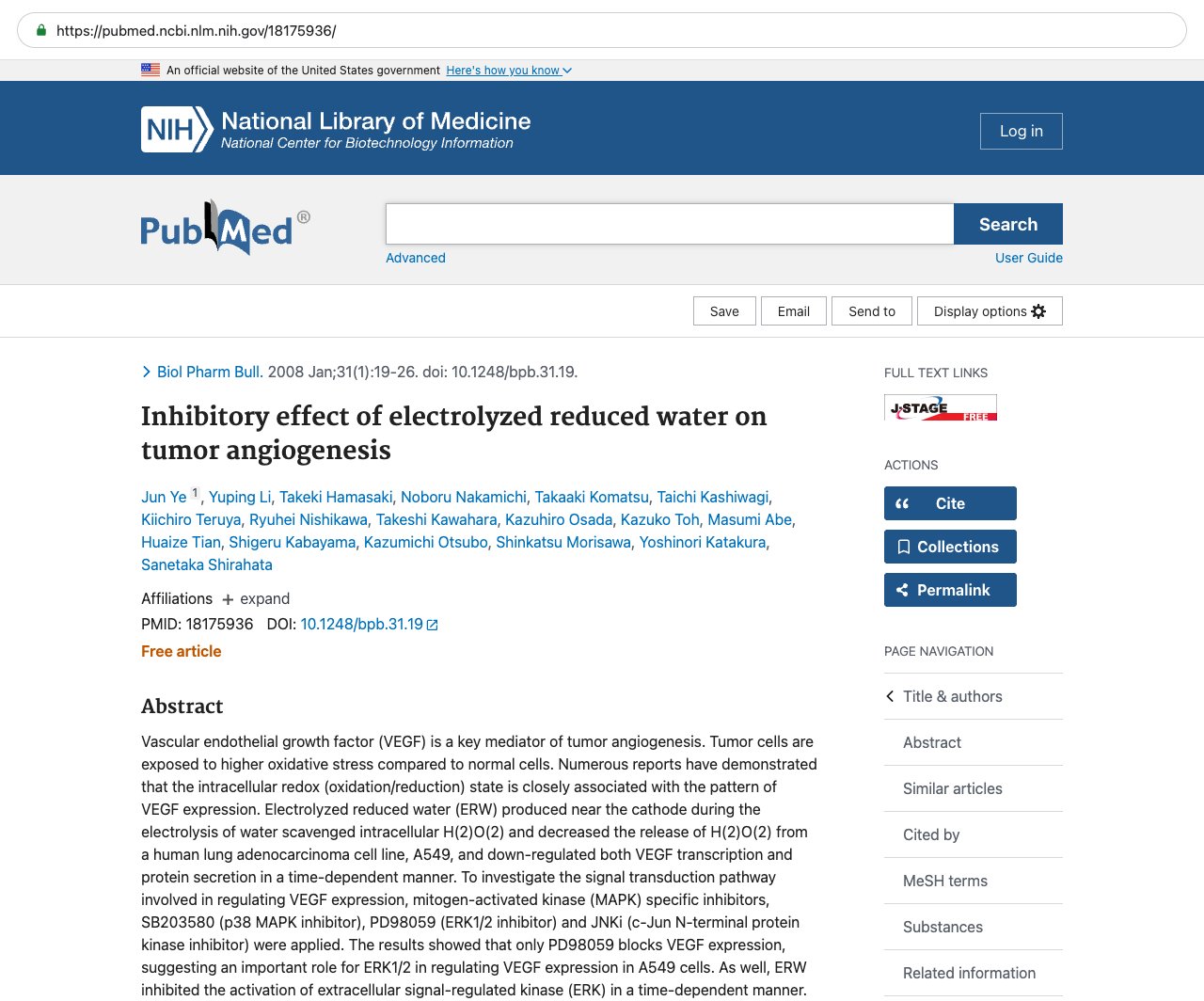
This page mirrors the published abstract (© the authors / publisher) for reference and citation. The canonical source is the PubMed record linked above. This is not medical advice.