2026 · Ye et al. — The Effect of Hydrogen-Rich Water Interventions on Lipid Profiles in Adults With Overweight or Obesity and Associated Metabolic Disorders: A Systematic Review and Meta-Analysis of Randomized Controlled Trials
Super-Abstract
Across 13 randomised trials with 757 adults with overweight or obesity, hydrogen-rich water lowered total cholesterol by 6.71 mg/dL and LDL cholesterol by 3.21 mg/dL compared with placebo or standard water, while triglycerides did not change significantly. HDL cholesterol fell slightly, by 1.16 mg/dL. The authors judge these changes to be below thresholds that matter for cardiovascular risk and advise against routine use of hydrogen-rich water as a lipid-lowering therapy outside research. Most trials enrolled people who already had cardiometabolic conditions. (Diabetology & Metabolic Syndrome, 2026.)
Commentary
Obesity-related dyslipidaemia adds to cardiovascular risk, and hydrogen-rich water has been proposed as an add-on intervention. The authors searched Scopus, PubMed, Web of Science and Embase for randomised controlled trials published up to November 2025 that compared hydrogen-rich water with placebo or standard water in adults with a mean body mass index of 25 kg/m² or more. They pooled weighted mean differences (WMD) with 95% confidence intervals in random-effects meta-analyses. Twelve articles reporting 13 trials with 757 participants were included. Most trials enrolled overweight or obese adults with cardiometabolic comorbidities. Outcomes were total cholesterol, LDL cholesterol, HDL cholesterol and triglycerides. The authors describe their subgroup analyses as underpowered and hypothesis-generating. The abstract does not report the doses or durations of the included trials, heterogeneity statistics, risk of bias or a certainty-of-evidence rating.
Key quotes
- „HRW significantly reduced total cholesterol (TC) (WMD: − 6.71 mg/dL; 95% CI: − 10.38 to − 3.04; P < 0.001) and low-density lipoprotein cholesterol (LDL-C) (WMD: − 3.21 mg/dL; 95% CI: − 6.31 to − 0.10; P = 0.043).“ — the main results: statistically significant but small reductions in cholesterol
- „Triglycerides showed no significant change (WMD: − 4.21 mg/dL; 95% CI: − 17.75 to 9.32; P = 0.54).“ — the null result for triglycerides
- „These effects are below thresholds considered meaningful for cardiovascular risk reduction and should not justify routine use of HRW as a lipid-lowering therapy outside of research settings“ — the authors' own judgement of the clinical relevance of their findings
Our assessment
The review pools randomised trials and reports its effects in clinical units, which makes their size easy to judge. Total and LDL cholesterol fell by statistically significant but small amounts, and HDL cholesterol also fell slightly. Triglycerides showed no significant change. The authors themselves state that these effects are below thresholds considered meaningful for cardiovascular risk reduction. Limitations: the abstract reports no heterogeneity statistics, risk-of-bias assessment or certainty rating, and it does not describe doses or trial durations. The upper confidence limit for LDL cholesterol (−0.10 mg/dL) lies close to zero. Most trials enrolled adults with existing cardiometabolic conditions, so the results do not apply to everyone with overweight or obesity. The subgroup analyses were underpowered. Blood lipids are surrogate markers, and the abstract reports no clinical events.
Study design
- Type: systematic review and meta-analysis of randomised controlled trials (Scopus, PubMed, Web of Science and Embase to November 2025, random-effects models) · n: 757 participants in 13 trials (twelve articles) · H₂ delivery: drinking hydrogen-rich water
- Included studies: 13 randomised controlled trials in adults with a mean BMI of 25 kg/m² or more, most with cardiometabolic comorbidities, comparing hydrogen-rich water with placebo or standard water
- Result: total cholesterol WMD −6.71 mg/dL (95% CI −10.38 to −3.04, P < 0.001), LDL cholesterol −3.21 mg/dL (95% CI −6.31 to −0.10, P = 0.043), HDL cholesterol −1.16 mg/dL (95% CI −1.92 to −0.40, P = 0.003), triglycerides −4.21 mg/dL (95% CI −17.75 to 9.32, P = 0.54), not significant
Abstract
OBJECTIVE: Obesity-related dyslipidemia remains a significant health challenge, contributing to increased cardiovascular risk. Hydrogen-rich water (HRW) has been proposed as a potential adjunctive intervention due to its antioxidant and anti-inflammatory properties. This systematic review and meta-analysis aimed to evaluate the effects of HRW on lipid profiles in adults with overweight or obesity. METHODS: We searched Scopus, PubMed, Web of Science, and Embase for randomized controlled trials (RCTs) published up to November 2025 that compared HRW with placebo or standard water in adults with mean body mass index (BMI) ≥ 25 kg/m². Random-effects meta-analyses were performed to estimate pooled weighted mean differences (WMDs) and 95% confidence intervals (CIs). RESULTS: Twelve articles comprising 13 RCTs (n = 757 participants) were included. HRW significantly reduced total cholesterol (TC) (WMD: − 6.71 mg/dL; 95% CI: − 10.38 to − 3.04; P < 0.001) and low-density lipoprotein cholesterol (LDL-C) (WMD: − 3.21 mg/dL; 95% CI: − 6.31 to − 0.10; P = 0.043). A small reduction in high-density lipoprotein cholesterol (HDL-C) was observed (WMD: − 1.16 mg/dL; 95% CI: − 1.92 to − 0.40; P = 0.003). Triglycerides showed no significant change (WMD: − 4.21 mg/dL; 95% CI: − 17.75 to 9.32; P = 0.54). Most trials enrolled overweight or obese adults with cardiometabolic comorbidities. Subgroup analyses were underpowered and considered hypothesis-generating. CONCLUSION: HRW supplementation in overweight or obese adults produces small, statistically detectable but clinically modest reductions in TC and LDL-C, with minimal effects on TG and HDL-C. These effects are below thresholds considered meaningful for cardiovascular risk reduction and should not justify routine use of HRW as a lipid-lowering therapy outside of research settings and these findings primarily apply to adults with preexisting metabolic conditions and should not be generalized to all overweight/obese individuals. Any potential role remains limited to an investigational adjunct, and further adequately powered, longer-term RCTs are needed before HRW can be considered in dyslipidemia management.
Source & links
Screenshot of the PubMed page
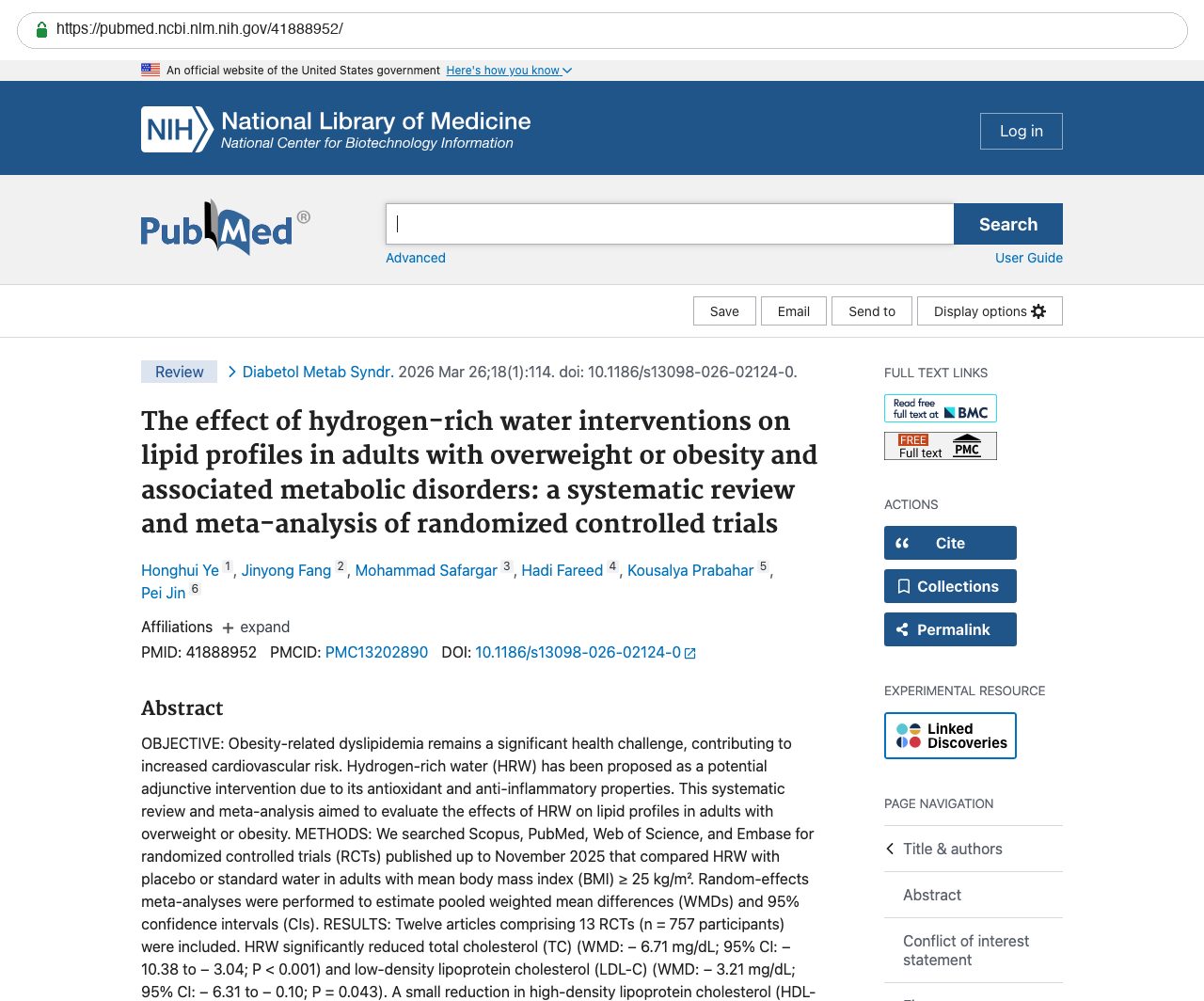
This page mirrors the published abstract (© the authors / publisher) for reference and citation. The canonical source is the PubMed record linked above. This is not medical advice.