2027 · Yin et al. — Hydrogen-Rich Water Combined with Traditional Chinese Medicine Compound in the Treatment of Kidney Stones: A Randomized Controlled Prospective Clinical Trial
Super-Abstract
In a 12-week trial in 100 patients with kidney stones, hydrogen-rich water did not clearly raise the total effective rate: 32% compared with 28% without it, and 80% compared with 76% when combined with an herbal formula (per full text not statistically significant). The two groups taking the herbal formula did better than the two groups without it. The authors report improved oxidative stress and urine markers with the combination, but per full text, compared with the herbal formula alone, only superoxide dismutase differed significantly (P = 0.046). (Medical Gas Research, 2027.)
Commentary
Kidney stones are linked to abnormal urine metabolism, oxidative stress and inflammation. This randomised controlled prospective trial ran from July 2025 to March 2026 at one hospital in Shanghai. 100 patients with kidney stones were randomly assigned to four groups for 12 weeks: no addition, hydrogen-rich water, hydrogen-rich water plus a herbal formula, or the herbal formula alone. All received guideline-based basic treatment. Per full text, patients drank 2 L a day of hydrogen-rich water (1 to 1.5 ppm hydrogen) or plain water, randomisation was computer-generated, and patients were not blinded, but staff doing follow-up and laboratory tests were. The primary endpoint, per full text, was the total effective rate: disappearance of symptoms plus stone passage, stone movement into the upper ureter or more than 3 cm downward, shrinkage by at least 30%, or disappearance of hydronephrosis on ultrasound. Secondary outcomes included urine metabolic markers, kidney function, interleukin-6 and the oxidative stress markers glutathione reductase and superoxide dismutase. Blood counts and liver function served as safety measures.
Key quotes
- „Results showed that the total effective rate of kidney stone treatment in blank group, Chinese medicines group, hydrogen-rich water and Chinese medicine group and hydrogen-rich water group was 28%, 76%, 80% and 32%.“ — the primary result for all four groups, given without p-values
- „The hydrogen-rich water therapy showed only efficacy in improving glutathione reductase“ — of all secondary markers, hydrogen-rich water alone improved only this one
- „The results indicate that the addition of hydrogen-rich water can improve urinary metabolism and oxidative stress status in the treatment of kidney stones“ — the authors' conclusion for use with the herbal formula, from laboratory markers, not stone outcomes
Our assessment
The four-group design can separate the effect of hydrogen-rich water from that of the herbal formula. On the primary endpoint, hydrogen-rich water made no statistically significant difference, alone or added to the herbal formula (per full text). In the full text, the authors themselves write that the combination cannot improve the therapeutic effect on kidney stones. Their positive conclusion rests on secondary laboratory markers. Limitations: single centre, 25 analysed patients per group, and per full text the patients were not blinded. The abstract reports no p-values. Many markers were compared across six pairs of groups, which raises the chance of isolated significant findings. Per full text, 106 patients were enrolled and 6 withdrew, so the 100 in the abstract are those analysed. Per full text, only stones up to 7 mm were included. Per full text, safety blood tests did not change.
Study design
- Type: randomised controlled prospective trial with four parallel groups, single centre, participants not blinded (per full text) · n: 100 analysed, 25 per group (per full text 106 enrolled, 6 withdrew) · H₂ delivery: hydrogen-rich water, per full text 1 to 1.5 ppm, 2 L daily for 12 weeks
- Comparator: plain water plus basic treatment (blank group); for the combination, the herbal formula alone
- Result: total effective rate 28% (blank), 76% (herbal formula), 80% (combination), 32% (hydrogen-rich water). Per full text, hydrogen-rich water compared with blank and combination compared with herbal formula alone were not statistically significant. Hydrogen-rich water alone improved only glutathione reductase. The combination improved several oxidative stress, uric acid and tubular markers compared with blank; compared with the herbal formula alone, only superoxide dismutase differed (P = 0.046, per full text). Safety blood tests unchanged
Abstract
The formation and development of kidney stones are related to abnormal urine metabolism, oxidative stress and inflammation. Hydrogen-rich water has clear efficacy in antioxidant and improving inflammatory status, while Ye-Shi-Shi-Lin-Formula is a clinically effective traditional Chinese medicine compound preparation for treating kidney stones. This randomized controlled prospective clinical trial from July 2025 to March 2026 at the Seventh People's Hospital Affiliated to Shanghai University of Traditional Chinese Medicine examined the effect of hydrogen-rich water and Ye-Shi-Shi-Lin-Formula on kidney stones. The included 100 patients with kidney stones were randomly divided into blank, hydrogen-rich water, hydrogen-rich water and Chinese medicine, and Chinese medicines groups. The patients received drinking hydrogen-rich water and/or Ye-Shi-Shi-Lin-Formula daily for 12 weeks. All subjects received basic treatment following the guidelines. Imaging examination, urine metabolism testing, renal function, inflammation and oxidative stress index, blood routine and liver function are used to detect the efficacy and safety of hydrogen-rich water and Ye-Shi-Shi-Lin-Formula. Results showed that the total effective rate of kidney stone treatment in blank group, Chinese medicines group, hydrogen-rich water and Chinese medicine group and hydrogen-rich water group was 28%, 76%, 80% and 32%. The Ye-Shi-Shi-Lin-Formula can partially alleviate the oxidative stress, uric acid metabolism and urinary magnesium levels of patients with kidney stone and improve the function of renal tubules. The hydrogen-rich water therapy showed only efficacy in improving glutathione reductase but the combination of hydrogen-rich water and Ye-Shi-Shi-Lin-Formula has shown superior efficacy in improving oxidative stress and related metabolic factors of blood uric acid and urine stones, as well as in renal tubular function. The results indicate that the addition of hydrogen-rich water can improve urinary metabolism and oxidative stress status in the treatment of kidney stones with Ye-Shi-Shi-Lin-Formula. The study was registered at the International Traditional Medicine Clinical Trial Registry (Registration No. ITMCTR2025001446).
Source & links
Screenshot of the PubMed page
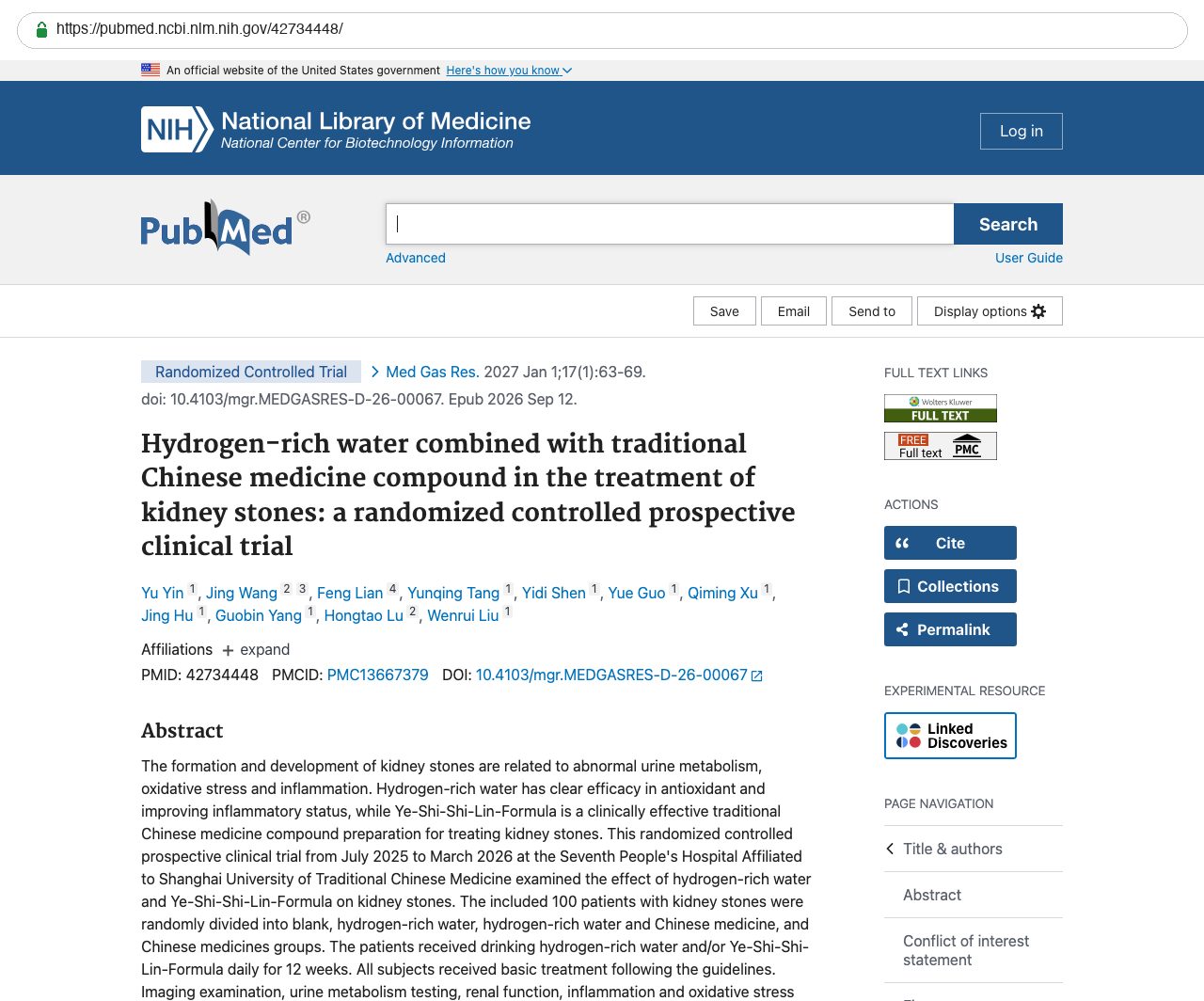
This page mirrors the published abstract (© the authors / publisher) for reference and citation. The canonical source is the PubMed record linked above. This is not medical advice.