2026 · Stolecka-Warzecha — Redox Water Consumption Attenuates Exercise-Induced Inflammation and Oxidative Stress in Physically Active Adults: A Randomized Controlled Trial
Super-Abstract
Eight weeks of hydrogen-enriched redox water dampens the inflammatory surge after intense exercise. In a controlled trial with 40 physically active adults, the inflammatory marker IL-6 fell after the exercise test in the water group, while it rose sharply in the control group (interaction p < 0.001). (Nutrients, 2026.)
Commentary
This randomized controlled trial looks at the biochemical level: intense training triggers a transient surge of inflammation and oxidative stress — readable in the messenger interleukin-6 (IL-6) and in fat-oxidation products (MDA, a marker of lipid peroxidation). 40 physically active adults were split into two groups: 20 drank a „redox water“ for eight weeks — molecularly modified, alkaline, hydrogen-enriched water (pH 9.2 to 9.4) — the other 20 normal water. Then all completed a maximal endurance test. The strongest finding is a very pronounced group-by-time interaction for IL-6 (F = 36.89, p < 0.001): in the water group IL-6 fell after exertion, in the control group it shot up. For the oxidation marker MDA there was also a significant interaction (p = 0.029), but — and the authors say this clearly themselves — a marked imbalance of baseline values limits causal interpretation. Blood count and coagulation stayed normal. Honestly: small sample (n = 40), an unfavorable baseline imbalance, and the authors themselves call for larger studies for confirmation.
Key quotes
- „A pronounced group × time interaction was observed for IL-6 (F(1,38) = 36.89, p < 0.001). The EG exhibited a significant post-exercise reduction in IL-6, whereas the CG demonstrated a robust increase.“ — the core finding: opposite inflammatory response
- „consumed redox water subjected to molecular-level modification, yielding alkaline hydrogen-enriched water (pH 9.2-9.4)“ — the intervention is hydrogen-enriched water
- „pronounced baseline imbalance limits causal interpretation and warrants confirmation in larger trials“ — the authors' honest self-limitation
Our assessment
Directly relevant to exercise recovery and inflammation regulation, because a concrete biochemical pathway is shown here: a dampened IL-6 response after exertion. This fits mechanistically with the antioxidant profile of H₂. Limitation, stated honestly: the authors themselves stress a pronounced baseline imbalance in the inflammatory values that limits the causal statement — the MDA effect largely disappears after baseline adjustment. Small sample (n = 40). Solid RCT design (evidence level 3), but with clear reservations.
Study design
- Type: RCT (parallel groups) · n: 40 (EG 20, CG 20) · Duration: 8 weeks intervention + standardized maximal test · H₂ delivery: alkaline, hydrogen-enriched redox water (pH 9.2–9.4) vs. standard water
- Result figures: IL-6 group × time F(1,38) = 36.89, p < 0.001 (EG falls, CG rises); MDA interaction F(1,38) = 4.98, p = 0.029 (after baseline adjustment largely explained by initial imbalance); blood count/coagulation within normal range
Abstract
BACKGROUND: Acute high-intensity exercise induces transient inflammatory and oxidative stress responses, mediated by redox-sensitive signaling pathways and reflected by elevations in interleukin-6 (IL-6) and lipid peroxidation products. Modulation of these responses through hydration-based redox interventions remains insufficiently characterized at the biochemical level. OBJECTIVE: This randomized controlled trial investigated whether regular consumption of redox (alkaline) water influences exercise-induced inflammatory and oxidative stress markers in physically active adults. METHODS: Forty physically active adults were randomized into an experimental group (EG; n = 20) and consumed redox water subjected to molecular-level modification, yielding alkaline hydrogen-enriched water (pH 9.2-9.4), or a control group (CG; n = 20) that consumed standard water. After eight weeks of intervention, participants performed a standardized maximal aerobic exercise test. Plasma IL-6 and malondialdehyde (MDA) concentrations were measured at baseline and immediately post-exercise. Statistical analyses included two-way repeated measures ANOVA and ANCOVA. RESULTS: A pronounced group × time interaction was observed for IL-6 (F(1,38) = 36.89, p < 0.001). The EG exhibited a significant post-exercise reduction in IL-6, whereas the CG demonstrated a robust increase. A significant group × time interaction was also detected for MDA (F(1,38) = 4.98, p = 0.029), reflecting stable lipid peroxidation levels in the EG and increased levels in the CG; however, baseline-adjusted analyses indicated that post-exercise MDA differences were largely attributable to initial variability. Hematological and coagulation parameters remained within physiological ranges in both groups. CONCLUSIONS: Redox water intake was associated with lower immediate post-exercise IL-6 compared with controls after baseline adjustment; however, pronounced baseline imbalance limits causal interpretation and warrants confirmation in larger trials with balanced inflammatory profiles. These findings highlight a potential biochemical mechanism linking hydration redox properties with inflammatory regulation during physical stress.
Source & links
Screenshot of the PubMed page
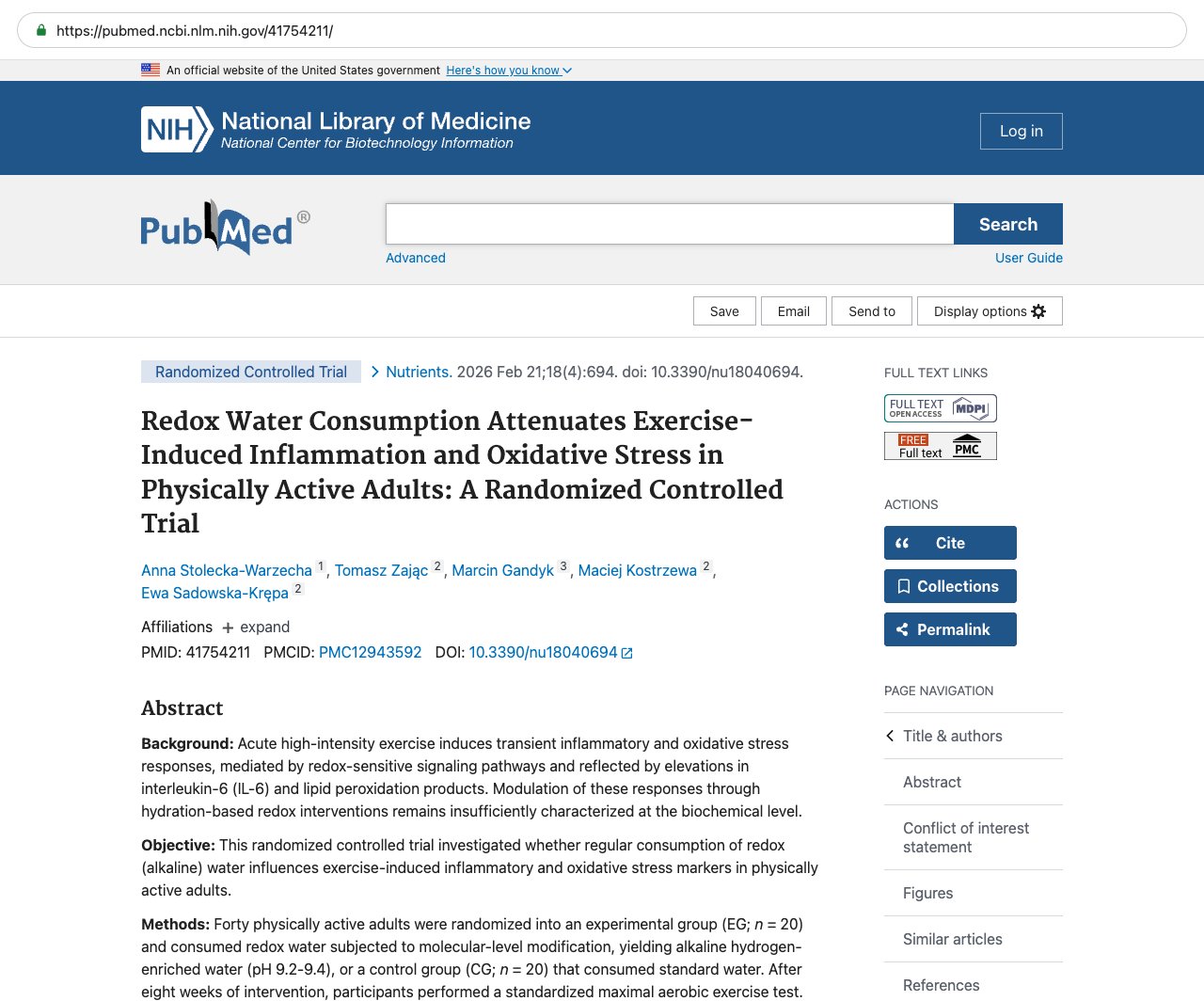
This page mirrors the published abstract (© the authors / publisher) for reference and citation. The canonical source is the PubMed record linked above. This is not medical advice.