2026 High altitude medicine & biology RCT Human H₂ therapy Drinking (HRW) Oxidative stressRespiratory / COVID
2026 · Zhang et al. — Does Hydrogen-Rich Water Reduce Oxidative Stress in Patients with Chronic Mountain Sickness? A Randomized, Blinded, Controlled Trial
Super-Abstract
In adults with chronic mountain sickness, drinking 990 ml of hydrogen-rich water a day for 8 weeks did not reduce oxidative damage compared with placebo: malondialdehyde rose more in the hydrogen group (+2.11, p < 0.001), as did total antioxidant capacity (+2.86, p = 0.043). The rise in malondialdehyde was larger in participants with a body mass index of 24 or more (p = 0.02 for interaction). Adverse events, most often dizziness, occurred in 50% of the hydrogen group and 37% of the placebo group. (High Alt Med Biol, 2026.)
Commentary
Oxidative stress is implicated in chronic mountain sickness (CMS), which is the rationale for testing antioxidants. This 8-week trial took place at the Tibetan Hospital of Nagqu, China, from July to December 2024. Adults with untreated CMS, defined by the Qinghai score, were randomised 1:1 by dynamic minimisation to 990 ml a day of hydrogen-rich water or placebo. Participants, clinicians and investigators were all blinded to allocation. The abstract does not give the hydrogen concentration of the water or describe the placebo. The primary efficacy endpoint was the change from baseline to week 8 in six oxidative stress markers: catalase, glutathione, malondialdehyde (MDA), superoxide dismutase, 8-hydroxy-2'-deoxyguanosine and total antioxidant capacity (T-AOC). Safety was assessed through adverse event reports. Of 60 randomised participants, one in the placebo group did not receive treatment and was excluded, leaving 30 in the hydrogen group and 29 in the placebo group for analysis.
Key quotes
- „At week 8, HRW produced greater changes in MDA and T-AOC compared with placebo: MDA, +2.11 (95% CI: 1.13-3.09; p < 0.001); T-AOC, +2.86 (95% CI: 0.09-5.64; p = 0.043).“ — the main result: two markers moved, one read as pro-oxidative and one as antioxidative
- „Adverse events occurred in 50% (15/30) of the hydrogen group and 37% (11/29) of the placebo group; dizziness was the most common.“ — safety: adverse events were more frequent in the hydrogen group
- „HRW demonstrated both pro-oxidative and antioxidative effects in CMS. However, it did not reduce oxidative stress-induced damage and may increase oxidative risk in individuals with higher BMI.“ — the authors' own conclusion: no reduction in oxidative damage
Our assessment
This is a registered, randomised, blinded, placebo-controlled trial. It found no reduction in oxidative damage with hydrogen-rich water. Malondialdehyde rose more than with placebo and total antioxidant capacity also rose. The authors describe both pro-oxidative and antioxidative effects, with a possible added oxidative risk at higher body mass index. Limitations: 60 participants at one hospital and 8 weeks of treatment. Only laboratory markers were reported, with no symptom scores or clinical outcomes in the abstract. The primary endpoint is a panel of six markers, and the abstract gives results for only two of them. The body mass index finding comes from a subgroup analysis. The abstract does not state the hydrogen concentration or the units of the marker changes. Adverse events were more frequent with hydrogen (50% compared with 37%), and the abstract does not say whether this difference was tested.
Study design
- Type: randomised, blinded, placebo-controlled trial at one centre (Tibetan Hospital of Nagqu, China), 8 weeks · n: 60 randomised, 30 hydrogen and 29 placebo analysed · H₂ delivery: hydrogen-rich water, 990 ml per day (concentration not stated in the abstract)
- Comparator: placebo (not further described in the abstract), with participants, clinicians and investigators blinded to allocation, assigned 1:1 by dynamic minimisation
- Result: primary endpoint (change in six oxidative stress markers at week 8): greater changes with hydrogen in MDA (+2.11, 95% CI 1.13 to 3.09, p < 0.001) and T-AOC (+2.86, 95% CI 0.09 to 5.64, p = 0.043). Results for the other four markers not reported in the abstract. MDA rise larger at a BMI of 24 or more (+2.57, p = 0.02 for interaction). Adverse events 50% vs. 37%, mostly dizziness
Abstract
UNLABELLED: Zhang, Fengying, Yang Zhong, Qiuyue Li, Doudou Hao, Zhiyou Shi, Suying Zhu, Qian Zhang, and Yunhong Wu. Does hydrogen-rich water reduce oxidative stress in patients with chronic mountain sickness? a randomized, blinded, controlled trial. High Alt Med Biol. 27:133-142, 2026. BACKGROUND: Oxidative stress is implicated in the pathogenesis of chronic mountain sickness (CMS), providing a rationale for antioxidant therapies. This study evaluated the safety and efficacy of hydrogen-rich water (HRW) as a potential antioxidant in individuals with CMS. METHODS: We conducted an 8-week, randomized, blinded, placebo-controlled trial at the Tibetan Hospital of Nagqu, China. Adults with untreated CMS (defined by Qinghai score) were randomly assigned (1:1) to receive 990 ml/day of HRW or placebo using a dynamic minimization method. Participants, clinicians, and investigators were blinded to treatment allocation. The primary efficacy endpoint was change in oxidative stress biomarkers from baseline to week 8, including catalase, glutathione, malondialdehyde (MDA), superoxide dismutase, 8-hydroxy-2'-deoxyguanosine, and total antioxidant capacity (T-AOC). Safety was assessed by adverse event reporting. This trial has been completed and is registered at chictr.org under the identifier ChiCTR2400082685. RESULTS: From July 3 to December 24, 2024, 60 participants were randomized; one in the placebo group did not receive treatment and was excluded from the analysis. At week 8, HRW produced greater changes in MDA and T-AOC compared with placebo: MDA, +2.11 (95% CI: 1.13-3.09; p < 0.001); T-AOC, +2.86 (95% CI: 0.09-5.64; p = 0.043). In participants with body mass index (BMI) ≥24, the increase in MDA was more pronounced (Δ+2.57; p = 0.02 for interaction). Adverse events occurred in 50% (15/30) of the hydrogen group and 37% (11/29) of the placebo group; dizziness was the most common. CONCLUSION: HRW demonstrated both pro-oxidative and antioxidative effects in CMS. However, it did not reduce oxidative stress-induced damage and may increase oxidative risk in individuals with higher BMI.
Source & links
Screenshot of the PubMed page
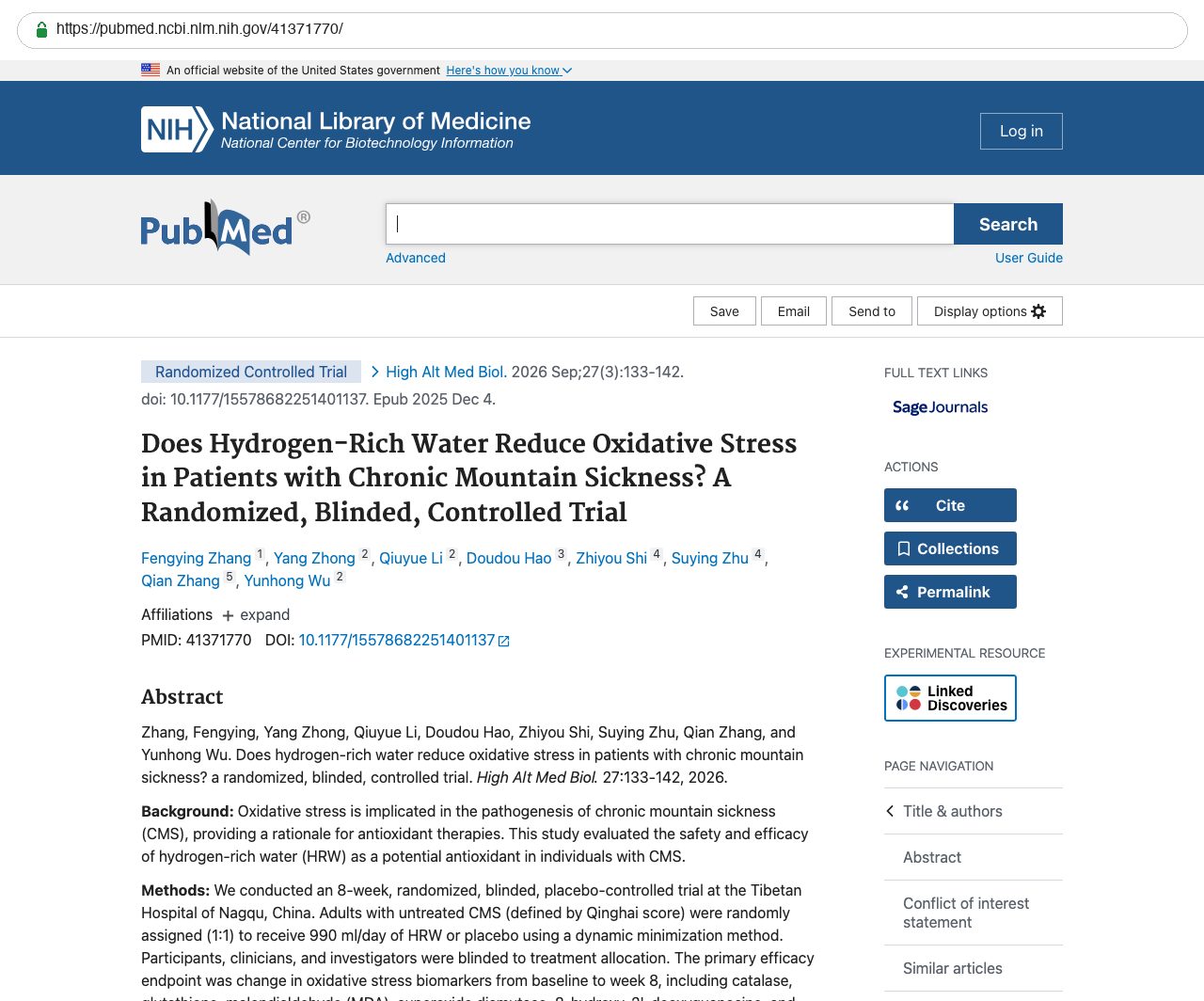
This page mirrors the published abstract (© the authors / publisher) for reference and citation. The canonical source is the PubMed record linked above. This is not medical advice.