2025 · Ying — Molecular hydrogen: Mechanism against oxidative stress and application in periodontitis: A review
Super-Abstract
Periodontitis is driven by an oxidative stress cascade that current dental treatments only partially address — this review summarises how molecular hydrogen's antioxidant properties could be applied before, during, and after periodontal surgery, and introduces a new benefit-evaluation model (ENFP) for assessing novel agents in dentistry. (Medicine, 2025.)
Commentary
Periodontitis is the sixth most prevalent disease worldwide and a significant contributor to systemic conditions. Conventional treatment — scaling, root planing, surgical intervention — manages bacterial load but does not directly counteract the oxidative damage driving chronic tissue breakdown. This review examines H₂'s potential in this specific clinical context. It first maps the mechanism (selective •OH and ONOO⁻ scavenging, Nrf2 pathway activation, modulation of inflammatory cytokines), then applies this to periodontal pathophysiology, and concludes with a practical three-phase application proposal (before, during, after surgery). A novel contribution is the ENFP (Essence-Necessity-Feasibility-Practice) model — a structured benefit-evaluation framework the authors propose for assessing any new therapeutic agent in dentistry. The review is honest that periodontal-specific clinical data for H₂ remain limited and that the ENFP analysis is itself a conceptual contribution rather than empirical evidence.
Key quotes
- „Molecular hydrogen, as an effective anti-oxidative stress reagent, has been extensively studied in medicine with new developments continuing to be reported during the years.“ — the starting premise: H₂ has a well-documented antioxidant profile across medicine
- „we develop an Essence-Necessity-Feasibility-Practice (ENFP) benefit evaluation model for whether to introduce new reagents in medical treatment“ — the novel conceptual contribution: a structured framework for evaluating new agents in dental practice
- „we propose our conclusions on the application of molecular hydrogen before, during, and after periodontal surgeries.“ — the practical output: a three-phase clinical application proposal for H₂ in periodontitis treatment
Our assessment
This is a narrative review with a conceptual contribution (the ENFP model). It makes a logically coherent case for H₂ in periodontitis based on mechanism and general antioxidant evidence, but randomised clinical trial data specifically in periodontitis are not cited. The ENFP framework is an interesting methodological addition for the dental field. The review does not overstate certainty, and its structured three-phase proposal is practically oriented without making unsubstantiated efficacy claims. A useful orientation paper for dental researchers considering H₂ as an adjunct.
Study design
- Type: narrative review with novel evaluation framework · n: n/a (literature synthesis + conceptual model) · H₂ delivery: not specified for periodontal use (general antioxidant mechanism reviewed; specific dental application methods discussed conceptually)
- Result: H₂ mechanism summarised (•OH/ONOO⁻ scavenging, Nrf2 activation, cytokine modulation); application proposed in three phases (pre-, intra-, post-operative); ENFP benefit-evaluation model introduced; specific periodontitis clinical trial data absent
Abstract
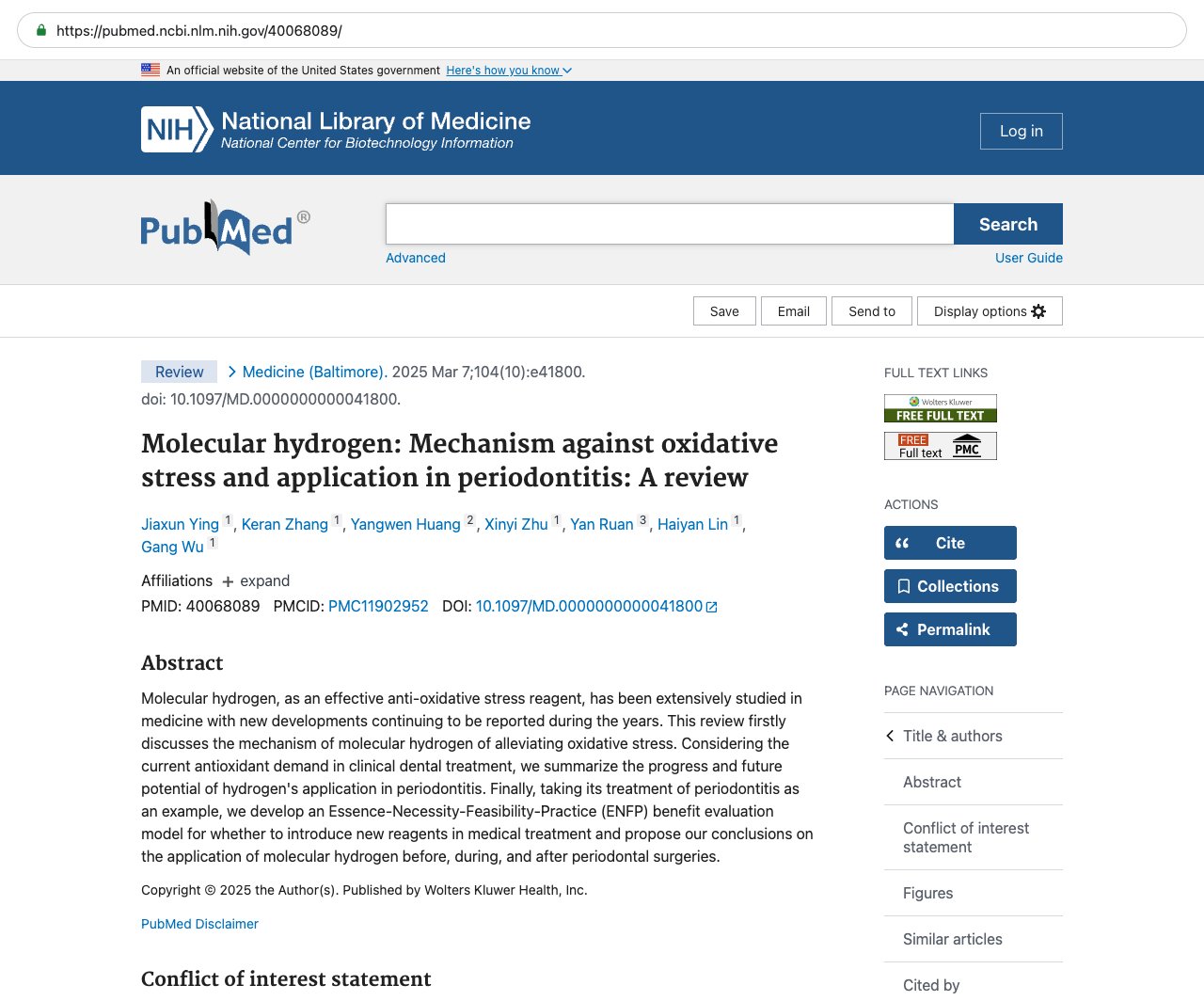
Molecular hydrogen, as an effective anti-oxidative stress reagent, has been extensively studied in medicine with new developments continuing to be reported during the years. This review firstly discusses the mechanism of molecular hydrogen of alleviating oxidative stress. Considering the current antioxidant demand in clinical dental treatment, we summarize the progress and future potential of hydrogen's application in periodontitis. Finally, taking its treatment of periodontitis as an example, we develop an Essence-Necessity-Feasibility-Practice (ENFP) benefit evaluation model for whether to introduce new reagents in medical treatment and propose our conclusions on the application of molecular hydrogen before, during, and after periodontal surgeries.
Source & links
Screenshot of the PubMed page
This page mirrors the published abstract (© the authors / publisher) for reference and citation. The canonical source is the PubMed record linked above. This is not medical advice.