2018 Hua xi kou qiang yi xue za zhi = Huaxi kouqiang yixue zazhi = West China journal of stomatology Mechanism / Preclinical Unspecified
2018 · Zhou — Protective effects of hydrogen-rich medium on lipopolysaccharide-induced injury in human periodontal ligament cells
Super-Abstract
In cultured human periodontal ligament cells (hPDLCs) exposed to lipopolysaccharide (LPS) to simulate bacterial inflammation, hydrogen-rich medium improved cell proliferation, reduced apoptosis, and lowered oxidative stress markers. This is a cell culture study — results cannot be applied directly to clinical periodontitis treatment. (West China Journal of Stomatology, 2018.)
Commentary
Periodontal disease is driven in part by bacterial lipopolysaccharides triggering an inflammatory oxidative cascade that damages the periodontal ligament. This study isolated human periodontal ligament cells (hPDLCs) and exposed them to LPS, then tested whether culturing them in hydrogen-rich medium could mitigate the damage. Cell viability (CCK-8), lactate dehydrogenase release (membrane damage), antioxidant enzymes (SOD, CAT), oxidative stress marker MDA, and apoptosis rate (flow cytometry) were measured. Key findings: hydrogen-rich medium improved proliferation and reduced apoptosis significantly. CAT levels were markedly elevated at 6 and 12 hours. However, SOD levels showed no significant difference between groups, and LDH release was also not significantly different — suggesting the hydrogen effect is selective and not uniformly protective across all stress pathways. The study is methodologically straightforward but limited to a single cell type in artificial culture conditions.
Key quotes
- „hydrogen could significantly improve hPDLCs growth and decrease cell apoptosis under LPS stimulation (P<0.05).“ — main functional result: hydrogen preserves cell growth and survival
- „The CAT levels significantly increased at 6 and 12 h in the hydrogen-rich medium as compared with the normal medium group.“ — selective antioxidant effect on catalase but not superoxide dismutase
- „no significant difference in LDH release was found between the two groups.“ — a null finding — hydrogen did not significantly reduce membrane damage by LDH measure
Our assessment
This is an in-vitro cell study. The results suggest a partial protective effect of H₂ on periodontal ligament cells under LPS stress, but the null results for SOD and LDH mean the protection is not comprehensive. No animal or clinical periodontal data are provided. The findings are preliminary and relevant primarily for guiding future preclinical research into H₂ and oral health. No treatment conclusions should be drawn.
Study design
- Type: in-vitro cell study · Model: isolated human periodontal ligament cells (hPDLCs) + 1 μg/mL LPS stimulation
- H₂ delivery: hydrogen-rich culture medium · Endpoints: CCK-8 proliferation, LDH release, SOD/CAT activity, MDA level, apoptosis rate (flow cytometry at 24 h)
- Result: improved proliferation, reduced apoptosis, elevated CAT at 6 and 12 h, reduced MDA at 6 h; SOD and LDH release not significantly different between groups
Abstract
OBJECTIVE: In this study, lipopolysaccharides (LPS) was used to damage human periodontal ligament cells (hPDLCs) and consequently investigate the protective effects of hydrogen on reducing oxidative stress and cell apoptosis rate. METHODS: hPDLCs were isolated, and then cultured with normal medium+1 μg·mL⁻¹ LPS or with hydrogen-rich medium+
1 μg·mL⁻¹ LPS. Cell proliferation activity was assessed using a cell counting kit-8 (CCK-8), and lactic dehydrogenase (LDH) release was also detected. The activities of superoxide dismutase (SOD) and catalase (CAT), and the level of malonaldehyde (MDA) in supernatants were also measured. Cell apoptosis was detected by flow cytometry at 24 h after LPS stimulation. RESULTS: CCK-8 results showed that hydrogen could significantly improve hPDLCs growth and decrease cell apoptosis under LPS stimulation (P<0.05). However, no significant difference in LDH release was found between the two groups. The CAT levels significantly increased at 6 and 12 h in the hydrogen-rich medium as compared with the normal medium group (P<0.05, P<0.01, respectively). However, SOD levels were not significant different at each time point. At 6 h after LPS stimulation, the MDA levels in the cell supernatant of hydrogen-rich medium group were significantly reduced as compared with those in the normal medium group (P<0.05). CONCLUSIONS: The hydrogen-rich medium can effectively improve hPDLCs proliferation activity and antioxidant capacity and reduce apoptosis and oxidative stress under LPS stimulation.
Source & links
Screenshot of the PubMed page
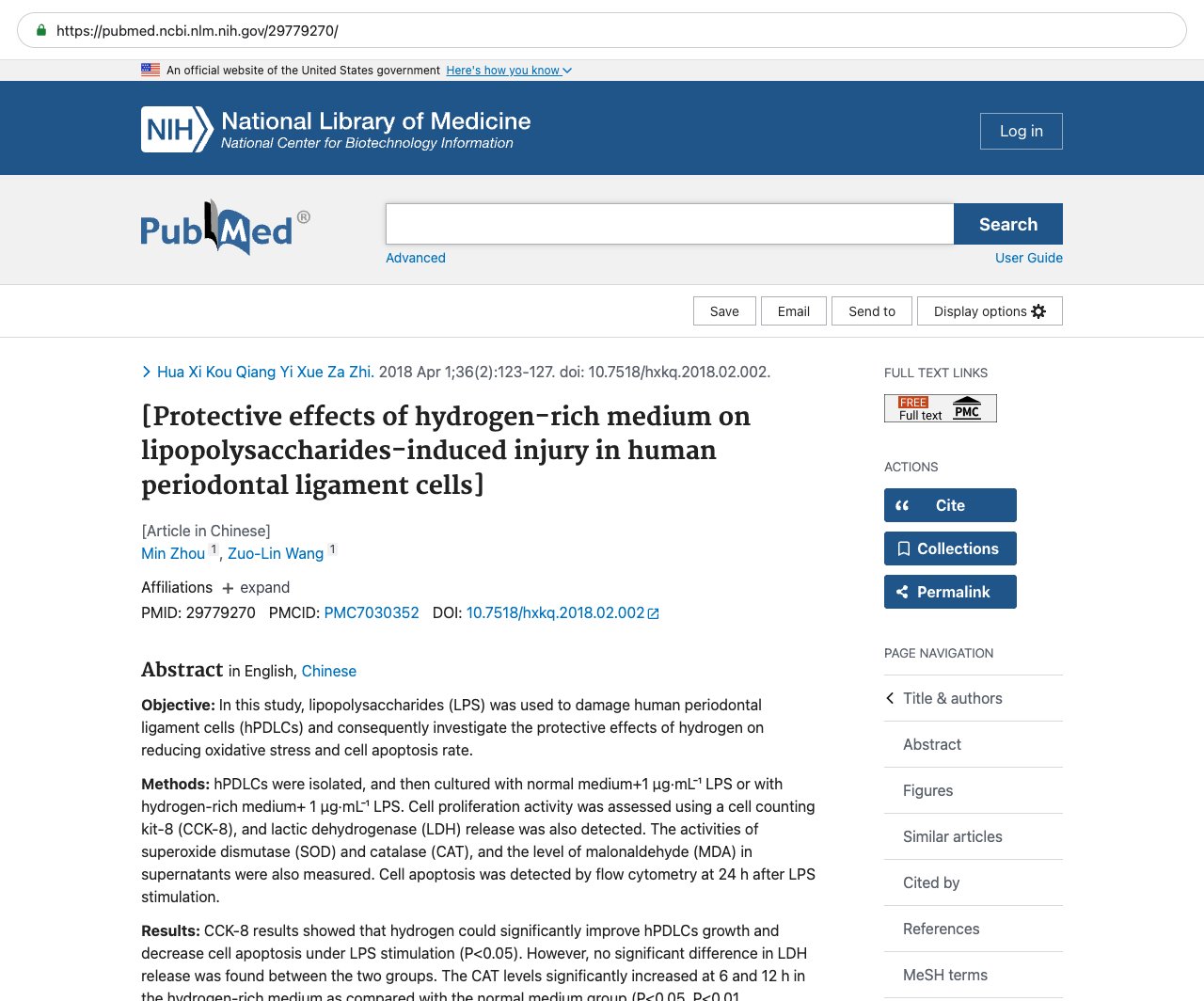
This page mirrors the published abstract (© the authors / publisher) for reference and citation. The canonical source is the PubMed record linked above. This is not medical advice.