2013 Movement disorders : official journal of the Movement Disorder Society RCT Human H₂ therapy Drinking (HRW)
2013 · Yoritaka et al. — Pilot study of H₂ therapy in Parkinson's disease: a randomized double-blind placebo-controlled trial.
Super-Abstract
In a 48-week double-blind, placebo-controlled pilot trial, 17 levodopa-medicated Parkinson's patients drinking 1,000 mL/day of H₂-rich water showed improved UPDRS motor scores on average, while the placebo group worsened — a statistically significant difference despite the small sample size. This is among the first rigorous RCTs of H₂ in a neurodegenerative disease. (Movement Disorders, 2013.)
Commentary
Parkinson's disease (PD) involves the progressive loss of dopaminergic neurons in the substantia nigra — a process in which oxidative stress, particularly from hydroxyl radicals, is considered a major driver. H₂ selectively scavenges the hydroxyl radical, making the biological rationale for this trial mechanistically sound. At 48 weeks, the H₂-water group showed a median UPDRS improvement of −1.0 points (mean −5.7 ± 8.4), while the placebo group worsened by a median of +4.5 (mean +4.1 ± 9.2). Despite only 17 patients and large standard deviations — suggesting considerable individual variability — the between-group difference reached statistical significance (P<0.05). This is a genuinely exciting pilot result. The authors are appropriately cautious about the small sample and short duration. No serious adverse events were reported, confirming the safety of daily HRW in PD patients on levodopa.
Key quotes
- „Total Unified Parkinson's Disease Rating Scale (UPDRS) scores in the H₂-water group (n=9) improved (median, -1.0; mean ± standard deviation, -5.7 ± 8.4), whereas UPDRS scores in the placebo group (n=8) worsened (median, 4.5; mean ± standard deviation, 4.1 ± 9.2).“ — the key result: divergence in motor scores between H₂ and placebo groups
- „Despite the minimal number of patients and the short duration of the trial, the difference was significant (P<0.05).“ — authors' honest acknowledgment of limitations alongside the positive finding
- „The results indicated that drinking H₂-water was safe and well tolerated, and a significant improvement in total UPDRS scores for patients in the H₂-water group was demonstrated.“ — conclusion: safety confirmed and positive signal demonstrated
Our assessment
A landmark pilot study for H₂ in neurology. The positive result in an objective, validated scale (UPDRS) is statistically significant and clinically plausible given H₂'s antioxidant mechanism. However, the study is severely limited by n=9 vs. n=8 — far too small for definitive conclusions. Large standard deviations indicate high individual variability. The study was not powered for definitive efficacy, and results should not be extrapolated beyond their role as a hypothesis-generating pilot. A larger, multi-center RCT in PD is needed (and has been conducted in subsequent years). No safety concerns identified.
Study design
- Type: randomized, double-blind, placebo-controlled, parallel-group pilot RCT · n: 17 levodopa-medicated Parkinson's patients (9 H₂, 8 placebo) · H₂ delivery: 1,000 mL/day H₂-rich water orally for 48 weeks
- Primary outcome: total UPDRS score change from baseline to week 48
- Result: H₂ group UPDRS improved (median −1.0), placebo group worsened (median +4.5); between-group difference P<0.05; no serious adverse events
Abstract
BACKGROUND: Oxidative stress is involved in the progression of Parkinson's disease (PD). Recent studies have confirmed that molecular hydrogen (H₂) functions as a highly effective antioxidant in cultured cells and animal models. Drinking H₂-dissolved water (H₂-water) reduced oxidative stress and improved Parkinson's features in model animals. METHODS: In this a placebo-controlled, randomized, double-blind, parallel-group clinical pilot study, the authors assessed the efficacy of H₂ -water in Japanese patients with levodopa-medicated PD. Participants drank 1,000 mL/day of H₂-water or pseudo water for 48 weeks. RESULTS: Total Unified Parkinson's Disease Rating Scale (UPDRS) scores in the H₂-water group (n=9) improved (median, -1.0; mean ± standard deviation, -5.7 ± 8.4), whereas UPDRS scores in the placebo group (n=8) worsened (median, 4.5; mean ± standard deviation, 4.1 ± 9.2). Despite the minimal number of patients and the short duration of the trial, the difference was significant (P<0.05). CONCLUSIONS: The results indicated that drinking H₂-water was safe and well tolerated, and a significant improvement in total UPDRS scores for patients in the H₂-water group was demonstrated.
Source & links
Screenshot of the PubMed page
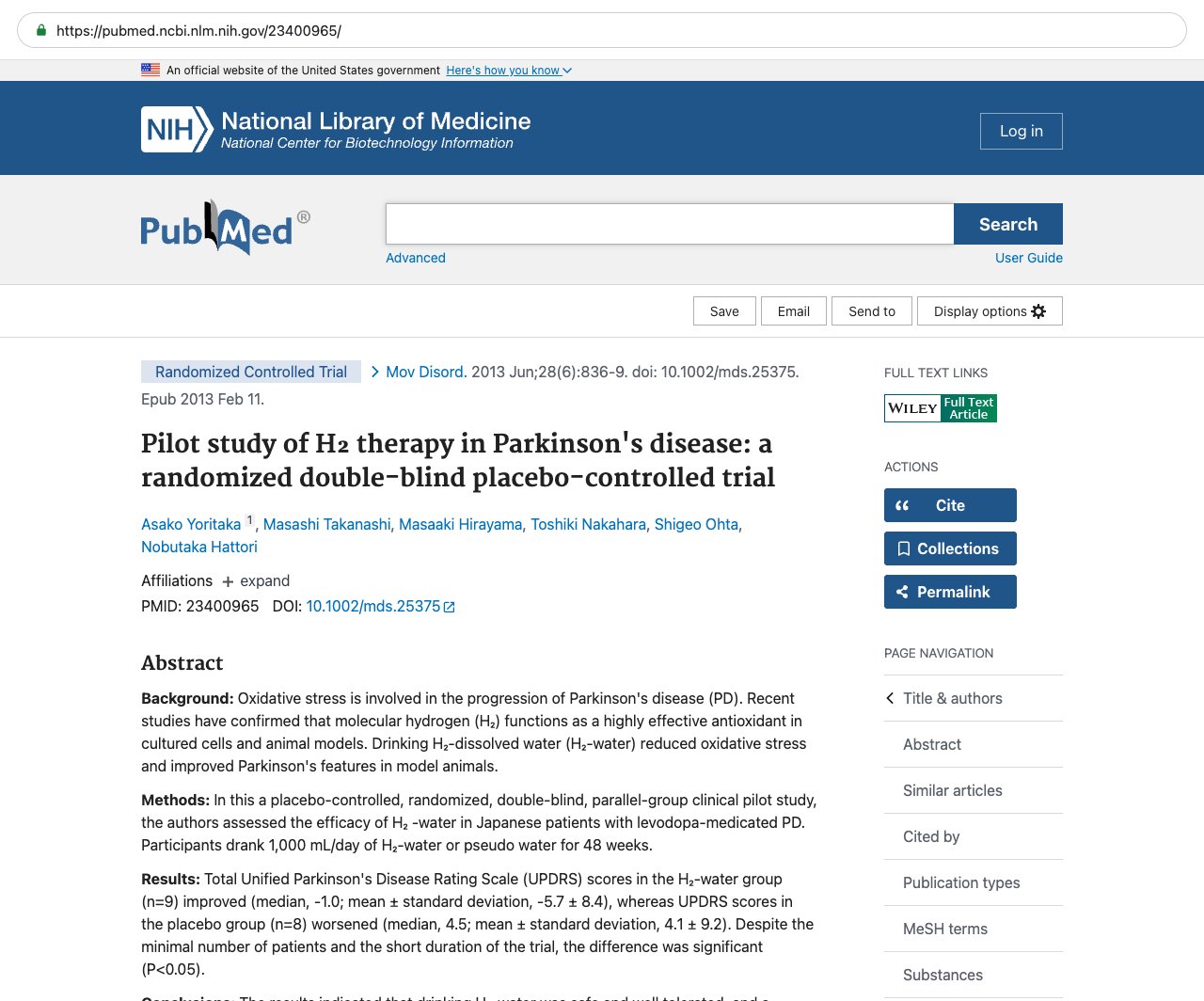
This page mirrors the published abstract (© the authors / publisher) for reference and citation. The canonical source is the PubMed record linked above. This is not medical advice.