2021 · Yoritaka — Randomized double-blind placebo-controlled trial of hydrogen inhalation for Parkinson's disease: a pilot study
Super-Abstract
Hydrogen inhalation was safe in Parkinson's — but showed no measurable benefit. In this randomized, double-blind, placebo-controlled pilot study (20 patients, 16 weeks), 6.5% H₂ gas did not significantly improve the Parkinson's scale over placebo. (Neurological Sciences, 2021.)
Commentary
This study is important because it provides an honest counterweight: hydrogen does not work everywhere, and serious information shows that too. Oxidative stress is considered a co-driver of Parkinson's disease progression, and in animal models H₂ was neuroprotective — that was the hope. The design is clean: randomized, double-blind, placebo-controlled, in a parallel-group format with 20 Japanese Parkinson's patients on levodopa therapy. For 16 weeks they inhaled, twice daily for one hour, either 6.5% hydrogen gas or placebo air. The result was sober: on the main measure, the change in the MDS-UPDRS score, there was no significant difference between the H₂ and placebo groups (p > 0.05). On the positive side: no adverse events occurred — so H₂ inhalation was safe. However, five participants had to be excluded because they did not meet the inhalation duration; adherence declined in older patients and at higher levodopa doses. Bottom line: a small, well-conducted pilot project that found no effect — valuable for exactly that reason.
Key quotes
- „No significant differences were seen in the change in the total Movement Disorder Society Unified Parkinson's Disease Rating Scale score from baseline to the 16th week between the group that inhaled hydrogen gas and the group that inhaled placebo air (Mann-Whitney U test, p > 0.05).“ — the central negative result
- „No adverse events were seen.“ — safety confirmed
- „This pilot study revealed that the inhalation of molecular hydrogen gas was safe, but did not show any beneficial effects in patients with PD.“ — the authors' clear, honest conclusion
Our assessment
We deliberately include this study even though it is negative — a credible study database also shows where H₂ did not help. For us it is an anchor for honest communication: no cure-all promise. The value lies in the clean design (randomized, double-blind) and the safety finding. Limitation, stated honestly: very small sample (n = 20, of which 5 excluded → effectively 15), a pure pilot study without power for small effects, possible under-dosing or too short a duration. A null result in a pilot trial does not definitively refute H₂ in Parkinson's — it only shows that this specific approach produced no effect.
Study design
- Type: RCT, randomized/double-blind/placebo-controlled/parallel-group (pilot) · n: 20 (Parkinson's, levodopa-treated; 5 excluded for protocol deviation) · Duration: 16 weeks, 2 × 1 h/day · H₂ delivery: inhalation of 6.5 vol% H₂ in 2 L/min mixed air
- Result: MDS-UPDRS change with no significant difference H₂ vs. placebo (p > 0.05); no adverse events; declining adherence with higher age and higher levodopa dose (p < 0.05)
Abstract
BACKGROUND: Oxidative stress is involved in the progression of Parkinson's disease (PD). Recent studies have confirmed that molecular hydrogen (H2) functions as a highly effective antioxidant in animal models of PD. A placebo-controlled, randomized, double-blind, parallel-group clinical pilot study was conducted to assess the efficacy of hydrogen gas inhalation in Japanese patients with PD on treatment with levodopa. METHODS: Twenty participants fulfilling the Movement Disorder Society criteria were enrolled. Participants inhaled 6.5 (0.1) vol% hydrogen gas in 2 L/min of mixed air or placebo air for 16 weeks, twice a day for 1 h. RESULTS: Five participants were excluded due to deviation from the protocol of the total duration of inhalation < 112 h. No significant differences were seen in the change in the total Movement Disorder Society Unified Parkinson's Disease Rating Scale score from baseline to the 16th week between the group that inhaled hydrogen gas and the group that inhaled placebo air (Mann-Whitney U test, p > 0.05). No adverse events were seen. The compliance to the protocol-based duration of inhalation time in all participants decreased with the elderly participants, the higher daily dose of levodopa, and the higher PDQ-39 items on emotions (n = 20, p < 0.05). CONCLUSION: This pilot study revealed that the inhalation of molecular hydrogen gas was safe, but did not show any beneficial effects in patients with PD. TRIAL REGISTRATION: UMIN ID: 000,039,217 (October 6, 2018).
Source & links
Screenshot of the PubMed page
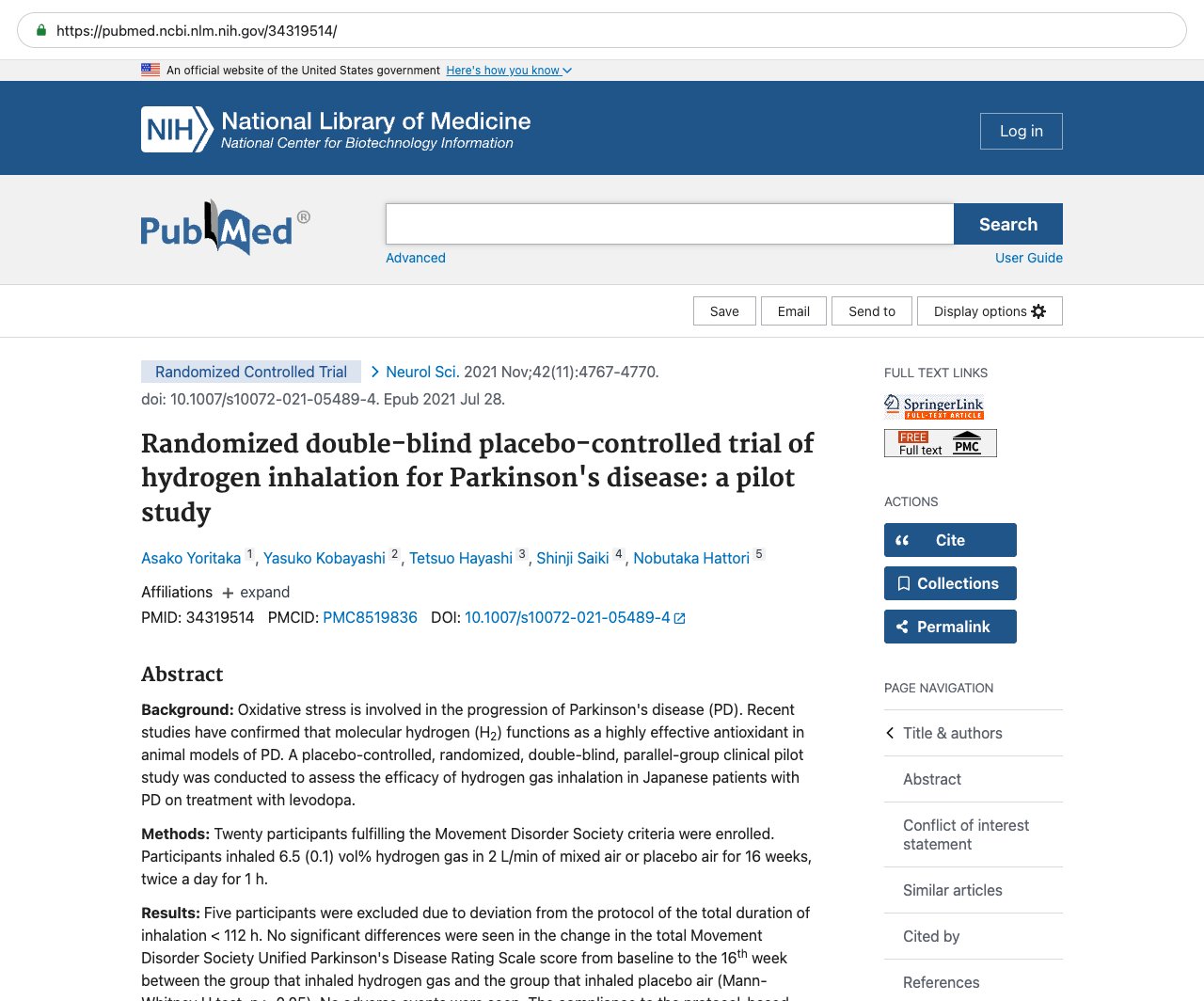
This page mirrors the published abstract (© the authors / publisher) for reference and citation. The canonical source is the PubMed record linked above. This is not medical advice.