2018 · Yuan — Hydrogen-rich water attenuates oxidative stress in rats with traumatic brain injury via Nrf2 pathway
Super-Abstract
In a rat model of traumatic brain injury (TBI), hydrogen-rich water significantly improved survival, reduced neurological deficits, and lowered oxidative stress markers. The protective mechanism appears to involve activation of the Nrf2 pathway, prompting downstream expression of protective enzymes HO-1 and NQO1. This is an animal study — results cannot be directly transferred to humans. (Journal of Surgical Research, 2018.)
Commentary
This study used the classic Feeney weight-drop model to inflict standardised TBI in rats, then treated animals with hydrogen-rich drinking water. The authors carefully tracked both survival rates over seven days and neurological severity scores at 24 hours. On the mechanistic side, they measured oxidative stress markers (MDA, GPx, CAT) and quantified Nrf2 protein in the nucleus — a sign that the transcription factor was activated and moving to do its job. The results are coherent: hydrogen-rich water not only reduced oxidative damage but also nudged Nrf2 into the nucleus, raising downstream antioxidant enzymes. The study is methodologically solid for a preclinical model, with three clearly separated groups (sham, TBI, TBI+HW). However, rat brain physiology and TBI dynamics differ substantially from human TBI, and no dose-finding or pharmacokinetic data for H₂ in brain tissue were reported.
Key quotes
- „Hydrogen-rich water administration significantly increased 7-d survival rates, reduced neurologic deficits, and lowered intracellular oxidative stress levels.“ — main efficacy finding across survival and functional outcome
- „hydrogen-rich water caused Nrf2 to enter the cell nucleus, which resulted in increases in the expression of downstream factors such as HO-1 and NQO1.“ — proposed mechanism: Nrf2 nuclear translocation drives antioxidant response
- „Nrf2 nucleoprotein levels were upregulated in the TBI group compared with the sham group and peaked at 24 h after TBI; however, no significant changes in Nrf2 mRNA levels were noted after TBI.“ — nuanced finding: TBI itself activates Nrf2 protein, but not mRNA — hydrogen further amplifies this
Our assessment
A well-structured preclinical study with internally consistent results. This is an animal experiment — its findings cannot be extrapolated to human TBI patients without clinical trials. Rat TBI models are valuable for mechanistic insight but routinely overestimate translational success. The Nrf2-pathway narrative is plausible and aligns with other H₂ research, but the specific doses, timing windows, and H₂ concentrations used in rats may not be achievable or relevant in a clinical context. No human data exists from this paper.
Study design
- Type: animal study (rat, in vivo) · Model: modified Feeney weight-drop TBI · Groups: sham / TBI / TBI + hydrogen-rich water · n: 20 rats/group for survival; 6/group for neurological scoring
- H₂ delivery: hydrogen-rich water (drinking) · Outcome measures: 7-day survival, modified neurological severity score, MDA/GPx/CAT levels, Nrf2 nuclear protein, HO-1, NQO1 (western blot, RT-PCR, immunohistochemistry)
- Result: significantly improved survival and neurological scores; reduced MDA, elevated GPx/CAT; Nrf2 nuclear translocation with downstream HO-1 and NQO1 upregulation in treated rats
Abstract
BACKGROUND: Several studies have recently found that oxidative stress plays a pivotal role in the pathogenesis of traumatic brain injury (TBI) and may represent a target in TBI treatment. Hydrogen-rich water was recently shown to exert neuroprotective effects in various neurological diseases through its antioxidant properties. However, the mechanisms underlying its effects in TBI are not clearly understood. The purpose of our study was to evaluate the neuroprotective role of hydrogen-rich water in rats with TBI and to elucidate the possible mechanisms underlying its effects. MATERIALS AND METHODS: The TBI model was constructed according to the modified Feeney weight-drop method. In part 1 of the experiment, we measured oxidative stress levels by observing the changes in catalase (CAT), glutathione peroxidase (GPx), and malondialdehyde (MDA) expressions. We also evaluated nuclear factor erythroid 2-related factor 2 (Nrf2) levels to determine the role of the protein in the neuroprotective effects against TBI. In part 2, we verified the neuroprotective effects of hydrogen-rich water in TBI and observed its effects on Nrf2. All the experimental rats were divided into sham group, TBI group, and TBI + hydrogen-rich water-treated (TBI + HW) group. We randomly chose 20 rats from each group and recorded their 7-d survival rates. Modified neurological severity scores were recorded from an additional six rats per group, which were then sacrificed 24 h after testing. Spectrophotometry was used to measure GPx, CAT, and MDA levels, whereas western blotting, reverse transcription polymerase chain reaction, and immunohistochemistry were used to measure the expression of Nrf2 and downstream factors like heme oxygenase 1 (HO-1) and NAD(P)H quinone oxidoreductase 1 (NQO1). RESULTS: GPx and CAT activity was significantly decreased, and MDA content was increased in the TBI group compared with the sham group at 6 h after TBI. MDA content peaked at 24 h after TBI. Nrf2 nucleoprotein levels were upregulated in the TBI group compared with the sham group and peaked at 24 h after TBI; however, no significant changes in Nrf2 mRNA levels were noted after TBI. Hydrogen-rich water administration significantly increased 7-d survival rates, reduced neurologic deficits, and lowered intracellular oxidative stress levels. Moreover, hydrogen-rich water caused Nrf2 to enter the cell nucleus, which resulted in increases in the expression of downstream factors such as HO-1 and NQO1. CONCLUSIONS: Our results indicate that hydrogen-rich water has neuroprotective effects against TBI by reducing oxidative stress and activating the Nrf2 pathway.
Source & links
Screenshot of the PubMed page
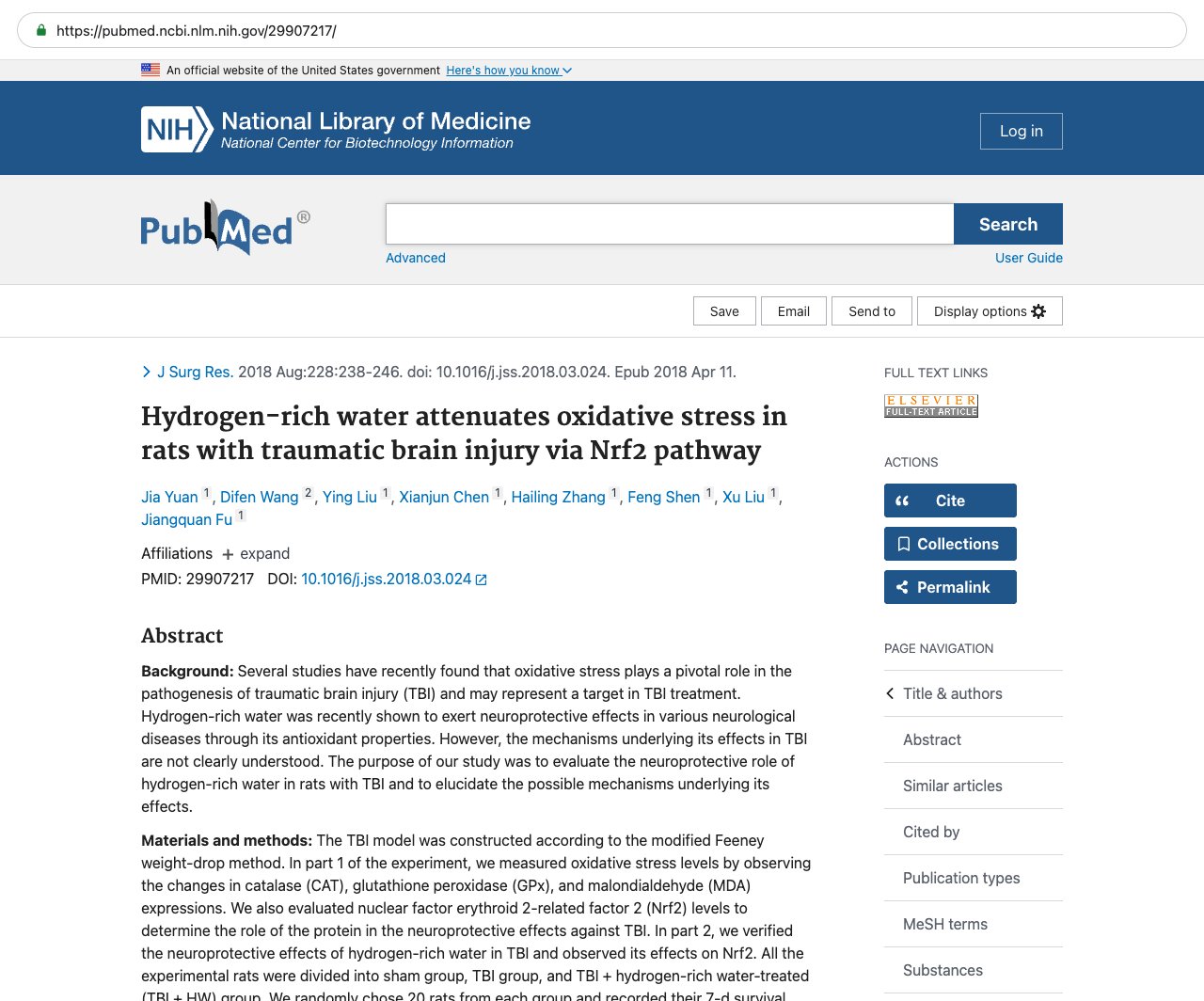
This page mirrors the published abstract (© the authors / publisher) for reference and citation. The canonical source is the PubMed record linked above. This is not medical advice.