2018 · Zhang — Hydrogen ameliorates oxidative stress via PI3K-Akt signalling pathway in UVB-induced HaCaT cells
Super-Abstract
In human keratinocyte cells (HaCaT line) irradiated with UVB, hydrogen treatment reduced reactive oxygen species and oxidative damage markers while activating the PI3K/Akt/Nrf2/HO-1 protective cascade. This is an in-vitro study on skin cells — not a clinical study in humans, and no sun-protection or anti-ageing claims can be derived from it. (International Journal of Molecular Medicine, 2018.)
Commentary
UV-induced oxidative stress is a well-established driver of skin damage and photoageing. This study examined whether molecular hydrogen could protect HaCaT keratinocytes against UVB irradiation, and through which pathway. The authors measured multiple oxidative stress readouts (ROS, 8-iso-PGF2α, MDA) and cell viability, then tracked the expression of PI3K, Akt, Nrf2, and HO-1 — a chain of signalling proteins that collectively mount an antioxidant defence response. Hydrogen reduced oxidative markers and activated this protective cascade. Crucially, when PI3K was blocked pharmacologically, hydrogen's protective effects were only partially reversed — meaning the PI3K/Akt route is important but not the only mechanism. The authors phrase this somewhat oddly (saying H₂ „inhibits Nrf2/HO-1 activation through PI3K/Akt“ when their data actually show activation of that pathway), which suggests either a phrasing error or a nuanced interpretation of pathway dynamics. Results are consistent within the model but remain at cell-level only.
Key quotes
- „hydrogen decreased the levels of reactive oxygen species, 8-iso-prostaglandin F2α and malondialdehyde, and promoted the UVB exposure-induced expression of PI3K, Akt, Nrf2 and heme oxygenase-1 in HaCaT cells.“ — dual effect: lower oxidative damage + higher antioxidant signalling
- „PI3K inhibition partially reversed the effects of hydrogen on UVB-induced HaCaT cells.“ — mechanistic proof — and an honest qualifier: partial reversal means other pathways also contribute
- „hydrogen effectively protects cells from UVB radiation-induced oxidative stress by inhibiting Nrf2/HO-1 activation through the PI3K/Akt signaling pathway.“ — the authors' conclusion — note: the wording is ambiguous in the original; data show activation, not inhibition, of this protective pathway
Our assessment
This is an in-vitro cell study on a keratinocyte cell line. The mechanistic findings are interesting and internally consistent for the most part, though the conclusion's phrasing has an apparent contradiction regarding pathway „inhibition“ vs. activation. In any case, HaCaT cells in culture do not replicate the complexity of living human skin — thickness, immune cells, blood supply, melanocytes, repair mechanisms. No clinical sun-damage or skin-health conclusions can be drawn.
Study design
- Type: in-vitro cell study · Model: HaCaT human keratinocyte cell line, UVB irradiation
- H₂ delivery: hydrogen-saturated medium (method not fully specified) · Endpoints: ROS (fluorescence spectrometry), 8-iso-PGF2α (ELISA), MDA, cell viability (MTT), cytotoxicity (LDH), PI3K/Akt/Nrf2/HO-1 protein expression (western blot)
- Result: hydrogen reduced ROS, 8-iso-PGF2α, and MDA; improved cell viability; upregulated PI3K, Akt, Nrf2, HO-1; PI3K inhibition partially reversed hydrogen's protective effect
Abstract
Chronic ultraviolet (UV) exposure-induced oxidative stress is associated with the pathogenesis of skin damage. However, the nuclear factor erythroid‑2‑related factor 2 (Nrf2) pathway is a critical factor in protecting cells against UVB‑induced injury through inhibiting oxidative stress. Furthermore, Nrf2 activation requires the involvement of the phosphoinositide-3 kinase (PI3K)/protein kinase B (AKT) pathway, which has a major role in survival of various cell types. Molecular hydrogen exerts protective effects on UV‑induced injury, but the underlying mechanisms have remained elusive. The present study assessed the protective effects of hydrogen against oxidative stress‑induced injury caused by UVB irradiation and investigated the molecular mechanisms. In vitro, UVB‑induced HaCaT cells were collected for the detection of reactive oxygen species, 8‑iso‑prostaglandin F2α, malondialdehyde via fluorescence spectrometry and ELISA; cell activity and cytotoxicity by MTT and lactate dehydrogenase assays, respectively. Additionally, the expression level of PI3K, Akt, Nrf2 and heme oxygenase‑1 (HO‑1) were investigated using western blot, etc. All of the results indicated that hydrogen decreased the levels of reactive oxygen species, 8‑iso‑prostaglandin F2α and malondialdehyde, and promoted the UVB exposure‑induced expression of PI3K, Akt, Nrf2 and heme oxygenase‑1 in HaCaT cells. Of note, PI3K inhibition partially reversed the effects of hydrogen on UVB‑induced HaCaT cells. Therefore, hydrogen effectively protects cells from UVB radiation‑induced oxidative stress by inhibiting Nrf2/HO‑1 activation through the PI3K/Akt signaling pathway.
Source & links
Screenshot of the PubMed page
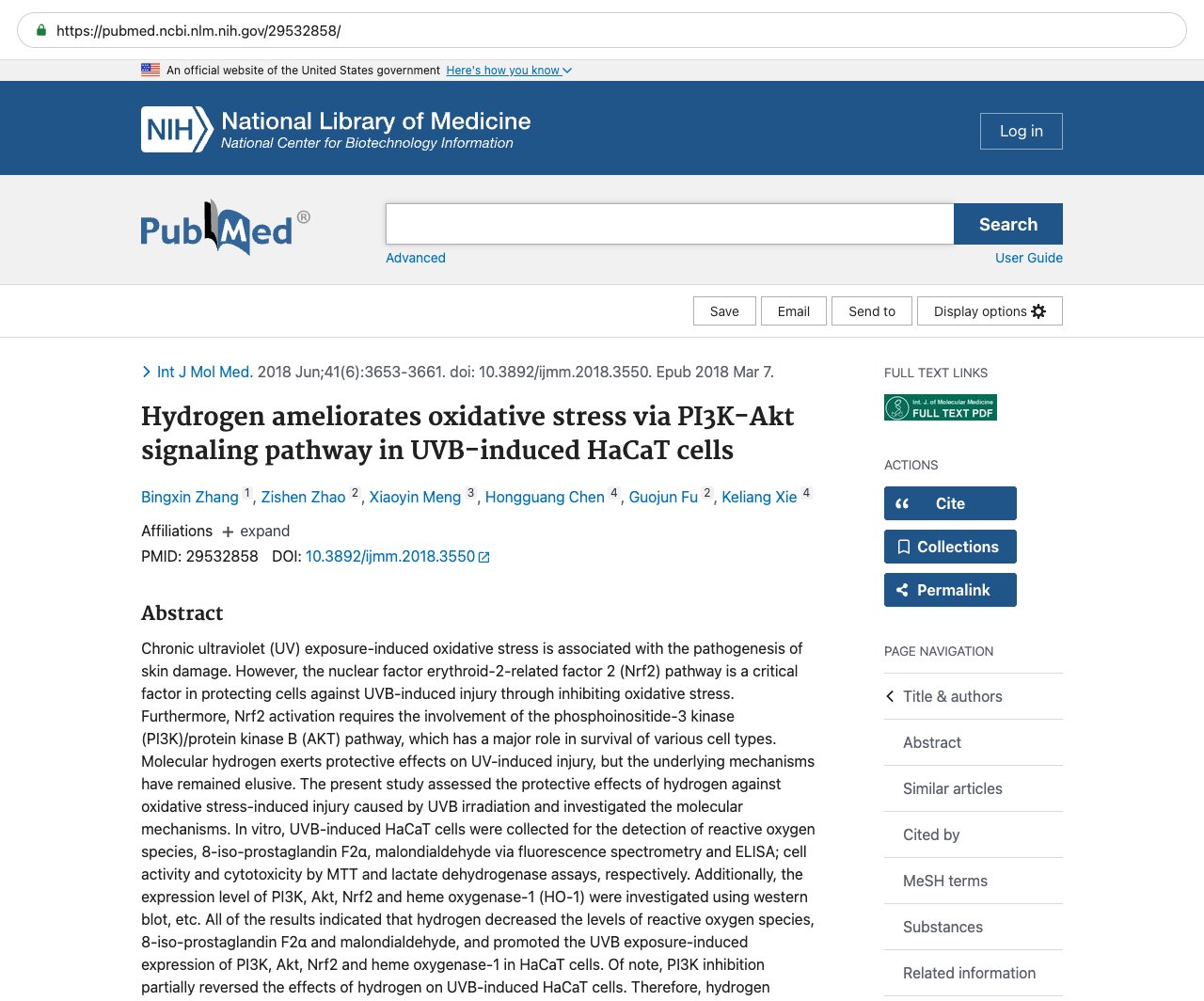
This page mirrors the published abstract (© the authors / publisher) for reference and citation. The canonical source is the PubMed record linked above. This is not medical advice.