2019 · Zhang — Hydrogen Gas Improves Photothermal Therapy of Tumor and Restrains the Relapse of Distant Dormant Tumor
Super-Abstract
A biomimetic nanoparticle (mPDAB) that releases molecular hydrogen (H₂) locally in the tumor was combined with photothermal therapy (PTT) in a mouse breast cancer model, leading to complete elimination of primary tumors and suppression of distant dormant tumor regrowth. The H₂ released by ammonia borane within the nanoparticle reduced inflammation caused by PTT and disrupted redox balance in cancer cells. These are animal/in-vitro results; human relevance is unestablished. (Biomaterials, 2019.)
Commentary
Photothermal therapy uses light-absorbing nanoparticles to generate lethal heat in tumors, but inflammation triggered by PTT can paradoxically promote distant tumor outgrowth. Zhang et al. address this by engineering a biomembrane-camouflaged nanoparticle (mPDAB) that pairs polydopamine (photothermal agent) with ammonia borane (H₂ source). The outer biomembrane improves tumor targeting and reduces systemic toxicity. In the tumor microenvironment, H₂ is released, depleting oxidants and reducing inflammation. The combined approach completely eliminated primary breast tumors and, notably, prevented outgrowth of distant dormant tumors — a clinically critical challenge. The mechanism involves H₂ disrupting redox homeostasis in cancer cells while simultaneously dampening the pro-tumorigenic inflammation. This is sophisticated nanomedicine and the results are impressive in the mouse model, but translation to humans involves enormous additional hurdles.
Key quotes
- „Ammonia borane was linked to the surface of polydopamine through the interaction of hydrogen bonding, which could destroy redox homoeostasis in tumor cells and reduce inflammation by H2 release in tumor microenvironment.“ — H₂ released locally acts on two fronts: redox disruption and inflammation reduction
- „Excellent PTT efficacy and inflammation reduction made the mPDAB completely eliminate the primary tumors, while also restraining the outgrowth of distant dormant tumors.“ — combined result: local cure plus suppression of distant relapse
- „The biomimetic nanomedicine shows potentials as a universal inflammation-self-alleviated platform to ameliorate inflammation-related disease treatment“ — broader potential claim by the authors — speculative at this stage
Our assessment
This is an animal study (mouse breast cancer model) with sophisticated in-vitro mechanistic support. The results — complete primary tumor elimination and dormant tumor suppression — are striking. However, honest limitations apply: (1) mouse xenograft models do not replicate the complexity of human breast cancer; (2) the nanoparticle formulation has not been tested in humans; (3) long-term toxicity and biodistribution of mPDAB are not addressed; (4) the dormant tumor model used here is a specific experimental setup — clinical distant metastasis is far more complex. This paper represents innovative preclinical nanomedicine research, not evidence for H₂ therapy in human cancer. No health claims should be derived from it.
Study design
- Type: animal study (in vivo) + in-vitro mechanistic assays · Model: mouse subcutaneous breast tumor xenograft; in-vitro cancer cell lines · H₂ delivery: local release from ammonia borane within mPDAB nanoparticle at tumor site
- PTT: polydopamine photothermal agent + 808 nm laser irradiation
- Result: mPDAB + PTT: complete primary tumor elimination; distant dormant tumor outgrowth suppressed; reduced inflammation and redox disruption in tumor microenvironment; low systemic toxicity
Abstract
Inflammation during photothermal therapy (PTT) of tumor usually results in adverse consequences. Here, a biomembrane camouflaged nanomedicine (mPDAB) containing polydopamine and ammonia borane was designed to enhance PTT efficacy and mitigate inflammation. Polydopamine, a biocompatible photothermal agent, can effectively convert light into heat for PTT. Ammonia borane was linked to the surface of polydopamine through the interaction of hydrogen bonding, which could destroy redox homoeostasis in tumor cells and reduce inflammation by H2 release in tumor microenvironment. Owing to the same origin of outer biomembranes, mPDAB showed excellent tumor accumulation and low systemic toxicity in a breast tumor model. Excellent PTT efficacy and inflammation reduction made the mPDAB completely eliminate the primary tumors, while also restraining the outgrowth of distant dormant tumors. The biomimetic nanomedicine shows potentials as a universal inflammation-self-alleviated platform to ameliorate inflammation-related disease treatment, including but not limited to PTT for tumor.
Source & links
Screenshot of the PubMed page
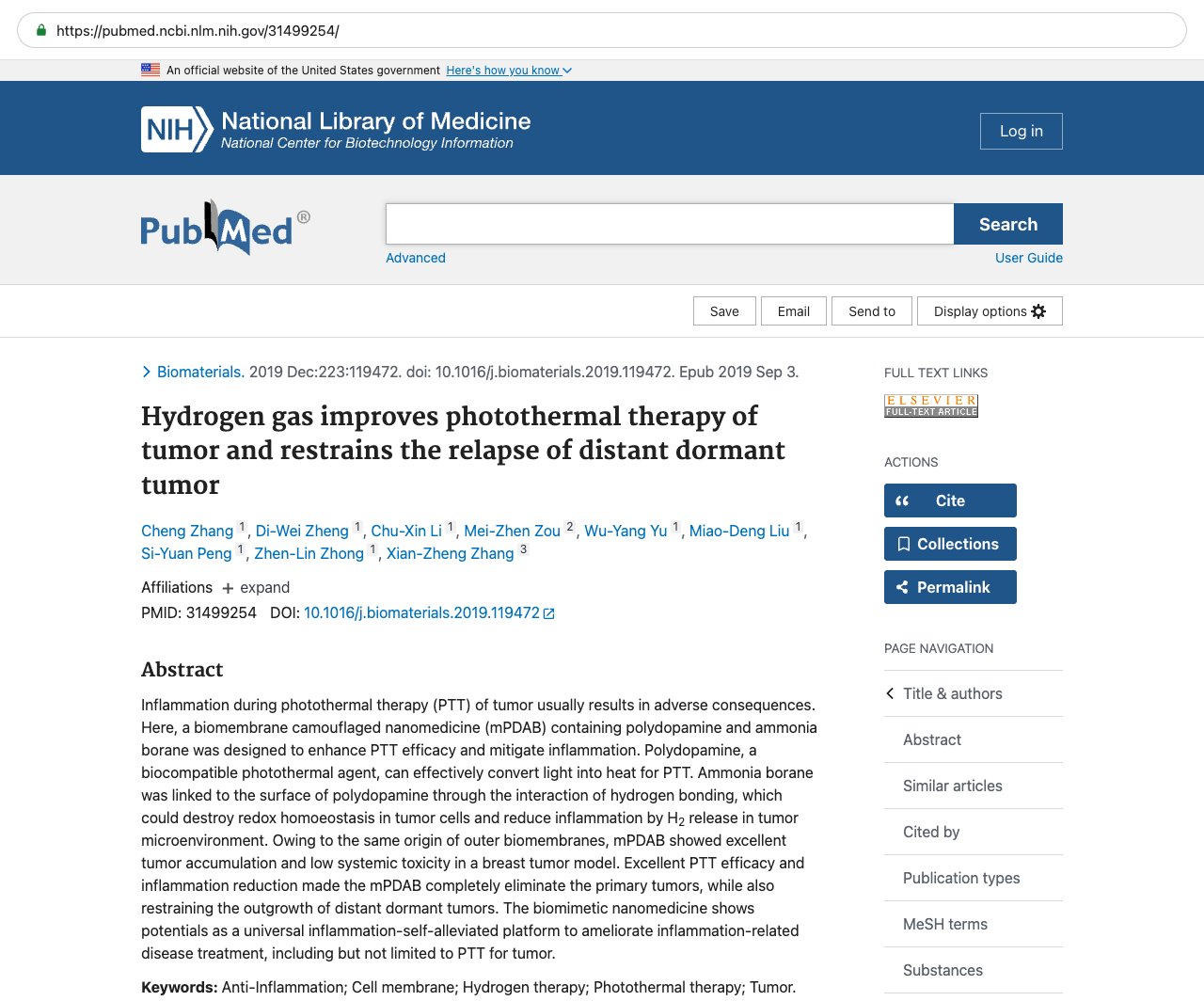
This page mirrors the published abstract (© the authors / publisher) for reference and citation. The canonical source is the PubMed record linked above. This is not medical advice.