2011 · Zheng et al. — Hydrogen resuscitation, a new cytoprotective approach.
Super-Abstract
Oxidative injury — from ischemia-reperfusion, inflammation, trauma, or toxins — damages cells, tissues, and organs by unleashing reactive oxygen species. This review introduces the concept of „hydrogen resuscitation”: using molecular hydrogen (H₂) as a cytoprotective intervention to protect cells from oxidative damage and help restore function. The review covers three delivery routes (inhalation, hydrogen-enriched fluid, endogenous bacterial production) and surveys preclinical evidence across multiple injury models. As a review, it synthesizes existing literature rather than reporting new experiments.
Commentary
The concept of „hydrogen resuscitation” coined by Zheng et al. is a useful framing: rather than treating disease with H₂ as a pharmacological agent, the approach is defensive — using H₂'s radical-scavenging properties to protect vulnerable tissue during acute oxidative injury events (ischemia-reperfusion, organ transplantation, sepsis, trauma). The review is comprehensive for its time (2011) and covers diverse disease models. Key mechanistic insight: the primary mechanism is selective elimination of hydroxyl radicals (•OH), but the authors note that other mechanisms (H₂ as a signaling molecule) may also contribute. The review also helpfully identifies the key limitations: the precise mechanism underlying H₂'s effects was still unclear, and clinical validation was needed. The authors are appropriately measured in their enthusiasm, noting that „more work is needed to identify the precise mechanism... and to validate its therapeutic potential in the clinical setting.”
Key quotes
- „hydrogen is a potent anti-oxidative, anti-apoptotic and anti-inflammatory agent and so may have potential medical application.“ — the three core therapeutic properties attributed to H₂
- „Studies have shown that hydrogen resuscitation has cytoprotective effects in different cell types and disease models, including ischaemia-reperfusion injury, inflammation, toxicity, trauma and metabolic disease.“ — the breadth of preclinical models supporting H₂ cytoprotection
- „more work is needed to identify the precise mechanism underlying the actions of hydrogen and to validate its therapeutic potential in the clinical setting.“ — the authors' honest conclusion: preclinical promise, clinical validation pending
Our assessment
This is a narrative review synthesizing preclinical evidence for H₂ as a cytoprotective agent across multiple oxidative injury models. It is well-structured and honest about limitations: the mechanistic picture was incomplete in 2011, and clinical validation had not been established. The evidence presented is predominantly preclinical (animal and cell studies); clinical data are not the focus. The review is useful as a conceptual framework for H₂ resuscitation research and for understanding the state of the field in 2011. Readers should note that substantial further clinical research has occurred since this review was published.
Study design
- Type: narrative review · n: n/a (literature synthesis) · H₂ delivery routes reviewed: inhalation, hydrogen-enriched fluid (oral/IV), modulation of endogenous intestinal bacterial H₂ production
- Result: no new experimental data; surveys cytoprotective evidence across ischemia-reperfusion, inflammation, toxicity, trauma, and metabolic disease models; identifies •OH scavenging as primary mechanism with possible additional signaling roles; calls for clinical validation
Abstract
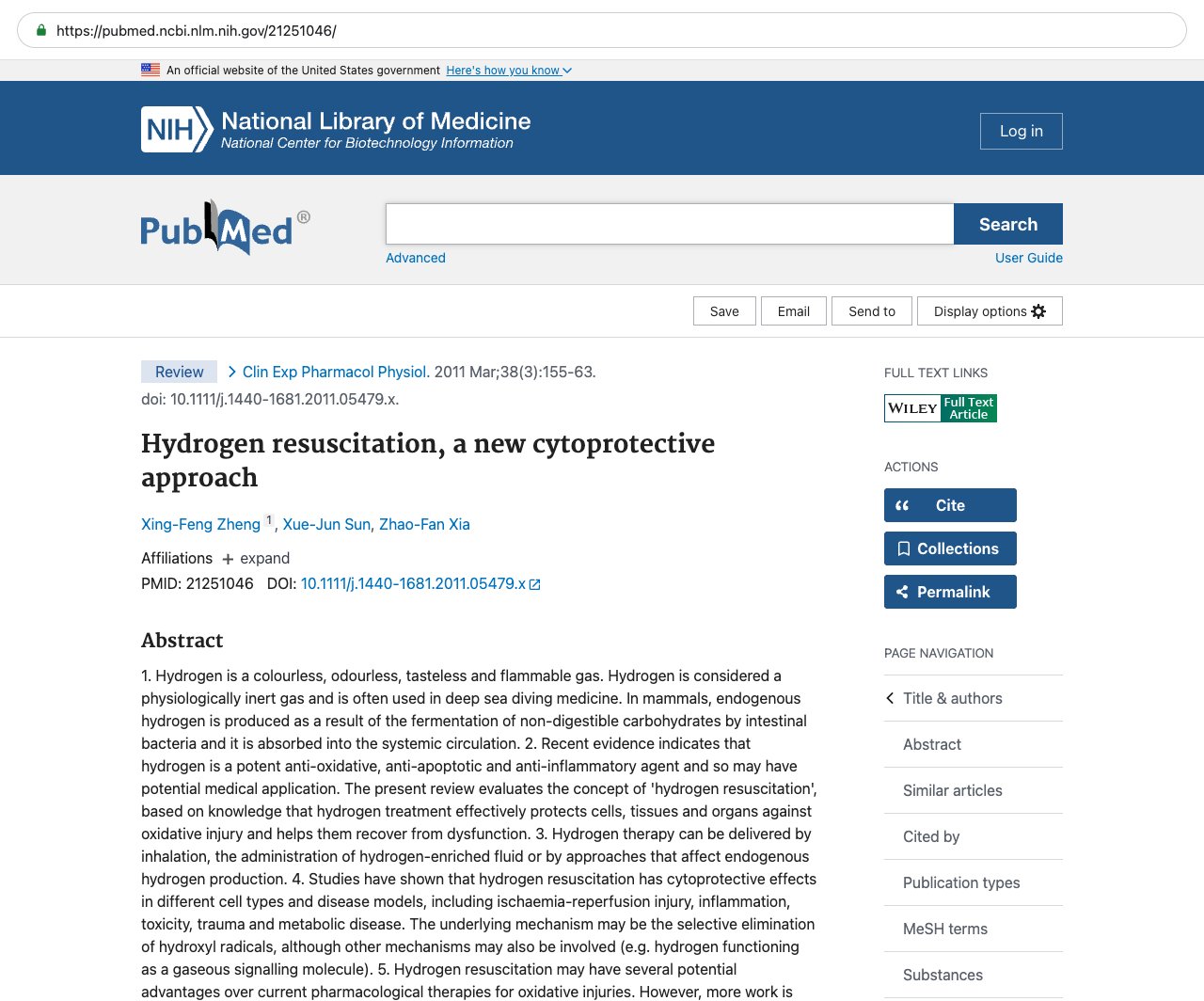
1. Hydrogen is a colourless, odourless, tasteless and flammable gas. Hydrogen is considered a physiologically inert gas and is often used in deep sea diving medicine. In mammals, endogenous hydrogen is produced as a result of the fermentation of non-digestible carbohydrates by intestinal bacteria and it is absorbed into the systemic circulation. 2. Recent evidence indicates that hydrogen is a potent anti-oxidative, anti-apoptotic and anti-inflammatory agent and so may have potential medical application. The present review evaluates the concept of 'hydrogen resuscitation', based on knowledge that hydrogen treatment effectively protects cells, tissues and organs against oxidative injury and helps them recover from dysfunction. 3. Hydrogen therapy can be delivered by inhalation, the administration of hydrogen-enriched fluid or by approaches that affect endogenous hydrogen production. 4. Studies have shown that hydrogen resuscitation has cytoprotective effects in different cell types and disease models, including ischaemia-reperfusion injury, inflammation, toxicity, trauma and metabolic disease. The underlying mechanism may be the selective elimination of hydroxyl radicals, although other mechanisms may also be involved (e.g. hydrogen functioning as a gaseous signalling molecule). 5. Hydrogen resuscitation may have several potential advantages over current pharmacological therapies for oxidative injuries. However, more work is needed to identify the precise mechanism underlying the actions of hydrogen and to validate its therapeutic potential in the clinical setting.
Source & links
Screenshot of the PubMed page
This page mirrors the published abstract (© the authors / publisher) for reference and citation. The canonical source is the PubMed record linked above. This is not medical advice.