2024 Biomedicine & pharmacotherapy = Biomedecine & pharmacotherapie Review / Meta-analysis Unspecified
2024 · Zheng — Potential Role of Molecular Hydrogen Therapy on Oxidative Stress and Redox Signaling in Chronic Kidney Disease
Super-Abstract
Chronic kidney disease (CKD) is driven in large part by oxidative stress — and current therapies to slow its progression remain inadequate. This review examines how molecular hydrogen (H₂) could address CKD by activating the NRF2-KEAP1 antioxidant defence system, modulating NF-κB inflammation, regulating HIF signalling, and influencing FOXO transcription factors. The authors acknowledge that while preclinical results are encouraging, clinical trials in CKD are still scarce and further investigation is needed. This is a literature review.
Commentary
CKD affects hundreds of millions of people globally and its progression — from damaged kidney cells through fibrosis to end-stage renal failure — is tightly coupled to chronic oxidative stress and inflammation. Existing antioxidant therapies have produced mixed results. This review makes a mechanistically detailed case for H₂ as an adjunct therapy in CKD: H₂ selectively scavenges ·OH and ONOO⁻, and crucially activates the NRF2-KEAP1 pathway — the master regulator of cellular antioxidant defence — via both the Wnt/β-catenin route and indirect mitochondrial activation. The authors also trace H₂'s suppression of the NF-κB inflammatory cascade, HIF signalling modulation, and effects on FOXO transcription factors. The mechanistic depth here is considerable. The important caveat: clinical CKD trials are sparse, and bench study results cannot be directly transposed to human kidneys with their complex fibrotic and inflammatory remodelling.
Key quotes
- „H2 is capable of capturing harmful •OH and ONOO- while maintaining the crucial reactive oxygen species (ROS) involved in cellular signaling.“ — selective ROS scavenging — the mechanistic foundation of H₂ therapy
- „H2 activates this pathway, fortifying antioxidant defenses and scavenging ROS to counteract oxidative stress.“ — NRF2-KEAP1 pathway activation as a key mechanism in CKD protection
- „Despite the encouraging results of bench studies, clinical trials are still limited and require further investigation.“ — honest limitation: bench evidence outpaces clinical evidence in CKD
Our assessment
This is a mechanistically detailed narrative review that makes a coherent case for H₂ as a candidate adjunct therapy in CKD via multiple redox-signalling pathways. The strength is the pathway-level mechanistic analysis; the weakness is that clinical evidence for H₂ in CKD is sparse and the review does not perform systematic effect-size quantification. The authors appropriately flag this gap. Until adequately powered randomised CKD trials with H₂ are available, clinical conclusions remain provisional.
Study design
- Type: narrative review · n: n/a (literature synthesis) · H₂ delivery: multiple modalities referenced (exact forms not specified in abstract)
- Result: no pooled effect sizes; mechanistic analysis identifies NRF2-KEAP1, NF-κB, HIF, and FOXO pathways as H₂ targets in CKD; preclinical evidence encouraging but clinical trials limited
Abstract
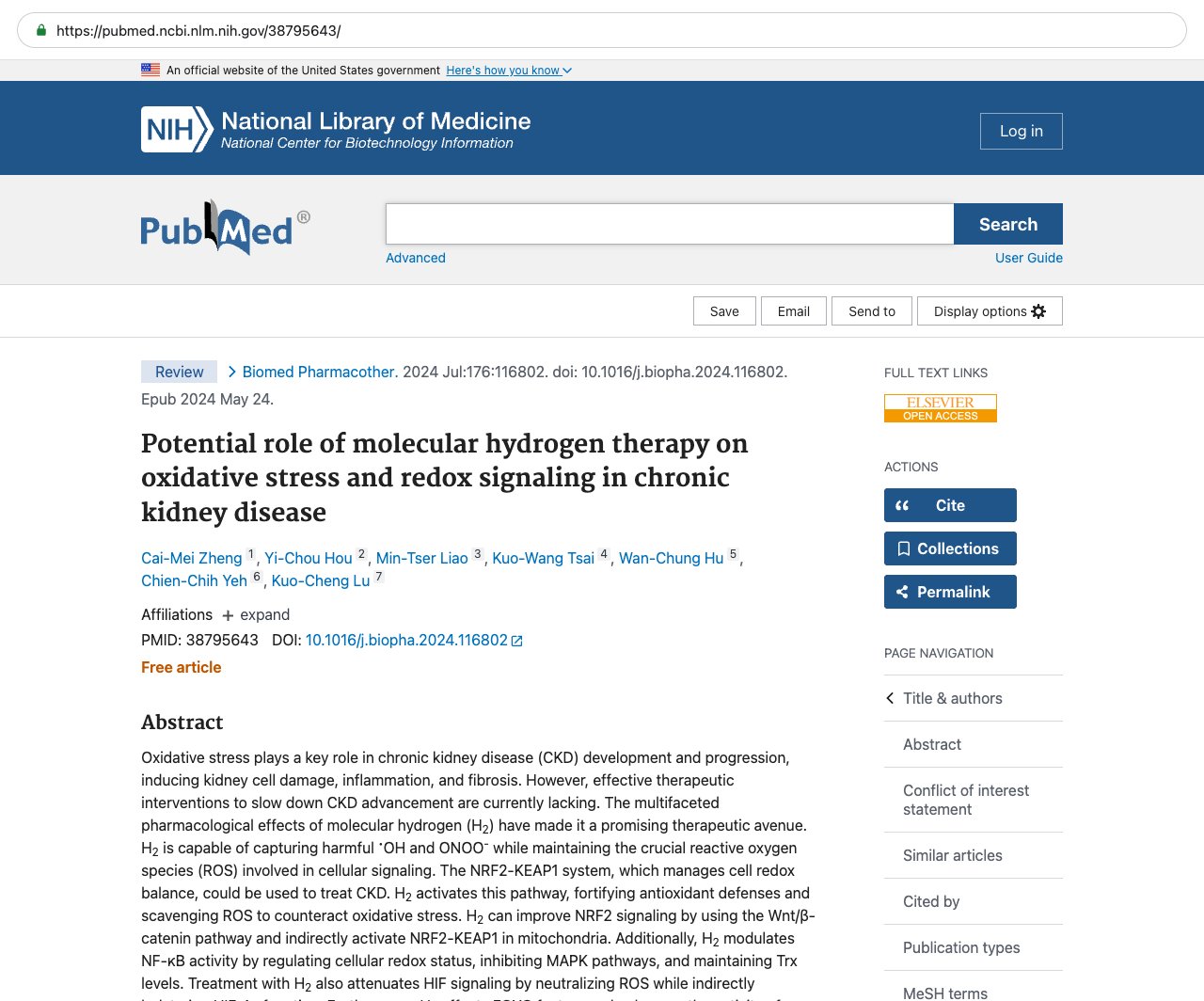
Oxidative stress plays a key role in chronic kidney disease (CKD) development and progression, inducing kidney cell damage, inflammation, and fibrosis. However, effective therapeutic interventions to slow down CKD advancement are currently lacking. The multifaceted pharmacological effects of molecular hydrogen (H2) have made it a promising therapeutic avenue. H2 is capable of capturing harmful •OH and ONOO- while maintaining the crucial reactive oxygen species (ROS) involved in cellular signaling. The NRF2-KEAP1 system, which manages cell redox balance, could be used to treat CKD. H2 activates this pathway, fortifying antioxidant defenses and scavenging ROS to counteract oxidative stress. H2 can improve NRF2 signaling by using the Wnt/β-catenin pathway and indirectly activate NRF2-KEAP1 in mitochondria. Additionally, H2 modulates NF-κB activity by regulating cellular redox status, inhibiting MAPK pathways, and maintaining Trx levels. Treatment with H2 also attenuates HIF signaling by neutralizing ROS while indirectly bolstering HIF-1α function. Furthermore, H2 affects FOXO factors and enhances the activity of antioxidant enzymes. Despite the encouraging results of bench studies, clinical trials are still limited and require further investigation. The focus of this review is on hydrogen's role in treating renal diseases, with a specific focus on oxidative stress and redox signaling regulation, and it discusses its potential clinical applications.
Source & links
Screenshot of the PubMed page
This page mirrors the published abstract (© the authors / publisher) for reference and citation. The canonical source is the PubMed record linked above. This is not medical advice.