2019 · Zhou — Micro/Nanomaterials-Augmented Hydrogen Therapy
Super-Abstract
Nanomedicine for hydrogen: H₂ works in oxidative-inflammatory diseases, but diffuses without direction and dissolves poorly in water. This review article shows how micro/nanomaterials can deliver H₂ to the target, release it in a controlled way, and amplify its effect. (Advanced Healthcare Materials, 2019.)
Commentary
This conceptual review article addresses an honest weakness of H₂ therapy: hydrogen is safe — unlike NO, CO or H₂S it does not poison the blood even at high concentration, because it does not impair the oxygen transport of the red blood cells — but it dissolves only poorly in water and diffuses fast and aimlessly. This limits how much H₂ actually arrives at the diseased site. The authors therefore propose the concept of „hydrogen nanomedicine“: functional micro- and nanomaterials that transport H₂ specifically to the target tissue, release it there in a controlled manner, and amplify its effect via catalytic or combined (multimodal) approaches. This is good evidence that H₂ research thinks beyond simple drinking water toward precise drug delivery. Staying honest: this is a <strong>review/concept paper</strong>, not an original study — it provides ideas and strategies, not clinical endpoints.
Key quotes
- „hydrogen gas has no blood poisoning risk at high concentration because it does not affect the oxygen-carrying behavior of blood red cells.“ — the central safety argument for H₂
- „Hydrogen molecules also have low aqueous solubility and high but aimless diffusibility, causing limited therapy efficacy in many diseases.“ — the honestly stated limitation of H₂ therapy
- „a concept of hydrogen nanomedicine to address the issues of hydrogen medicine by using functional micro/nanomaterials for augmented hydrogen therapy is proposed.“ — the core idea of the review
Our assessment
A useful review that does two things at once: it reaffirms the strong safety profile of H₂ (no blood poisoning even at high concentration) and openly names the pharmacological weakness (low solubility, aimless diffusion). For us this is doubly valuable — the safety argument is directly usable, the limitation helps stay realistic. The nanomaterial strategies presented, however, are research concepts, far removed from everyday H₂ water. Limitation, stated honestly: narrative review/concept paper (evidence level 4), no own data, no proof of clinical benefit; the described nano approaches are experimental.
Study design
- Type: narrative review/concept paper · n: n/a (literature synthesis) · Duration: n/a · H₂ delivery: nanomaterial-based targeted delivery and controlled release are discussed
- Result metrics: no own measurements; the contribution is a strategic framework for „hydrogen nanomedicine“
Abstract
Hydrogen therapy is an emerging and promising therapy strategy of using molecular hydrogen as a new type of safe and effective therapeutic agent, exhibiting remarkable therapeutic effects on many oxidative stress-/inflammation-related diseases owing to its bio-reductivity and homeostatic regulation ability. Different from other gaseous transmitters such as NO, CO, and H2 S, hydrogen gas has no blood poisoning risk at high concentration because it does not affect the oxygen-carrying behavior of blood red cells. Hydrogen molecules also have low aqueous solubility and high but aimless diffusibility, causing limited therapy efficacy in many diseases. To realize the site-specific hydrogen delivery, controlled hydrogen release and combined therapy is significant but still challenging. Here, a concept of hydrogen nanomedicine to address the issues of hydrogen medicine by using functional micro/nanomaterials for augmented hydrogen therapy is proposed. In this review, various strategies of micro/nanomaterials-augmented hydrogen therapy, including micro/nanomaterials-mediated targeted hydrogen delivery, controlled hydrogen release, and nanocatalytic and multimodel enhancement of hydrogen therapy efficacy, are summarized, which can open a new window for treatment of inflammation-related diseases.
Source & links
Screenshot of the PubMed page
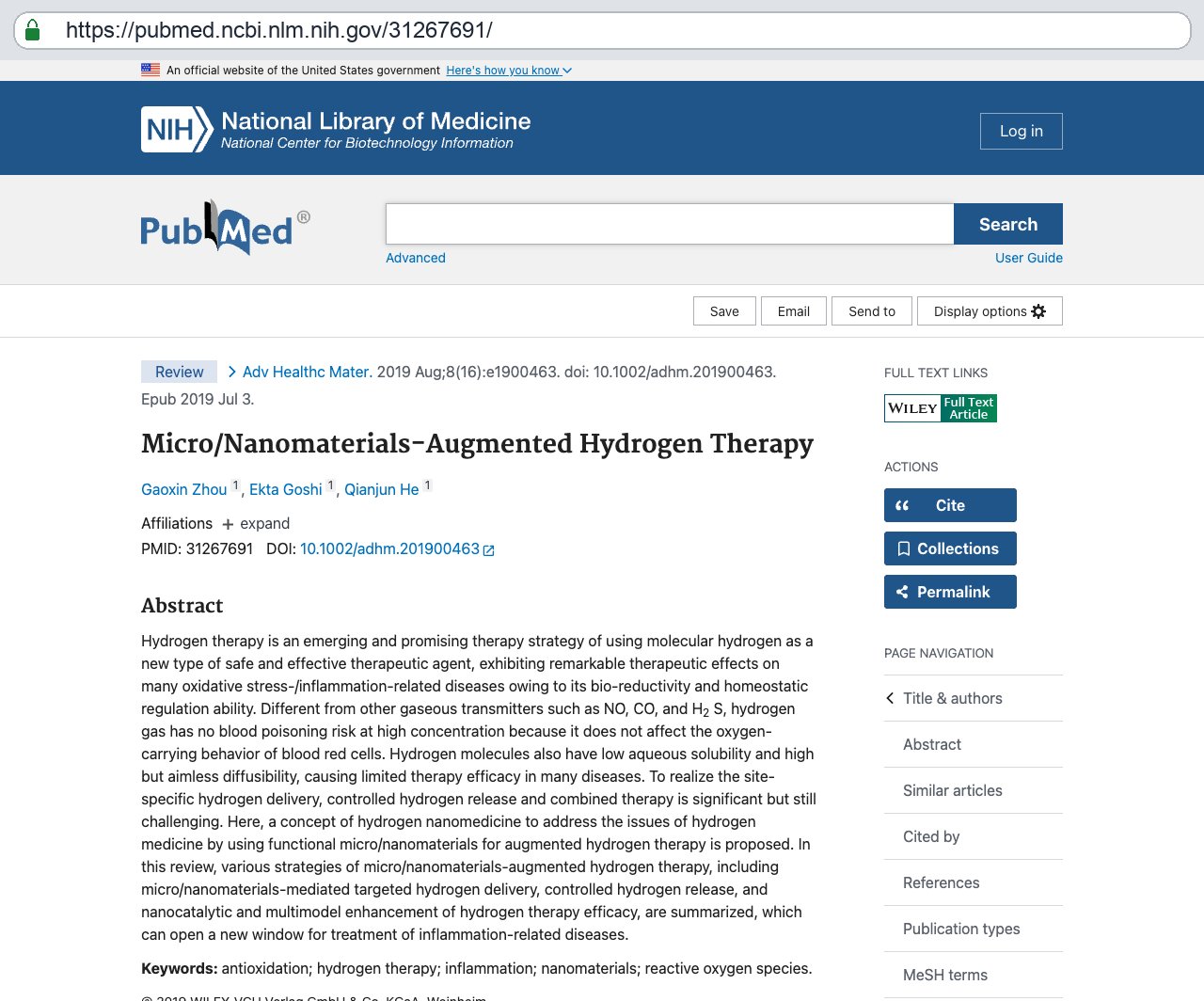
This page mirrors the published abstract (© the authors / publisher) for reference and citation. The canonical source is the PubMed record linked above. This is not medical advice.