2023 · Zhu — Inorganic Nanosheet-Shielded Probiotics: A Self-Adaptable Oral Delivery System for Intestinal Disease Treatment
Super-Abstract
Researchers developed a nanomaterial coating for probiotic bacteria that resists stomach acid, then spontaneously degrades in the intestine to release hydrogen gas — simultaneously exposing the probiotics for their anti-inflammatory effect on colitis. The concept was tested in an in-vitro and cell-based setting. No animal or human studies were conducted.
Commentary
Oral delivery of live probiotics is hampered by the harsh gastric environment; many bacteria die before reaching the intestine. This paper engineers an elegant dual-function material: SiH@TPGS-PEI, a silicon hydride (H-silicene) nanosheet modified with amphiphilic polymers that electrostatically coat bacteria. In the acidic stomach, the coating protects; in the near-neutral intestine, it degrades by reacting with water to release H₂ and expose the now-active probiotics. The in-vitro data demonstrate pH-triggered H₂ release and probiotic survival. A colitis cell model is used to test efficacy. The H₂ release is positioned as an additional anti-inflammatory benefit alongside the probiotics themselves. This is a materials-science proof-of-concept; actual colitis treatment in living organisms requires animal and then human studies.
Key quotes
- „SiH@TPGS-PEI electrostatically coated on the surface of probiotic bacteria helps to resist erosive destruction in the acidic stomach and spontaneously degrades by reacting with water to generate hydrogen, an anti-inflammatory gas in response to the neutral/weakly alkaline intestinal environment.“ — core mechanism of the pH-responsive dual-function coating
- „Thus exposing the probiotic bacteria for colitis amelioration.“ — degradation of the coating releases both H₂ and active probiotics at the target site
- „This strategy may shed new light on the development of intelligent self-adaptive materials.“ — authors frame this as a materials innovation, not a clinical intervention
Our assessment
This is an in-vitro/materials science proof-of-concept study. The concept of combining H₂ release with probiotic delivery in a pH-responsive nanocoating is creative. However, there are no animal data, no pharmacokinetics in a living gut, and no safety data for the SiH nanomaterial in humans. The path from this lab concept to a usable intestinal treatment is long. Results cannot be applied to any clinical context at this stage.
Study design
- Type: in-vitro / materials science proof-of-concept · n: cell experiments (no animal or human subjects) · H₂ delivery: spontaneous H₂ release from H-silicene nanosheets upon contact with neutral/alkaline water
- Result: pH-triggered H₂ release confirmed in vitro; probiotic viability preserved in simulated gastric conditions; colitis cell model showed amelioration; no in-vivo data
Abstract
The oral delivery of probiotics is commonly adopted for intestinal disease treatments in clinical settings; however, the probiotics suffer from a strong acidic attack in the gastric area and the low-efficiency intestinal colonization of naked probiotics. Coating living probiotics with synthetic materials has proven effective in enabling the adaption of bacteria to gastrointestinal environments, which, unfortunately, may shield the probiotics from initiating therapeutic responses. In this study, we report a copolymer-modified two-dimensional H-silicene nanomaterial (termed SiH@TPGS-PEI) that can facilitate probiotics to adapt to diverse gastrointestinal microenvironments on-demand. Briefly, SiH@TPGS-PEI electrostatically coated on the surface of probiotic bacteria helps to resist erosive destruction in the acidic stomach and spontaneously degrades by reacting with water to generate hydrogen, an anti-inflammatory gas in response to the neutral/weakly alkaline intestinal environment, thus exposing the probiotic bacteria for colitis amelioration. This strategy may shed new light on the development of intelligent self-adaptive materials.
Source & links
Screenshot of the PubMed page
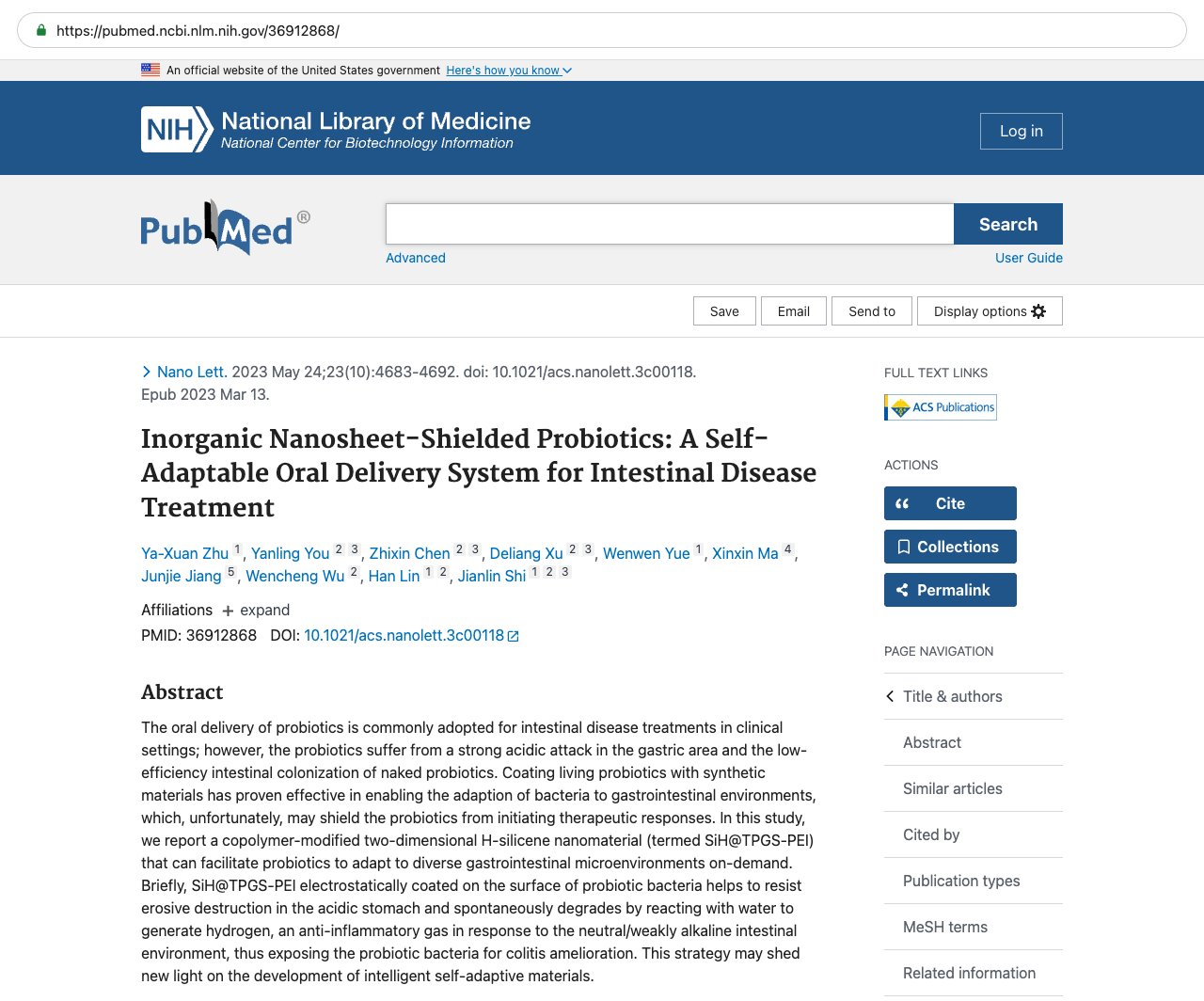
This page mirrors the published abstract (© the authors / publisher) for reference and citation. The canonical source is the PubMed record linked above. This is not medical advice.