2020 · Zhuang — Molecular hydrogen attenuates sepsis-induced neuroinflammation through regulation of microglia polarization through an mTOR-autophagy-dependent pathway.
Super-Abstract
In both a mouse sepsis model (cecal ligation and puncture) and LPS-stimulated BV-2 microglial cells, inhaled hydrogen reduced neuroinflammation, shifted microglia from a pro-inflammatory (M1) to an anti-inflammatory (M2) state, and improved cognitive function. The protective mechanism involved suppression of the mTOR pathway and activation of autophagy. These are animal and cell-culture results; clinical applicability in humans remains to be established.
Commentary
Sepsis-associated encephalopathy (SAE) is a severe complication of sepsis causing cognitive impairment with high mortality. This study addresses a specific question: does hydrogen inhalation protect the brain during sepsis, and if so, how? The two-arm design — an in-vivo mouse model (CLP) plus an in-vitro BV-2 cell model — strengthens the mechanistic story. The authors show that hydrogen shifts microglia from the inflammatory M1 phenotype to the resolving M2 phenotype, reduces TNF-α, IL-6 and HMGB1, increases IL-10 and TGF-β, and does so by suppressing mTOR and activating autophagy (LC3II/LC3I, Beclin-1, TREM-2). The confirmation experiment — adding an mTOR activator (MHY1485) abolished hydrogen's protection — is a clean mechanistic control. Limitations: CLP is a severe, non-reversible sepsis model; results in mice and cell lines do not translate directly to human SAE treatment.
Key quotes
- „Hydrogen inhalation attenuated sepsis-induced cognitive impairment with improved escape latency, time spent in the target platform quadrant and number of times crossing the target platform.“ — cognitive function improved in septic mice receiving H₂ inhalation
- „hydrogen reduced TNF-α, IL-6 and HMGB1 levels and M1 polarization, but increased IL-10 and TGF-β levels and M2 polarization.“ — H₂ shifted the inflammatory balance from pro- to anti-inflammatory
- „these results demonstrated that hydrogen attenuated sepsis-induced neuroinflammation by modulating microglia polarization, which was mediated by the mTOR-autophagy signaling pathway.“ — the identified mechanism: mTOR-autophagy controls microglial polarization
Our assessment
This is an animal + cell-culture study — not a human trial. The combination of an in-vivo CLP mouse model with an in-vitro BV-2 cell model provides convergent mechanistic evidence for H₂ in neuroinflammation from sepsis. The mTOR-autophagy pathway is a credible and well-established target. Limitations: mouse CLP is an extreme sepsis model; BV-2 cells are a simplified microglial surrogate. Translation to human SAE is uncertain and requires clinical investigation. No clinical claims are justified from these data alone.
Study design
- Type: animal study (in-vivo) + cell study (in-vitro) · Model: mice, cecal ligation and puncture (CLP) sepsis; BV-2 microglial cells + LPS 1 µg/ml · H₂ delivery: inhalation (mice); hydrogen-rich medium (cells)
- Outcome (in-vivo): improved Morris Water Maze performance, reduced M1 microglia, lower TNF-α/IL-6/HMGB1, higher IL-10/TGF-β · Outcome (in-vitro): same cytokine shifts, suppressed p-mTOR/p62, increased LC3II/LC3I and Beclin-1; mTOR activator MHY1485 abolished H₂ protection
Abstract
Sepsis-associated encephalopathy (SAE) is the cognitive impairment resulting from sepsis and is associated with increased morbidity and mortality. Hydrogen has emerged as a promising therapeutic agent to alleviate SAE. The mechanism, however, remains unclear. This research aimed to determine whether hydrogen alleviates SAE by regulating microglia polarization and whether it is mediated by the mammalian target of rapamycin (mTOR)-autophagy pathway. Septic models were established by cecal ligation and puncture (CLP) performed on mice. The Morris Water Maze was used to evaluate cognitive function. M1/M2 microglia polarization was assessed by immunofluorescence. Inflammatory cytokines were determined by ELISA. Septic cell models were established using BV-2 cells incubated with 1 μg/ml lipopolysaccharide (LPS). M1/M2 microglia polarization was assessed by flow cytometry. Inflammatory cytokines from culture medium supernatant were determined by ELISA, and associated protein expression levels of mTOR-autophagy pathway were assessed by Western blot. Hydrogen inhalation attenuated sepsis-induced cognitive impairment with improved escape latency, time spent in the target platform quadrant and number of times crossing the target platform. In both animal and cell research, hydrogen reduced TNF-α, IL-6 and HMGB1 levels and M1 polarization, but increased IL-10 and TGF-β levels and M2 polarization. Hydrogen treatment decreased the ratio of p-mTOR/mTOR and the expression of p62 and increased the ratio of p-AMPK/AMPK, LC3II/LC3I and the expression of TREM-2 and Beclin-1 in LPS-treated BV-2 cells. MHY1485, an mTOR activator, abolished the protective effects of hydrogen in vitro. Taken together, these results demonstrated that hydrogen attenuated sepsis-induced neuroinflammation by modulating microglia polarization, which was mediated by the mTOR-autophagy signaling pathway.
Source & links
Screenshot of the PubMed page
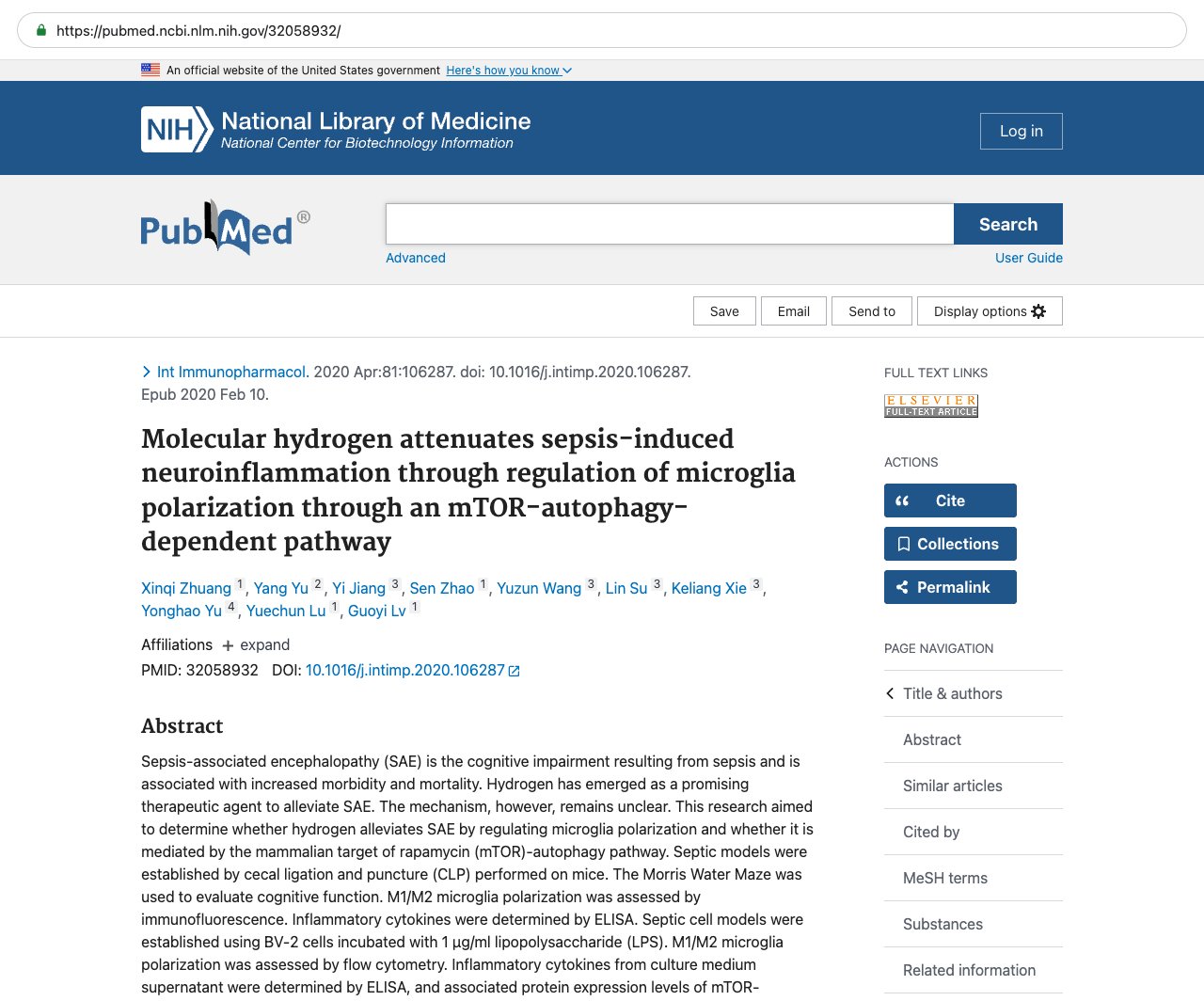
This page mirrors the published abstract (© the authors / publisher) for reference and citation. The canonical source is the PubMed record linked above. This is not medical advice.