2011 · Acuña Castroviejo — Melatonin-Mitochondria Interplay in Health and Disease
Super-Abstract
This review examines how melatonin interacts with mitochondria to counteract oxidative and nitrosative stress — one of the core mechanisms underlying a wide range of diseases. The „hydrogen hypothesis“ of mitochondrial origin is discussed as part of the evolutionary background. The review synthesises experimental and clinical evidence for melatonin's protective role in mitochondrial dysfunction. (Current Topics in Medicinal Chemistry, 2011.)
Commentary
Mitochondria are far more than the cell's power plants: they regulate life and death, produce heat, generate reactive oxygen species (ROS) as a byproduct of respiration, and harbour their own genome. This review situates melatonin — a well-known antioxidant and anti-inflammatory hormone — within this mitochondrial context. It covers the evolutionary „hydrogen hypothesis“ of mitochondrial origin (an anaerobic host acquiring a hydrogen-producing symbiont), the dual role of mitochondria in energy production and programmed cell death, and the mounting evidence that mitochondrial dysfunction underlies neurodegenerative and neuromuscular diseases. Melatonin is presented as a molecule that can attenuate both oxidative (ROS-driven) and nitrosative (peroxynitrite-driven) damage within mitochondria. The paper does not address molecular hydrogen (H₂) therapeutics directly; the „hydrogen hypothesis“ in the abstract refers to evolutionary theory. This distinction is important for proper contextualisation.
Key quotes
- „Melatonin is a known powerful antioxidant and anti-inflammatory and increasing experimental and clinical evidence shows its beneficial effects against oxidative/nitrosative stress status, including that involving mitochondrial dysfunction.“ — the central claim: melatonin protects against mitochondrial oxidative/nitrosative damage
- „mitochondria possess nitric oxide (NO·) for regulatory purposes but, in some instances it may react with superoxide anion radical to produce the toxic reactive nitrogen species (RNS), i.e. peroxynitrite anion, and the subsequent nitrosative damage.“ — how mitochondrial NO can become damaging under stress
- „The 'hydrogen hypothesis' invokes metabolic symbiosis as the driving force for a symbiotic association between an anaerobic, strictly hydrogen-dependent (the host) and an eubacterium (the symbiont) that was able to respire.“ — evolutionary context for mitochondrial origin — not a therapeutic H₂ statement
Our assessment
This is a narrative review, not a clinical trial or controlled experiment. It synthesises existing data on melatonin and mitochondria. The conclusions about melatonin's benefits rest on a broad base of experimental (mostly animal and cell culture) and some clinical evidence. Importantly: the „hydrogen hypothesis“ mentioned in this paper is an evolutionary theory about mitochondrial origins — it has no direct bearing on molecular hydrogen therapy. Readers should not confuse these two distinct uses of the word „hydrogen“. The review provides useful mechanistic background but does not establish clinical efficacy for any specific therapy in humans by itself.
Study design
- Type: narrative review · n: n/a (literature synthesis) · H₂ relevance: indirect — „hydrogen hypothesis“ refers to evolutionary theory of mitochondrial origin, not H₂ therapy
- Result: synthesises evidence that melatonin attenuates ROS/RNS-induced mitochondrial damage; relevant to understanding oxidative stress biology but does not test H₂ interventions
Abstract
Although two main hypotheses of mitochondrial origin have been proposed, i.e., the autogenous and the endosymbiotic, only the second is being seriously considered currently. The 'hydrogen hypothesis' invokes metabolic symbiosis as the driving force for a symbiotic association between an anaerobic, strictly hydrogen-dependent (the host) and an eubacterium (the symbiont) that was able to respire, but which generated molecular hydrogen as an end product of anaerobic metabolism. The resulting proto-eukaryotic cell would have acquired the essentials of eukaryotic energy metabolism, evolving not only aerobic respiration, but also the physiological cost of the oxygen consumption, i.e., generation of reactive oxygen species (ROS) and the associated oxidative damage. This is not the only price to pay for respiring oxygen: mitochondria possess nitric oxide (NO·) for regulatory purposes but, in some instances it may react with superoxide anion radical to produce the toxic reactive nitrogen species (RNS), i.e. peroxynitrite anion, and the subsequent nitrosative damage. New mitochondria contain their own genome with a modified genetic code that is highly conserved among mammals. The transcription of certain mitochondrial genes may depend on the redox potential of the mitochondrial membrane. Mitochondria are related to the life and death of cells. They are involved in energy production and conservation, having an uncoupling mechanism to produce heat instead of ATP, but they are also involved in programmed cell death. Increasing evidence suggest the participation of mitochondria in neurodegenerative and neuromuscular diseases involving alterations in both nuclear (nDNA) and mitochondrial (mtDNA) DNA. Melatonin is a known powerful antioxidant and anti-inflammatory and increasing experimental and clinical evidence shows its beneficial effects against oxidative/nitrosative stress status, including that involving mitochondrial dysfunction. This review summarizes the data and mechanisms of action of melatonin in relation to mitochondrial pathologies.
Source & links
Screenshot of the PubMed page
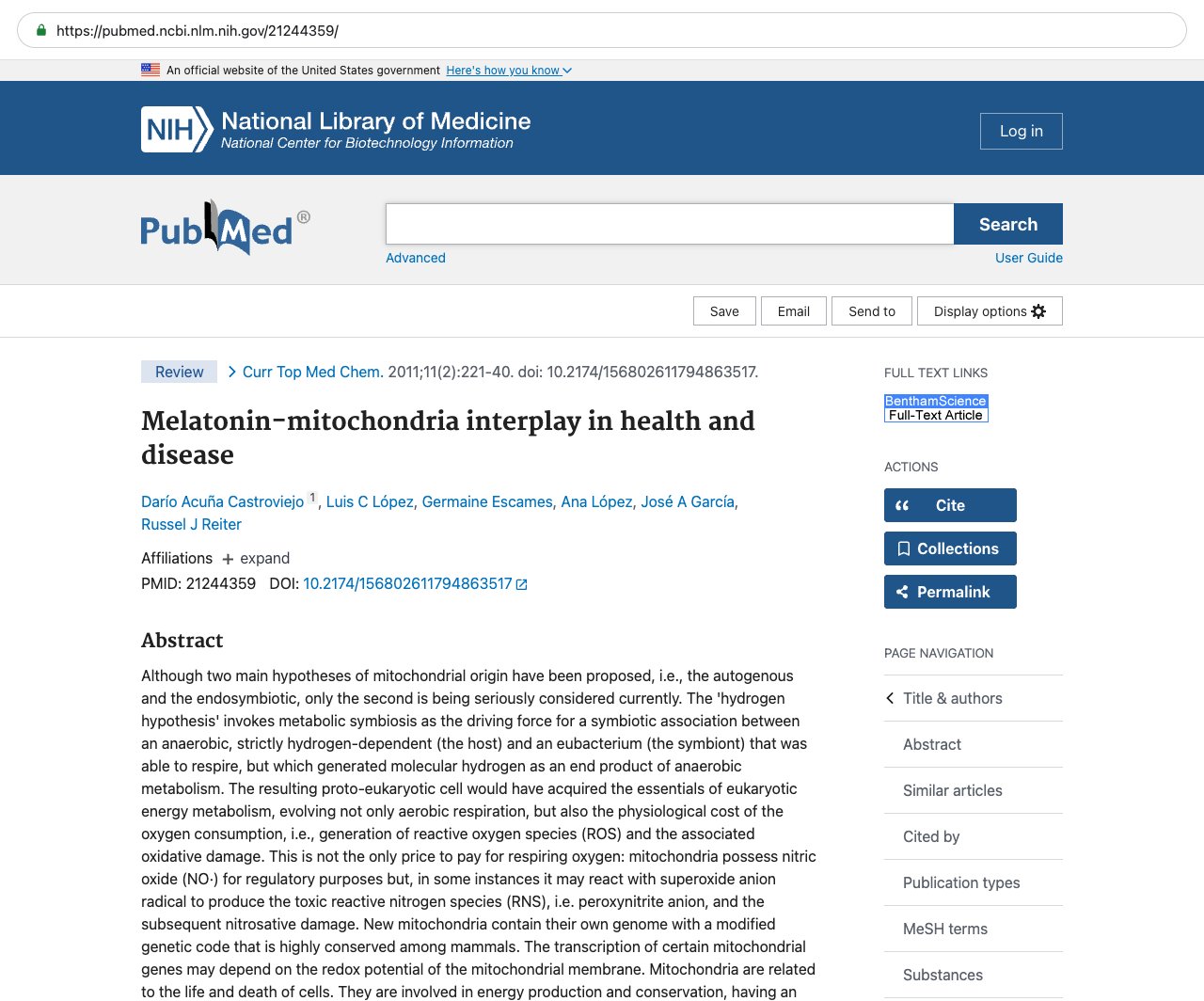
This page mirrors the published abstract (© the authors / publisher) for reference and citation. The canonical source is the PubMed record linked above. This is not medical advice.