2024 · Afkhami — Exploring Approaches to Pulp Vitality Assessment: A Scoping Review of Nontraditional Methods
Super-Abstract
Accurate assessment of dental pulp vitality is critical in endodontics — yet current clinical tests are imprecise. This scoping review systematically surveys 65 non-traditional techniques for assessing pulp vitality, including optical methods, MRI, ultrasound Doppler, terahertz imaging, and invasive approaches such as hydrogen gas desaturation. H₂ appears here in a diagnostic context (using hydrogen to assess blood flow in the pulp), not as a therapeutic agent. This is a systematic scoping review.
Commentary
Traditional pulp sensitivity tests (cold, heat, electric stimulation) assess neural function rather than true vascular vitality — a limitation in clinical settings where a tooth may have lost its nerve supply while retaining blood flow, or vice versa. This scoping review maps 65 non-traditional approaches that attempt to directly assess pulpal vascular status. Among them, hydrogen gas desaturation is listed as an invasive method — this uses the disappearance of dissolved H₂ from the pulp as a measure of local blood flow, analogous to clearance techniques used elsewhere in physiology. This is entirely distinct from drinking hydrogen-rich water or inhaling H₂ for systemic effects. The review is methodologically structured (pre-registered, PCC model, multi-database search) and provides an honest taxonomy of techniques ranging from ‚clinically impractical' to ‚promising'.
Key quotes
- „invasive methodologies, including 133xenon washout, radioisotope-labelled tracers, hydrogen gas desaturation, intravital microscopy and fluorescent microspheres isotope clearance.“ — H₂ gas desaturation classified as an invasive diagnostic technique — not a therapeutic use of H₂
- „These methods range from clinically impractical through to promising methods that may transform clinical practice.“ — honest spectrum of feasibility for non-traditional pulp vitality tests
- „Diagnostic procedures for pulp vitality assessment are a crucial aspect of routine dental practice.“ — clinical relevance of improved pulp diagnostics
Our assessment
This scoping review is methodologically sound and provides a useful landscape of emerging pulp vitality assessment techniques. It is important to note that H₂'s appearance here is strictly diagnostic — hydrogen gas desaturation uses H₂ as a tracer to quantify pulpal blood flow, and has no relationship to the systemic H₂ therapy literature. Readers interested in H₂ as a therapeutic agent should note this study is not relevant to that topic.
Study design
- Type: scoping review (pre-registered, multi-database systematic search) · n: 65 included studies · H₂ use: hydrogen gas desaturation as a diagnostic tracer (blood-flow measurement) — not therapeutic H₂
- Result: 65 non-traditional pulp vitality assessment approaches catalogued; hydrogen gas desaturation categorised as invasive; methods range from impractical to potentially practice-transforming; no H₂ therapy efficacy data
Abstract
INTRODUCTION: Diagnostic procedures for pulp vitality assessment are a crucial aspect of routine dental practice. This review aims to provide a comprehensive overview of nontraditional techniques and methodologies for assessing pulp vitality, specifically exploring promising approaches that are currently not used in dental practice. METHODS: The study protocol was registered a priori (https://osf.io/3m97z/). An extensive electronic search was conducted across multiple databases, including MEDLINE via PubMed, Scopus, Web of Science, and Embase. Inclusion criteria were guided by the research question based on the PCC model as follows: "What are the potential nontraditional techniques (Concept) for assessing pulp vitality (Population) in the field of endodontics or clinical practice (Context)?" Studies were included that explored possible approaches to pulp vitality assessment, utilizing a range of techniques, whilst any studies using traditional pulp tests (cold, heat, and electric stimulation) or well-known methods (pulse oximetry and laser Doppler flowmetry) were excluded. Reviewers independently screened articles and extracted data. A patent search was also performed. RESULTS: Of 3062 studies, 65 were included that described nontraditional approaches for assessing pulp vitality. These included a range of optical diagnostic methods, ultrasound Doppler flowmetry (UDF), magnetic resonance imaging (MRI), terahertz imaging, tooth temperature measurements, as well as invasive methodologies, including 133xenon washout, radioisotope-labelled tracers, hydrogen gas desaturation, intravital microscopy and fluorescent microspheres isotope clearance. The patent search included artificial intelligence and biomarkers methods. CONCLUSIONS: This review provides details for potential innovative tests that may directly describe pulp vitality. Importantly, these methods range from clinically impractical through to promising methods that may transform clinical practice. Several nontraditional techniques have the potential to enhance diagnostic accuracy and could provide valuable insights into the assessment of pulp vitality in challenging clinical scenarios.
Source & links
Screenshot of the PubMed page
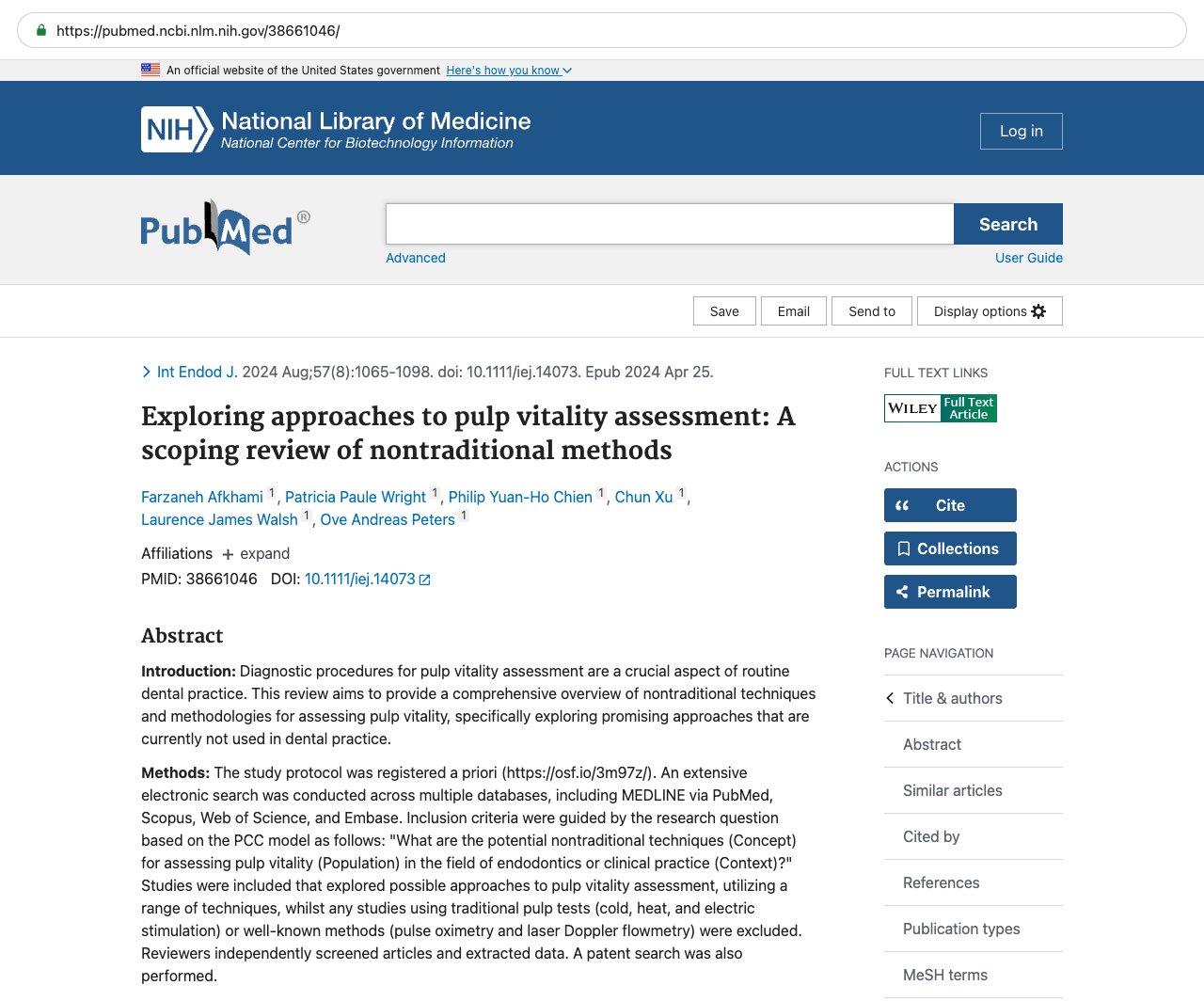
This page mirrors the published abstract (© the authors / publisher) for reference and citation. The canonical source is the PubMed record linked above. This is not medical advice.