2023 · Agar — The Inhibition Mechanism of Pancreatic Ductal Adenocarcinoma via LXR Receptors: A Multifaceted Approach Integrating Molecular Docking, Molecular Dynamics and Post-MD Inter-Molecular Contact Analysis
Super-Abstract
A computational in-silico study investigated how natural compounds — Baicalein, Beta-Sitosterol, and Polydatin — might inhibit Liver X receptors (LXR), which play a role in the progression of pancreatic ductal adenocarcinoma (PDAC). Molecular docking and dynamics simulations suggest that Baicalein inhibits both LXRα and LXRβ, while Beta-Sitosterol shows particularly strong binding to LXRβ. These are purely theoretical findings from computer modelling; no cell experiments, animal experiments, or human trials were conducted.
Commentary
Pancreatic ductal adenocarcinoma is one of the deadliest cancers, partly because it is often diagnosed late and responds poorly to available treatments. Liver X receptors have attracted attention as possible drug targets because they influence lipid metabolism and cell proliferation in several cancer types. This study used computational methods — molecular docking and molecular dynamics simulations — to screen natural phytochemicals as potential LXR inhibitors. While the approach can generate useful hypotheses about binding interactions, it is purely in-silico: no biochemical, cellular, or organism-level validation was performed. The connection to molecular hydrogen (H₂) in this study is indirect at best; H₂ is not a subject of investigation here. The study belongs to the broader landscape of computational oncology and is listed in the H₂-medicine context because LXR pathways intersect with oxidative stress and metabolic signalling relevant to H₂ research.
Key quotes
- „Baicalein exhibits versatile inhibitory effects on both receptors, while Beta-Sitosterol emerges as a highly effective inhibitor of LXRβ.“ — main computational finding on receptor binding
- „Further in vitro and in vivo investigations will be beneficial and would shed light onto the mechanism to decipher the suppression of PDAC evaluating the potential of Baicalein, Beta-Sitosterol, Polydatin natural ligand compounds.“ — authors acknowledge that experimental validation is still missing
- „LXRs have also emerged as potential targets for addressing PDAC, and recent findings have demonstrated that LXR ligands can impede cell proliferation in various cancer forms, notably pancreatic cancer.“ — rationale for choosing LXR as a target
Our assessment
This is a purely computational, hypothesis-generating study with no experimental validation. The docking scores and dynamics trajectories indicate that certain natural compounds bind plausibly to LXR receptors, but binding in a simulation does not equal biological activity. No H₂ intervention was tested; the relevance to molecular hydrogen therapy is indirect. Before any conclusions about cancer treatment can be drawn, in-vitro cell experiments and then animal studies would be required. Results cannot be transferred to humans at this stage.
Study design
- Type: in-silico computational study · n: n/a (no organisms or cells) · H₂ delivery: not applicable (H₂ is not studied)
- Method: molecular docking and molecular dynamics simulations of Baicalein, Beta-Sitosterol, Polydatin against LXRα and LXRβ
- Result: computational binding evidence only; Baicalein binds both LXR isoforms; Beta-Sitosterol shows high affinity for LXRβ; no in-vitro or in-vivo confirmation
Abstract
OBJECTIVE: Pancreatic ductal adenocarcinoma (PDAC) has an unfavorable outlook due to its aggressive characteristics, delayed diagnosis, and limited effective treatment options for advanced stages of the disease. The significant mortality rate has prompted investigations into additional factors that could aid in managing this type of cancer. Liver X receptors, specifically LXRα and LXRβ, are nuclear receptors that oversee the expression of genes related to cholesterol, glucose, lipid metabolism, and inflammatory responses. LXRs have also emerged as potential targets for addressing PDAC, and recent findings have demonstrated that LXR ligands can impede cell proliferation in various cancer forms, notably pancreatic cancer. This comprehensive computational research study involving oncological in silico mechanism discovery explored inhibitory ligands for Liver X receptors (LXRα and LXRβ), which are believed to have prognostic significance in PDAC. METHODS: The study utilized Baicalein, Beta-Sitosterol, Polydatin ligands in molecular docking and dynamics and post-molecular Hydrogen bonding contact analyses dynamics to characterize receptor inhibition. RESULT: The outcomes suggest that Baicalein exhibits versatile inhibitory effects on both receptors, while Beta-Sitosterol emerges as a highly effective inhibitor of LXRβ. CONCLUSION: Further in vitro and in vivo investigations will be beneficial and would shed light onto the mechanism to decipher the suppression of PDAC evaluating the potential of Baicalein, Beta-Sitosterol, Polydatin natural ligand compounds.
Source & links
Screenshot of the PubMed page
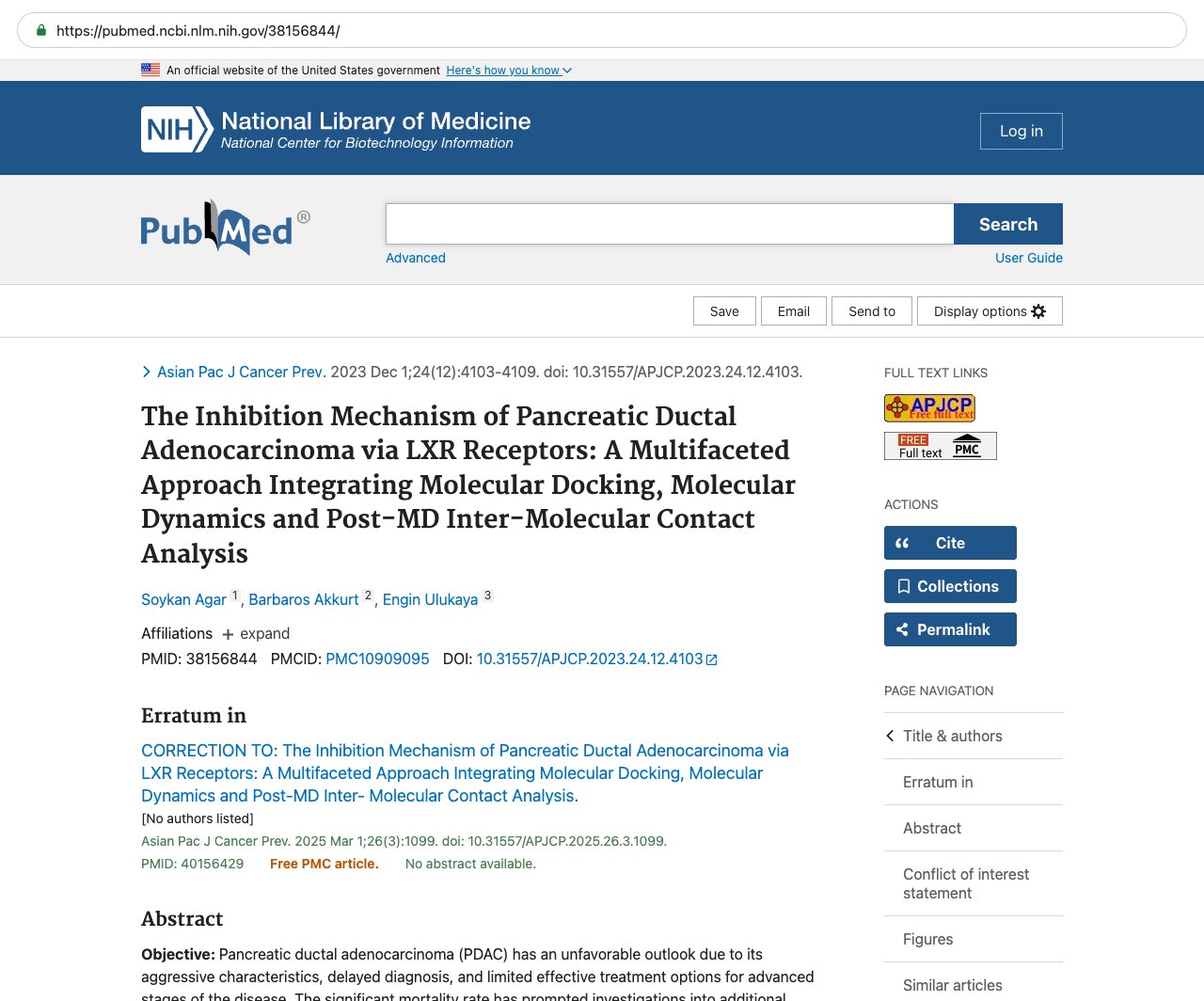
This page mirrors the published abstract (© the authors / publisher) for reference and citation. The canonical source is the PubMed record linked above. This is not medical advice.