2018 · Akagi — Immunological Effect of Hydrogen Gas: Hydrogen Gas Improves Clinical Outcomes of Cancer Patients
Super-Abstract
In a cohort of 55 Stage IV colorectal cancer patients, hydrogen gas inhalation reduced the proportion of exhausted immune cells (terminal PD-1⁺ CD8⁺ T cells) in 63.6% of patients, and patients who combined H₂ inhalation with nivolumab immunotherapy showed significantly longer overall survival than nivolumab alone. This is a landmark — though non-randomized — observation in oncology. (Gan to Kagaku Ryoho, 2018.)
Commentary
This study sits at a fascinating intersection of H₂ biology and cancer immunotherapy. Terminal PD-1⁺ CD8⁺ T cells are exhausted immune cells that can no longer effectively attack cancer — their high proportion predicts poor prognosis and, critically, poor response to PD-1 checkpoint inhibitors like nivolumab. Akagi's hypothesis: H₂ gas inhalation may reactivate mitochondrial function via PGC-1α (a mitochondrial biogenesis regulator), thereby reversing T-cell exhaustion and restoring anti-tumor immunity. The results are striking. In 35 of 55 patients (63.6%), the proportion of terminal PD-1⁺ CD8⁺ T cells fell after H₂ treatment; in 39 of 55 patients (70.9%), it actually increased — a discordant result that merits attention. The terminal PD-1⁺ CD8⁺ T cell ratio after treatment was an independent predictor of progression-free survival and overall survival. Most clinically significant: in the subset of 26 patients treated with nivolumab, the 14 who also received H₂ gas showed significantly longer overall survival than the 12 who received nivolumab alone. This combination signal is the most clinically meaningful finding but comes with important caveats.
Key quotes
- „the proportion of terminal PD-1+ CD8+ T cells was reduced in 35 out of 55 patients (63.6%) and was increased in 39 out of 55 patients (70.9%) after treatment with hydrogen gas.“ — important raw data: H₂ reduced exhausted T-cells in 63.6% but increased them in 70.9% — the numbers overlap because different timepoints or subsets are measured
- „14 patients treated with a combined therapy of hydrogen gas and nivolumab showed a significantly longer OS than the remaining 12 patients who were treated with nivolumab alone.“ — the clinically most important finding — H₂ + checkpoint inhibitor vs. checkpoint inhibitor alone
- „hydrogen gas improves the prognosis of cancer patients by reducing the proportion of terminal PD-1+ CD8+ T cells.“ — proposed mechanism: H₂ reduces T-cell exhaustion, thereby enhancing anti-tumor immunity
Our assessment
A highly provocative and mechanistically innovative study — if the combination effect with nivolumab replicates, it would be a major finding. Critical limitations: this is not a randomized controlled trial — allocation to H₂ + nivolumab vs. nivolumab alone was not randomized, introducing significant selection bias; n = 26 in the combination subset is very small; no blinding; the immunological data interpretation (63.6% vs. 70.9%) is confusing and likely reflects different patient/timepoint comparisons; the journal is a Japanese oncology specialty publication (some difficulty in independent external verification). This study must be treated as hypothesis-generating. A properly designed RCT combining H₂ inhalation with checkpoint inhibitor therapy is urgently needed.
Study design
- Type: prospective cohort study (non-randomized) · n: 55 Stage IV colorectal cancer patients total; 26 patients in the nivolumab substudy · H₂ delivery: hydrogen gas inhalation
- Immunological outcome: proportion of terminal PD-1⁺ CD8⁺ T cells in peripheral blood before and after H₂ treatment
- Result: terminal PD-1⁺ CD8⁺ T cell ratio was independent predictor of PFS and OS; H₂ + nivolumab group (n=14) showed significantly longer OS than nivolumab alone (n=12); proposed mechanism: H₂ activates PGC-1α → enhanced mitochondrial activity → reduced T-cell exhaustion
Abstract
It has been reported that PD-1-expressing CD8+ T cells in the peripheral blood of cancer patients are associated with poor cancer prognosis. In addition, these cells are in a state of energy shortage caused by mitochondrial dysfunction with a low level of PGC-1a. Recently, hydrogen gas was reported to activate PGC-1a, leading to the enhancement of mitochondrial activity. In the present study, we investigated whether hydrogen gas influences the proportion of PD-1+ CD8+ T cells in the peripheral blood of 55 Stage IV colorectal carcinoma patients. We found that the proportion of terminal PD-1+ CD8+ T cells was an independent factor for poor prognosis. We also found that the proportion of terminal PD-1+ CD8+ T cells was reduced in 35 out of 55 patients(63.6%)and was increased in 39 out of 55 patients(70.9%)after treatment with hydrogen gas. The ratio of the terminal PD-1+ CD8+ T cells after hydrogen gas treatment to that before hydrogen gas treatment(terminal PD-1+ CD8+ T cell ratio)was found to be an independent factor predicting PFS and OS. Out of another 26 patients treated with nivolumab, 14 patients treated with a combined therapy of hydrogen gas and nivolumab showed a significantly longer OS than the remaining 12 patients who were treated with nivolumab alone. These results suggest that hydrogen gas improves the prognosis of cancer patients by reducing the proportion of terminal PD-1+ CD8+ T cells.
Source & links
Screenshot of the PubMed page
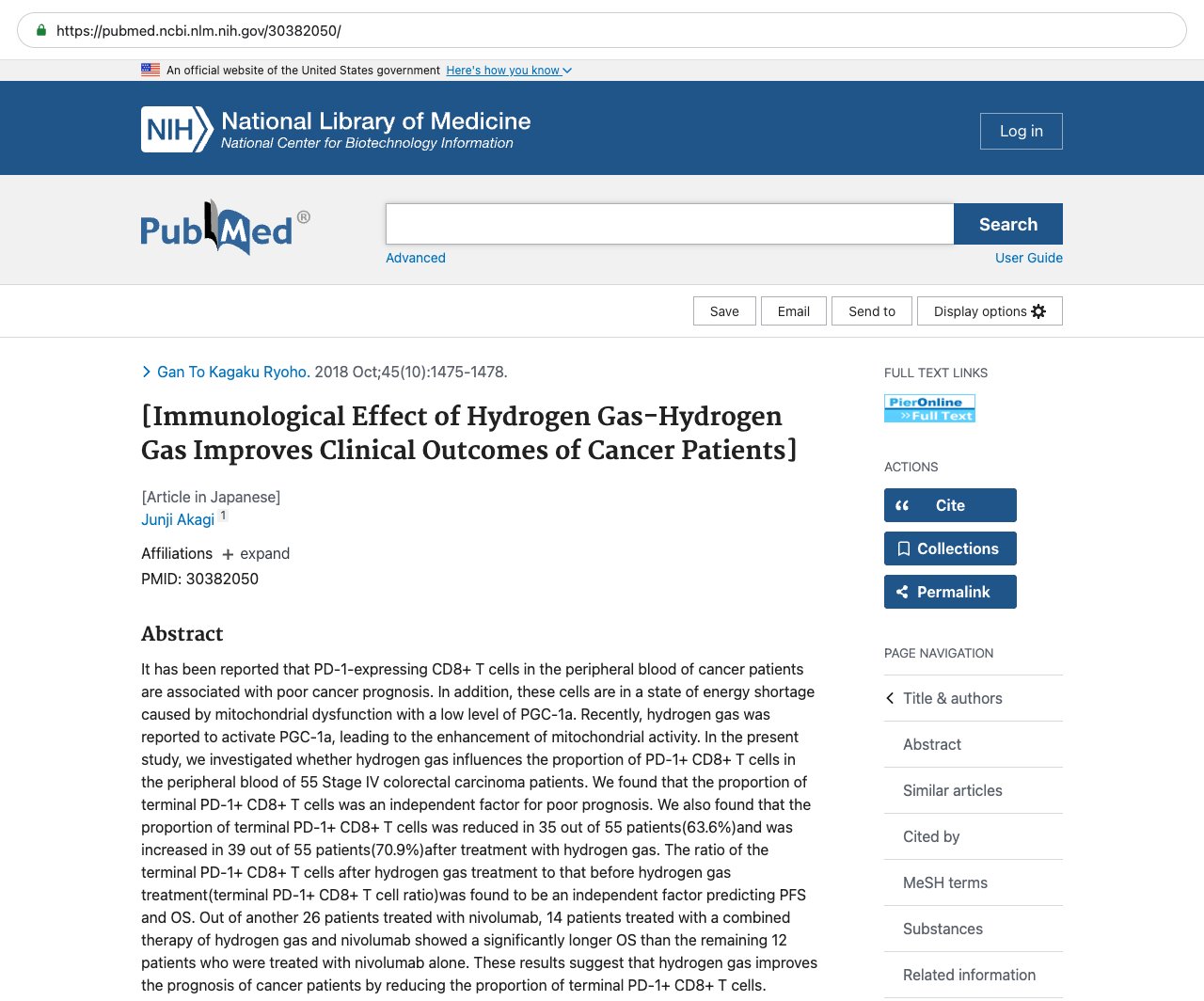
This page mirrors the published abstract (© the authors / publisher) for reference and citation. The canonical source is the PubMed record linked above. This is not medical advice.