2026 · Sato — Optimization of lens size and ion source parameters for gas chromatography/mass spectrometry-based metabolomics using hydrogen as a carrier gas
Super-Abstract
Global helium shortages are pushing analytical chemistry laboratories to adopt hydrogen gas as an alternative carrier gas for GC/MS metabolomics — but hydrogen causes unwanted ion-source reactions that alter fragmentation patterns. This in-vitro technical study developed a hydrogen-deactivated electron ionisation source and found that a 3 mm extraction lens provided the best performance, enabling reproducible metabolomic profiling comparable to helium-based systems. The system was validated on a human colon cancer cell line. (Journal of Chromatography A, 2026.)
Commentary
This paper is primarily an analytical chemistry methods study — it uses hydrogen gas as a technical tool (carrier gas for GC/MS), not as a therapeutic agent. The cancer cell line (HCT116) is used as a metabolomics test matrix, not to study any therapeutic effect of H₂. The main finding — that a hydrogen-deactivated ion source with a 3 mm lens gives reproducible spectra comparable to helium — is of direct relevance to analytical laboratories transitioning away from helium due to supply and cost pressures. The study successfully detected IDH1-mutant metabolic alterations (including elevated 2-hydroxyglutaric acid), confirming analytical validity. This paper has no bearing on the therapeutic or health applications of molecular hydrogen.
Key quotes
- „increasing costs and global shortages have prompted the exploration of hydrogen gas as an alternative.“ — the practical driver behind using H₂ as a carrier gas — not therapy, but cost and supply
- „The hydrogen-deactivated ion source equipped with a 3 mm extraction lens provided superior peak symmetry and the highest signal intensities, with acceptable relative standard deviation values.“ — the key analytical finding
- „These findings establish hydrogen gas-based GC/MS with a hydrogen-deactivated ion source as a robust and reliable platform for metabolomics, offering an effective alternative to helium-based systems.“ — the conclusion — a technical, not a medical, validation
Our assessment
This is an in-vitro analytical chemistry study — hydrogen gas is used here as a laboratory carrier gas, not as a medical or therapeutic agent. This study has no implications for H₂ health applications. Its value is entirely technical: it validates a practical workaround for helium scarcity in GC/MS metabolomics. Listing this paper in a health context requires clear labelling that the H₂ use here is purely instrumental.
Study design
- Type: in-vitro technical/methods study · Model: n-alkane standards + human colon cancer cell line HCT116 (IDH1-mutant) · H₂ use: carrier gas for GC/MS instrument (not therapeutic)
- Key finding: 3 mm extraction lens with hydrogen-deactivated EI source gives best peak symmetry and signal intensity; RSD acceptable; fragmentation patterns comparable to helium
- Application: metabolomic profiling of IDH1-mutant cancer cells — analytical validation only, no therapeutic inference
Abstract
Gas chromatography/mass spectrometry (GC/MS) is widely employed in metabolomics owing to its high resolution, reproducibility, and compatibility with volatile and semi-volatile compounds. While helium has traditionally been used as the carrier gas, increasing costs and global shortages have prompted the exploration of hydrogen gas as an alternative. Hydrogen offers faster analysis times and reduced ion source contamination but presents challenges, including ion source reactions, which can change compound fragmentation patterns. To address this, a hydrogen-deactivated electron ionization (EI) source has been developed to minimize undesired chemical interactions and improve spectral integrity. In this study, we systematically evaluated the effect of extraction lens sizes (3, 6, and 9 mm) under hydrogen carrier gas conditions using n-alkane and human metabolomic standard solutions. The hydrogen-deactivated ion source equipped with a 3 mm extraction lens provided superior peak symmetry and the highest signal intensities, with acceptable relative standard deviation (RSD) values (i.e., below 30%). In addition, the reproducible fragmentation patterns as those observed with helium carrier gas were obtained for phosphorylated metabolites. Using this optimized configuration, we applied hydrogen gas-based GC/MS to metabolomic profiling of the human colon cancer cell line HCT116 with mutant isocitrate dehydrogenase 1 (IDH1). Key metabolic alterations, including increased levels of the known biomarker 2-hydroxyglutaric acid, were detected in IDH1-mutant cells compared with wild-type cells. These findings establish hydrogen gas-based GC/MS with a hydrogen-deactivated ion source as a robust and reliable platform for metabolomics, offering an effective alternative to helium-based systems.
Source & links
Screenshot of the PubMed page
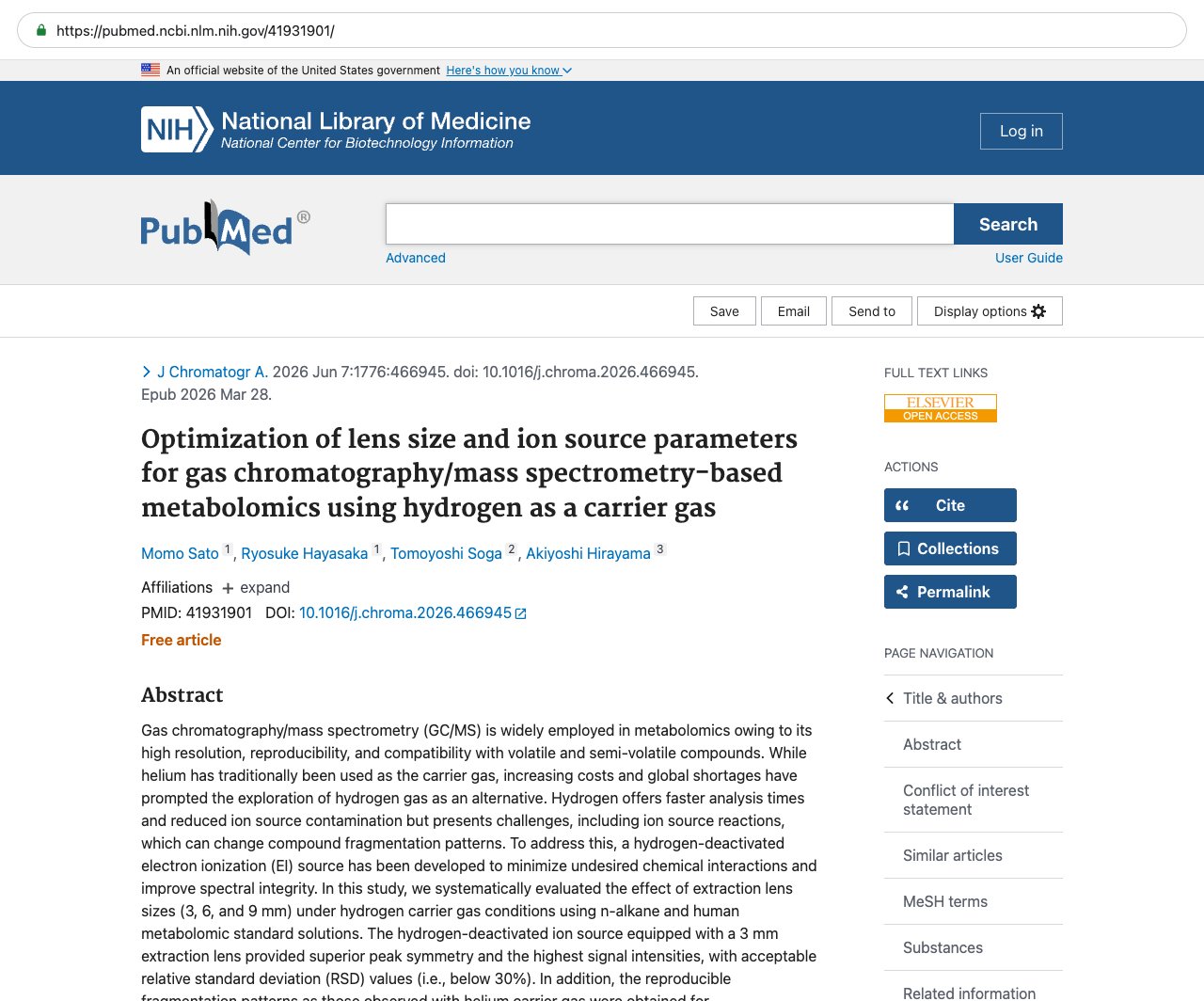
This page mirrors the published abstract (© the authors / publisher) for reference and citation. The canonical source is the PubMed record linked above. This is not medical advice.