2019 · Akagi et al. — Hydrogen gas restores exhausted CD8+ T cells in patients with advanced colorectal cancer to improve prognosis.
Super-Abstract
In 55 stage IV colorectal cancer patients inhaling H₂ gas (3 h/day at home) alongside chemotherapy, H₂ was associated with a shift in exhausted CD8+ T cells: fewer terminal PD-1+ exhausted cells, more active PD-1− cells — and both progression-free and overall survival were better in patients with the more favourable T-cell balance. This observational study proposes a novel patient classification system based on the PD-1+/PD-1− CD8 T-cell ratio. (Oncology Reports, 2019.)
Commentary
This study from Japan is one of the more mechanistically detailed H₂ cancer papers. The central observation — that H₂ inhalation shifts the exhausted/active CD8 T-cell balance — is linked to the biology of PGC-1α, a mitochondrial regulator reported to be activated by H₂ and inactivated in exhausted T cells. This makes the hypothesis coherent: H₂ → PGC-1α activation → mitochondrial function restored → T-cell exhaustion reversed. The survival signal (PFS and OS) is real and significant in this cohort. However, the study is observational: all patients received H₂ plus chemotherapy; there is no randomised no-H₂ comparison arm for the main outcomes. The proposal of a four-category patient classification system is interesting clinically but adds complexity that needs validation in independent cohorts.
Key quotes
- „exhausted terminal programmed cell death 1 (PD-1)+ CD8+ T cells in the peripheral blood are independently associated with worse progression-free survival (PFS) and overall survival (OS).“ — the baseline finding: PD-1+ T-cell exhaustion predicts worse outcomes
- „hydrogen gas decreased the abundance of exhausted terminal PD-1+ CD8+ T cells, increased that of active terminal PD-1- CD8+ T cells, and improved PFS and OS times.“ — H₂ association with T-cell rebalancing and survival — observational, not proven causal
- „a novel system for patient classification (category 1-4) was developed in the present study based on these two indices to assist in predicting the prognosis and therapeutic response.“ — translational proposal — needs validation in independent cohorts
Our assessment
A mechanistically rich observational study that connects H₂ biology (PGC-1α, mitochondrial function) to immune oncology (CD8 T-cell exhaustion) in a real cancer patient population. The PD-1+/PD-1− T-cell ratio as a prognostic index is novel and clinically potentially valuable. Limitations: all patients received H₂ — no untreated comparison arm for survival outcomes; chemotherapy confounds T-cell dynamics; n = 55 is relatively small for survival analysis in a heterogeneous metastatic cohort; home-based inhalation adherence not quantified; the PGC-1α mechanism in human patients is inferred, not directly measured.
Study design
- Type: prospective observational cohort (single arm: H₂ + chemotherapy) · n: 55 stage IV colorectal cancer patients · H₂ delivery: inhalation, 3 hours/day at home; enrolment July 2014 – July 2017
- Immunology: CD8+ T cells isolated from peripheral blood; PD-1+ (exhausted) vs. PD-1− (active) phenotyping by flow cytometry
- Result: H₂ shifted T-cell balance from exhausted to active; PD-1+ burden independently predicted worse PFS and OS; H₂ improved both; novel 4-category classification proposed
Abstract
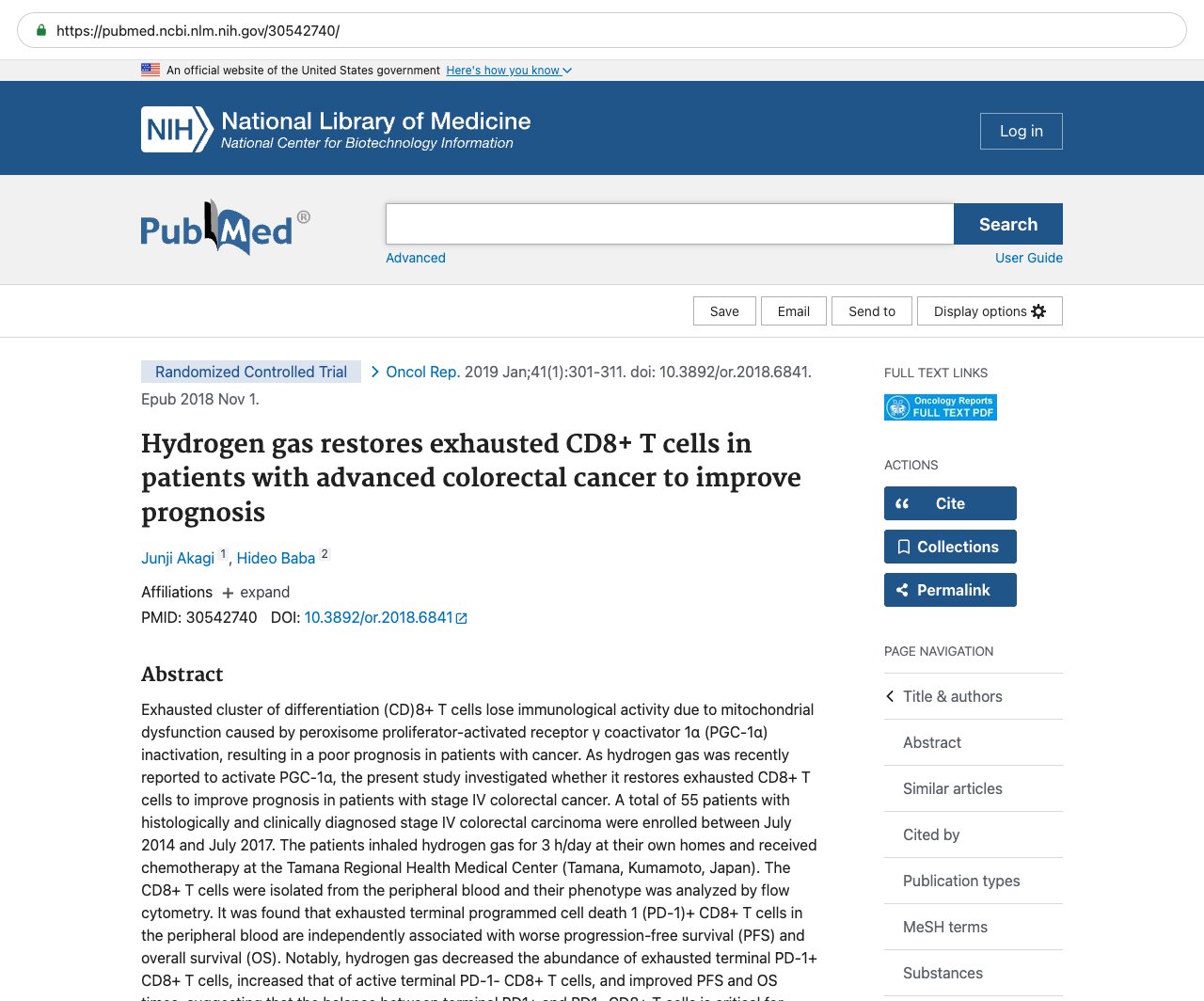
Exhausted cluster of differentiation (CD)8+ T cells lose immunological activity due to mitochondrial dysfunction caused by peroxisome proliferator‑activated receptor γ coactivator 1α (PGC‑1α) inactivation, resulting in a poor prognosis in patients with cancer. As hydrogen gas was recently reported to activate PGC‑1α, the present study investigated whether it restores exhausted CD8+ T cells to improve prognosis in patients with stage IV colorectal cancer. A total of 55 patients with histologically and clinically diagnosed stage IV colorectal carcinoma were enrolled between July 2014 and July 2017. The patients inhaled hydrogen gas for 3 h/day at their own homes and received chemotherapy at the Tamana Regional Health Medical Center (Tamana, Kumamoto, Japan). The CD8+ T cells were isolated from the peripheral blood and their phenotype was analyzed by flow cytometry. It was found that exhausted terminal programmed cell death 1 (PD‑1)+ CD8+ T cells in the peripheral blood are independently associated with worse progression‑free survival (PFS) and overall survival (OS). Notably, hydrogen gas decreased the abundance of exhausted terminal PD‑1+ CD8+ T cells, increased that of active terminal PD‑1‑ CD8+ T cells, and improved PFS and OS times, suggesting that the balance between terminal PD1+ and PD1‑ CD8+ T cells is critical for cancer prognosis. Therefore, a novel system for patient classification (category 1‑4) was developed in the present study based on these two indices to assist in predicting the prognosis and therapeutic response. Collectively, the present results suggested that hydrogen gas reverses imbalances toward PD‑1+ CD8+ T cells to provide an improved prognosis.
Source & links
Screenshot of the PubMed page
This page mirrors the published abstract (© the authors / publisher) for reference and citation. The canonical source is the PubMed record linked above. This is not medical advice.