2021 · Alharbi — Application of Molecular Hydrogen as an Antioxidant in Responses to Ventilatory and Ergogenic Adjustments during Incremental Exercise in Humans
Super-Abstract
H₂ supplementation altered ventilatory and acid-base status during incremental exercise. In a randomized, double-blind crossover study (18 trained people), H₂-rich calcium powder led at rest to lower ventilation and higher bicarbonate — during exertion ventilation stayed lower. (Nutrients, 2021.)
Commentary
This study is an honest, finely resolved physiology investigation — not a simple „H₂ makes you faster“. 18 healthy, trained people received, in a randomized, double-blind crossover design, either H₂-rich calcium powder (1500 mg/day, containing 2.544 µg H₂/day) or an H₂-free placebo for three days. Then they performed an incremental cycle ergometer protocol to exhaustion, with ventilation, CO₂ output, muscle oxygen saturation (via near-infrared spectroscopy) and blood gases measured. At rest, the H₂ group had significantly lower ventilation and CO₂ output as well as higher bicarbonate and higher CO₂ partial pressure. During exertion, pH dropped more, bicarbonate stayed higher, and ventilation stayed lower than with placebo. Interestingly: H₂ did NOT change oxygen uptake (V̇O₂) — so no direct performance boost in the classic sense. The authors interpret this as H₂-induced „hypoventilation“ that secondarily shifts the O₂ delivery/consumption balance in the rectus femoris muscle (but not the vastus lateralis) — possibly because of different fiber-type composition. Honestly: small sample (n = 18), very low H₂ dose, and the findings are complex and mechanistic, not clearly „performance-enhancing“.
Key quotes
- „the HCP group had significantly lower V˙E, V˙CO2, and higher HCO3-, partial pressures of CO2 (PCO2) versus placebo“ — at rest: lower ventilation/CO₂ output, higher bicarbonate with H₂
- „HCP did not affect the gas exchange status of V˙CO2 or oxygen uptake (V˙O2)“ — no effect on oxygen uptake — i.e. no direct aerobic performance boost
- „HCP-induced hypoventilation would lead to lower pH and secondarily impaired balance between O2 delivery and utilization in the local RF during exercise“ — H₂-induced hypoventilation locally shifts the O₂ balance in the rectus femoris
Our assessment
Relevant for H₂-in-sport products (here H₂-rich calcium powder, comparable to the Mg-stick/HRW concept), but as an honest differentiation example: the study shows measurable physiological effects (ventilation, acid-base balance) but precisely NO increase in oxygen uptake — i.e. no crude performance proof. This is valuable for honest argumentation: H₂ intervenes in exercise physiology, but the benefit is nuanced and not a blanket „more performance“. Limitations honestly: small sample (n = 18), very low H₂ dose (2.544 µg/day), effects in part only in one of the two muscles studied, interpretation mechanistic-speculative. Methodologically strong, though: randomized, double-blind, crossover.
Study design
- Type: RCT (randomized, double-blind, crossover) · n: 18 (healthy, trained) · Duration: 3 consecutive days of supplementation before the exercise test · H₂ delivery: H₂-rich calcium powder (HCP) 1500 mg/day with 2.544 µg H₂/day (placebo: H₂-free powder 1500 mg/day); incremental ergometer test (start 20 W, +20 W every 2 min to exhaustion)
- Result: at rest significantly lower V̇E and V̇CO₂, higher HCO₃⁻ and PCO₂ with HCP; during exertion lower pH and higher HCO₃⁻ (up to 240 W); lower V̇E with HCP; no change in V̇CO₂/V̇O₂; increased deoxy[Hb+Mb] in the rectus femoris, not the vastus lateralis (individual p-values not reported in the abstract)
Abstract
We investigated effects of molecular hydrogen (H2) supplementation on acid-base status, pulmonary gas exchange responses, and local muscle oxygenation during incremental exercise. Eighteen healthy, trained subjects in a randomized, double-blind, crossover design received H2-rich calcium powder (HCP) (1500 mg/day, containing 2.544 µg/day of H2) or H2-depleted placebo (1500 mg/day) for three consecutive days. They performed cycling incremental exercise starting at 20-watt work rate, increasing by 20 watts/2 min until exhaustion. Breath-by-breath pulmonary ventilation (V˙E) and CO2 output (V˙CO2) were measured and muscle deoxygenation (deoxy[Hb + Mb]) was determined via time-resolved near-infrared spectroscopy in the vastus lateralis (VL) and rectus femoris (RF). Blood gases' pH, lactate, and bicarbonate (HCO3-) concentrations were measured at rest and 120-, 200-, and 240-watt work rates. At rest, the HCP group had significantly lower V˙E, V˙CO2, and higher HCO3-, partial pressures of CO2 (PCO2) versus placebo. During exercise, a significant pH decrease and greater HCO3- continued until 240-watt workload in HCP. The V˙E was significantly lower in HCP versus placebo, but HCP did not affect the gas exchange status of V˙CO2 or oxygen uptake (V˙O2). HCP increased absolute values of deoxy[Hb + Mb] at the RF but not VL. Thus, HCP-induced hypoventilation would lead to lower pH and secondarily impaired balance between O2 delivery and utilization in the local RF during exercise, suggesting that HCP supplementation, which increases the at-rest antioxidant potential, affects the lower ventilation and pH status during incremental exercise. HPC induced a significantly lower O2 delivery/utilization ratio in the RF but not the VL, which may be because these regions possess inherently different vascular/metabolic control properties, perhaps related to fiber-type composition.
Source & links
Screenshot of the PubMed page
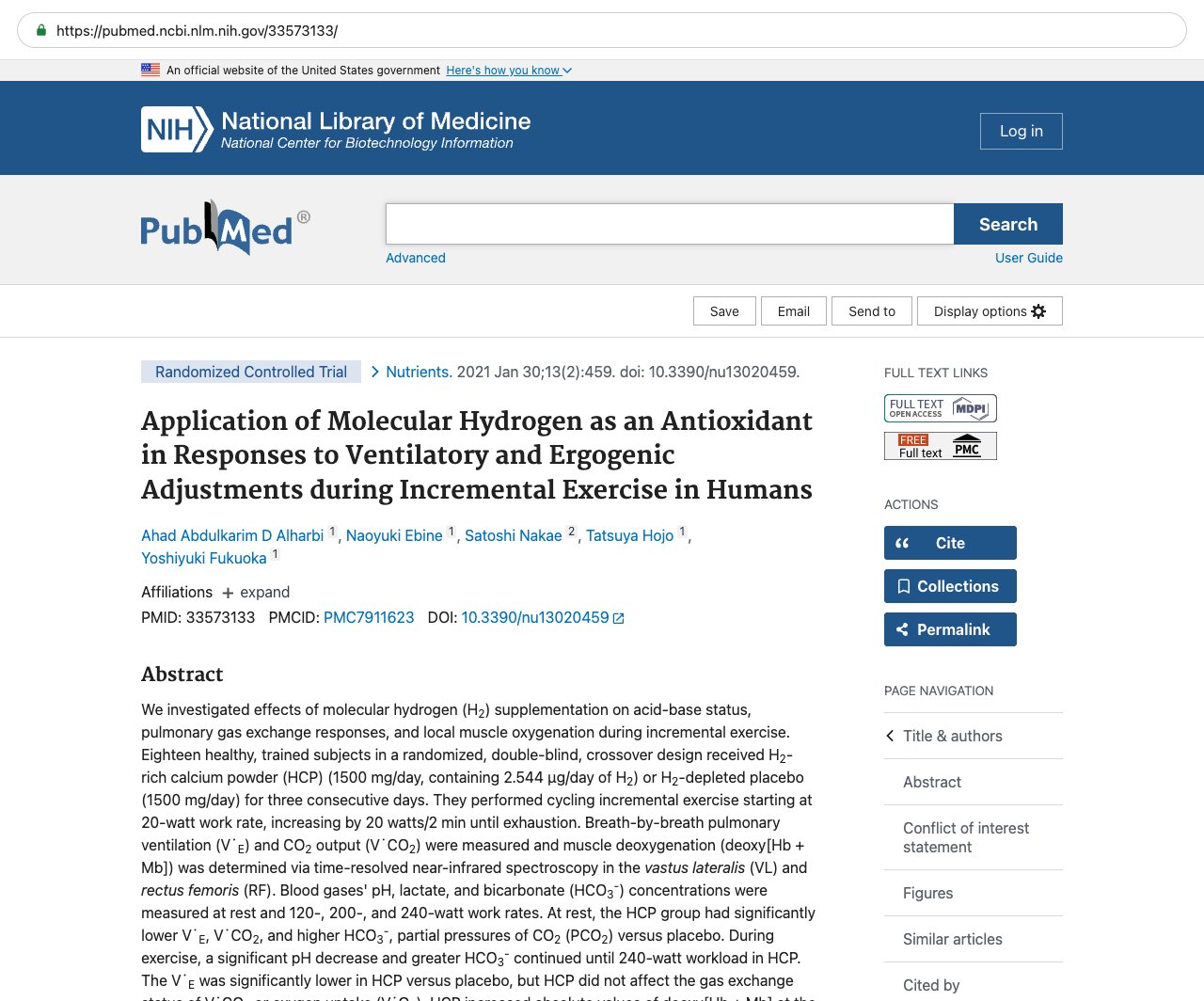
This page mirrors the published abstract (© the authors / publisher) for reference and citation. The canonical source is the PubMed record linked above. This is not medical advice.