2022 · Alharbi — The Acute Effects of a Single Dose of Molecular Hydrogen Supplements on Responses to Ergogenic Adjustments during High-Intensity Intermittent Exercise in Humans
Super-Abstract
A single dose of molecular hydrogen before high-intensity interval training raises peak power and improves muscle oxygen supply. In this randomized double-blind crossover study (10 trained subjects), peak power in the first HIIT bout was significantly higher with H₂ than with placebo (839 vs. 816 W, p = 0.001), with better O₂ extraction in the muscle. (Nutrients, 2022.)
Commentary
This study is the counterpart to the null finding in endurance running: here — in high-intensity, anaerobic interval training — a single dose of hydrogen does show effects. The design is randomized, double-blind, crossover, with 10 healthy, trained subjects. One hour before exertion they received either an H₂-rich calcium powder (1500 mg, releasing 2.544 µg H₂) or an H₂-free placebo. Then they performed six maximal 7-second sprints on a cycle ergometer (HIIT) with 40 seconds of rest between them, followed by a recovery phase. Blood gases and — via time-resolved near-infrared spectroscopy — oxygen saturation in the thigh muscle were measured. The results: at rest, the H₂ group had higher PCO₂ and bicarbonate values and a slight tendency toward acidosis. Peak power in the first bout was significantly higher with H₂ (839 ± 112 W vs. 816 ± 108 W, p = 0.001), and H₂ markedly increased muscle deoxygenation during exertion — i.e. more O₂ extraction in the working muscle — at the same heart rate. Blood flow and reoxygenation during recovery were also improved. The authors conclude that H₂ might have ergogenic (performance-enhancing) effects in high-intensity anaerobic training. Honestly: very small sample (n = 10), only an acute single dose, and „might“ — the authors stay cautious.
Key quotes
- „the first HIIT bout's peak power was significantly higher in HCP (839 ± 112 W) vs. Placebo (816 ± 108 W, p = 0.001)“ — higher peak power in the first sprint
- „HCP had a notable effect on significantly increased deoxy[Hb + Mb] concentration during HIIT exercise, despite no differences in heart rate response.“ — better O₂ extraction in the muscle at the same heart rate
- „The HCP supplement might exert ergogenic effects on high-intensity exercise and prove advantageous for improving anaerobic HIIT exercise performance.“ — cautious conclusion: possible performance advantage in HIIT
Our assessment
Important in the overall picture of the database: together with the Valenta null finding (endurance running, no effect), a differentiated picture emerges — H₂ seems to do something more in high-intensity, anaerobic training than in moderate aerobic endurance exertion. This nuance is exactly what makes a serious, engineering-honest database: no blanket „H₂ makes you faster“, but context-dependent differentiation. A useful building block for sport communication. Limitation, stated honestly: very small sample (n = 10), only an acute single dose, the H₂ amount at 2.544 µg is very small, the difference in peak power is small (23 W), and the authors phrase it deliberately cautiously („might“). Hence evidence level 2.
Study design
- Type: human study, randomized/double-blind/crossover (pilot character) · n: 10 healthy, trained subjects · Duration: acute single dose 1 h before exertion · H₂ delivery: H₂-rich calcium powder (HCP, 1500 mg, 2.544 µg H₂) vs. H₂-free placebo
- Result: peak power 1st bout 839 ± 112 W (HCP) vs. 816 ± 108 W (placebo), p = 0.001; muscle deoxygenation (deoxy[Hb+Mb]) during HIIT significantly ↑; greater O₂ extraction in the vastus lateralis and Hb volume in the rectus femoris; higher PCO₂/HCO₃⁻ at rest; heart rate unchanged
Abstract
This research examined the effects of single-dose molecular hydrogen (H2) supplements on acid-base status and local muscle deoxygenation during rest, high-intensity intermittent training (HIIT) performance, and recovery. Ten healthy, trained subjects in a randomized, double-blind, crossover design received H2-rich calcium powder (HCP) (1500 mg, containing 2.544 μg of H2) or H2-depleted placebo (1500 mg) supplements 1 h pre-exercise. They performed six bouts of 7 s all-out pedaling (HIIT) at 7.5% of body weight separated by 40 s pedaling intervals, followed by a recovery period. Blood gases' pH, PCO2, and HCO3- concentrations were measured at rest. Muscle deoxygenation (deoxy[Hb + Mb]) and tissue O2 saturation (StO2) were determined via time-resolved near-infrared spectroscopy in the vastus lateralis (VL) and rectus femoris (RF) muscles from rest to recovery. At rest, the HCP group had significantly higher PCO2 and HCO3- concentrations and a slight tendency toward acidosis. During exercise, the first HIIT bout's peak power was significantly higher in HCP (839 ± 112 W) vs. Placebo (816 ± 108 W, p = 0.001), and HCP had a notable effect on significantly increased deoxy[Hb + Mb] concentration during HIIT exercise, despite no differences in heart rate response. The HCP group showed significantly greater O2 extraction in VL and microvascular (Hb) volume in RF during HIIT exercise. The HIIT exercise provided significantly improved blood flow and muscle reoxygenation rates in both the RF and VL during passive recovery compared to rest in all groups. The HCP supplement might exert ergogenic effects on high-intensity exercise and prove advantageous for improving anaerobic HIIT exercise performance.
Source & links
Screenshot of the PubMed page
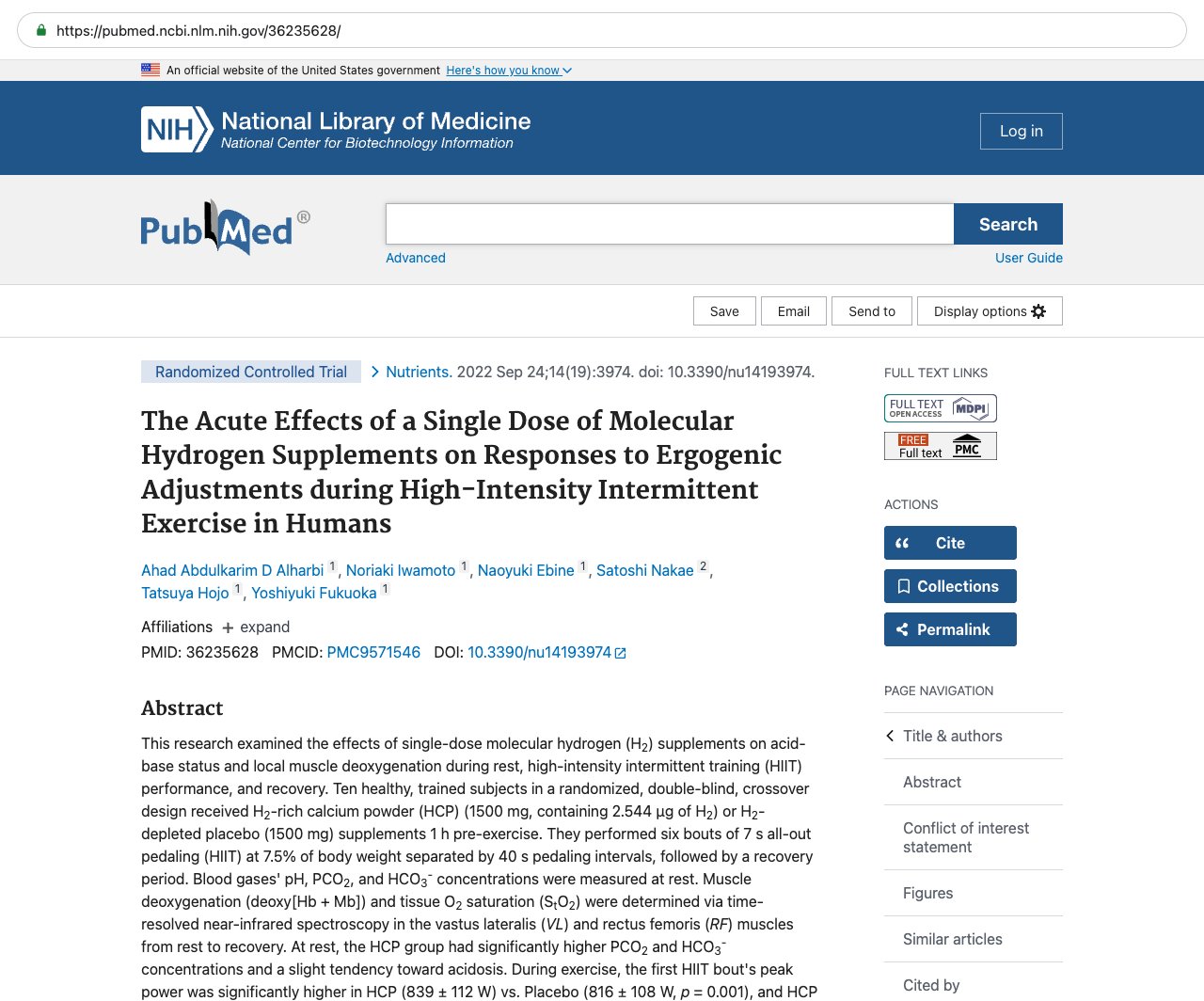
This page mirrors the published abstract (© the authors / publisher) for reference and citation. The canonical source is the PubMed record linked above. This is not medical advice.