2026 · Tsai et al. — Rhupus Syndrome With Multiple Drug Intolerances Managed by Reduced-dose Rituximab and Adjunctive Molecular Hydrogen Therapy: A Case Report
Super-Abstract
A 47-year-old man with the rare overlap of rheumatoid arthritis and systemic lupus erythematosus (Rhupus syndrome), who had failed or was intolerant to six different conventional drugs, achieved sustained disease control after adding oral molecular hydrogen capsules to low-dose rituximab — with normalisation of anti-dsDNA antibody, complement levels, and inflammatory markers, and successful discontinuation of prednisone. (In Vivo, 2026.)
Commentary
Rhupus syndrome sits at one of the most challenging intersections in rheumatology: the clinical features of both rheumatoid arthritis and systemic lupus erythematosus overlap, and standard disease-modifying drugs often fail or are not tolerated. This patient had documented intolerance to six agents — methotrexate, sulfasalazine, hydroxychloroquine, azathioprine, leflunomide, and standard-dose rituximab — leaving minimal treatment options. The addition of hydrogen therapy as an adjuvant in October 2023 was followed by a sustained clinical response, including a remarkable outcome: successful steroid withdrawal. The immunological correlates (T- and B-cell subset changes, anti-dsDNA normalisation) are systematically documented and internally consistent. However, in a single patient receiving rituximab simultaneously, it is impossible to disentangle the contributions of each intervention. The authors themselves call for further studies to confirm efficacy and standardise use — the appropriate scientific caution for a case report.
Key quotes
- „oral molecular hydrogen capsule therapy was initiated as adjuvant treatment, resulting in significant clinical improvement, which was paralleled by characteristic changes in T- and B-cell subsets, normalization of anti-dsDNA antibody, erythrocyte sedimentation rate (ESR), and complement levels, and successful discontinuation of prednisone.“ — the comprehensive clinical and immunological response attributed to hydrogen adjunct
- „Hydrogen therapy was well tolerated without major adverse effects.“ — safety profile in a patient with multiple prior drug intolerances
- „Further studies are needed to confirm its efficacy and standardize its use.“ — the authors' honest caveat about the limits of a single case
Our assessment
Single case report — inherently limited in generalisability. The steroid withdrawal and immunological normalisation are clinically meaningful outcomes, but concurrent rituximab use makes causal attribution of any benefit to H₂ impossible. Notable strength: extensive and systematic immunophenotyping over time. Key limitations: n = 1, no placebo or control arm, temporal correlation ≠ causation, drug intolerances may themselves have influenced the disease course, avascular necrosis from prior corticosteroid use is a serious background comorbidity. Adds to a growing case-series signal from the same research group and warrants a prospective trial.
Study design
- Type: case report · n: 1 (47-year-old man, 27-year RA history + SLE overlap) · H₂ delivery: oral molecular hydrogen capsules (adjunct to reduced-dose rituximab + mycophenolic acid)
- Result: clinical remission, anti-dsDNA normalisation, ESR and complement normalisation, successful prednisone discontinuation; sustained disease control at follow-up
- Tolerability: no major adverse events from hydrogen therapy; pre-existing avascular necrosis (corticosteroid-related) required hip arthroplasty (unrelated to H₂)
Abstract
BACKGROUND/AIM: Rhupus syndrome, an overlap of rheumatoid arthritis (RA) and systemic lupus erythematosus (SLE), is a rare condition characterized by heterogeneous clinical manifestations and difficult management. Conventional therapies, including glucocorticoids, disease-modifying anti-rheumatic drugs (DMARDs), immunosuppressants, and biologics, are often limited by drug intolerance and steroid-related complications. Molecular hydrogen (H2) has emerged as a potential adjuvant therapy due to its antioxidant and immunomodulatory properties. This report aimed to evaluate the clinical efficacy of H2 as an adjunct to rituximab in a patient with refractory Rhupus and multiple drug intolerances. CASE REPORT: We report a 47-year-old male with a 27-year history of rheumatoid arthritis, who subsequently developed systemic lupus erythematosus, fulfilling criteria for Rhupus syndrome. His disease course was complicated by multiple drug intolerances, including adverse reactions to methotrexate, sulfasalazine, hydroxychloroquine, azathioprine, leflunomide, and rituximab at standard dosing. Despite reduced-dose rituximab and mycophenolic acid, disease activity persisted and lupus nephritis was confirmed. In October 2023, oral molecular hydrogen capsule therapy was initiated as adjuvant treatment, resulting in significant clinical improvement, which was paralleled by characteristic changes in T- and B-cell subsets, normalization of anti-dsDNA antibody, erythrocyte sedimentation rate (ESR), and complement levels, and successful discontinuation of prednisone. Hydrogen therapy was well tolerated without major adverse effects. The patient developed avascular necrosis from prior corticosteroid use but recovered well after hip arthroplasty in January 2025. Disease control was sustained with mycophenolic acid and continued hydrogen therapy. CONCLUSION: This case suggests molecular hydrogen therapy as a potential adjuvant for refractory Rhupus with multiple drug intolerances, showing immune modulation, reduced inflammation, steroid withdrawal, and sustained control with low-dose rituximab. Further studies are needed to confirm its efficacy and standardize its use.
Source & links
Screenshot of the PubMed page
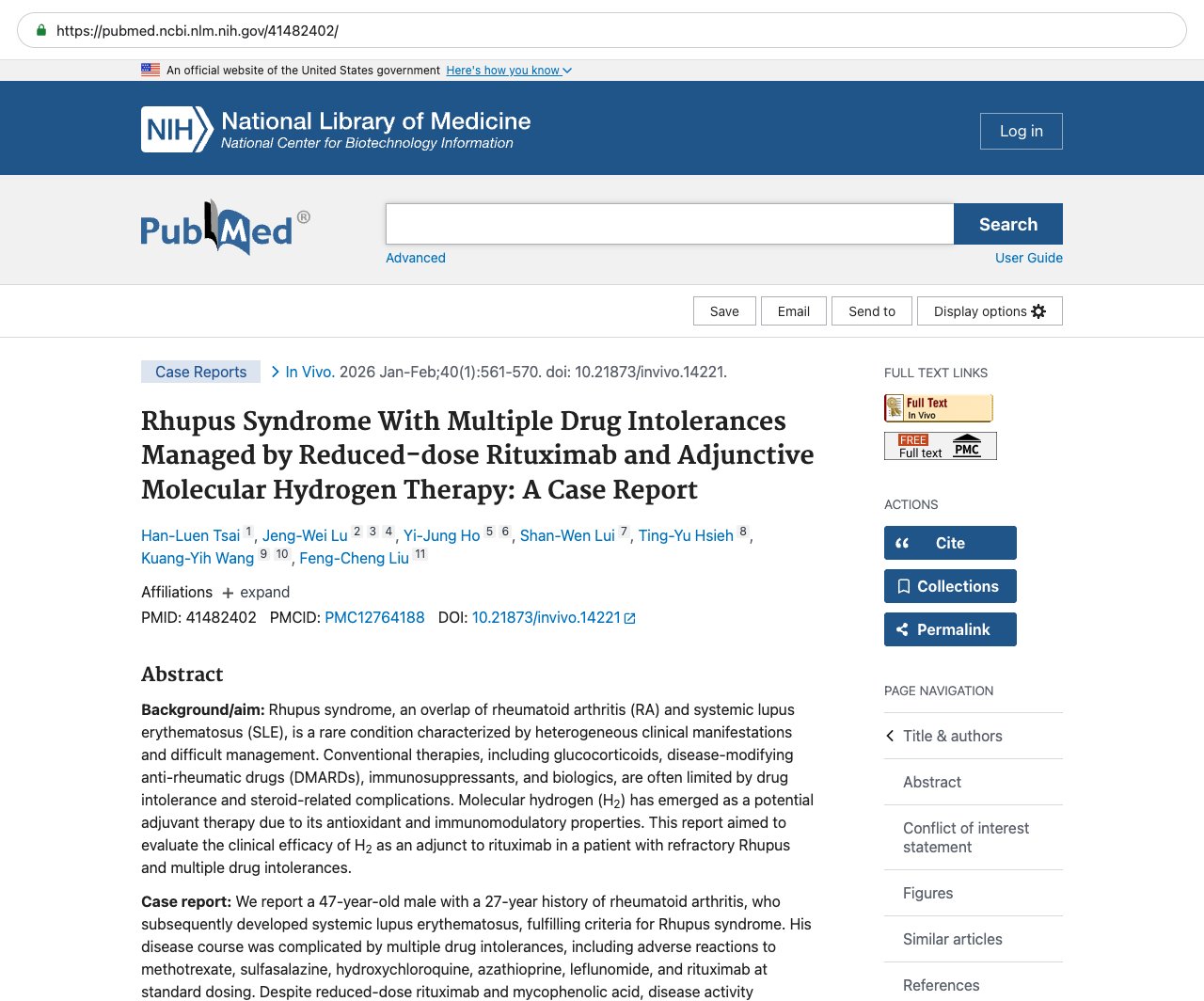
This page mirrors the published abstract (© the authors / publisher) for reference and citation. The canonical source is the PubMed record linked above. This is not medical advice.