2022 · Aoki — Molecular hydrogen has a positive impact on pregnancy maintenance through enhancement of mitochondrial function and immunomodulatory effects on T cells
Super-Abstract
Pregnant women with preterm birth produced measurably less endogenous H₂. In cell and mouse experiments, molecular hydrogen improved the mitochondrial function of T cells and dampened inflammatory responses — in the animal model, H₂ reduced T-cell-driven preterm births. (Life Sciences, 2022 — basic research with a clinical observational part.)
Commentary
This study links a clinical observation with laboratory experiments. First the team measured the exhaled H₂ concentration in pregnant women and found: women with preterm birth (PTB) produced significantly less H₂ — the authors even propose this as a possible biomarker for predicting preterm birth. In the lab they then added H₂ to T cells from healthy donors and observed effects on their differentiation, proliferation and above all energy metabolism — H₂ acted as an immunomodulator via mitochondrial function. Finally they administered H₂ to pregnant mice: this down-regulated the inflammatory response and reduced preterm births triggered by T-cell activation. To be honest in the assessment: this is predominantly preclinical research (cell culture + mouse); the human part is purely observational and shows only a correlation between low H₂ and preterm birth — no proof that H₂ administration prevents preterm birth in humans. The abstract does not give the exact sample size of the pregnant women.
Key quotes
- „Our prospective observational study revealed that maternal production of H2 is significantly lower in pregnant women with PTB, suggesting its potential as a biomarker for predicting PTB.“ — lower endogenous H₂ production in preterm birth — a possible biomarker
- „We found that H2 has clear associations with several maternal cytokines, and acts as an immunomodulator by exerting mitochondrial function in human T cells.“ — H₂ as an immunomodulator via the mitochondrial function of human T cells
- „in vivo administration of H2 to pregnant mice regulated inflammatory responses and reduced PTB caused by T cell activation“ — in the mouse model, H₂ reduced T-cell-driven preterm births
Our assessment
Notable because the study provides a mechanistic bridge: H₂ → mitochondrial function in T cells → immunomodulation → pregnancy maintenance. This fits the mechanistic picture of H₂ (selective antioxidant, mitochondrial action) and reaches into the sensitive area of women's health/pregnancy. Important — caution warranted: statements about pregnancy are delicate; this study justifies NO clinical recommendation of H₂ during pregnancy. Limitations honestly: the proof of effect comes from cell culture and mouse, not from an intervention study in humans. The human part is observational and shows only an association (low H₂ ↔ preterm birth), not cause and effect. Strength of evidence is therefore at the basic/mechanistic level.
Study design
- Type: preclinical (prospective human observation + in-vitro T cells + in-vivo mouse) · n: pregnancy cohort (size not stated in the abstract); human donor T cells; pregnant mice · Duration: not stated in the abstract · H₂ delivery: endogenous H₂ measurement (breath) in humans; H₂ addition in vitro; H₂ administration in vivo (mouse)
- Result: significantly lower maternal H₂ production in preterm birth; associations with several maternal cytokines; reduced T-cell-driven preterm birth with H₂ administration to mice (quantitative p-values not reported in the abstract)
Abstract
AIMS: Molecular hydrogen (H2) has attracted growing interest because of its implications in various diseases. However, the molecular mechanisms underlying the remarkable effect of a small amount of H2 remain elusive. No knowledge has been available on the role of H2 in the etiology of pregnancy disorders or its direct influence on human immune cells. Since maternal immunity, T cells in particular, plays a critical role in pregnancy maintenance. We investigated the effects of H2 on T cells and its relation to preterm birth (PTB). MAIN METHODS: Exhaled H2 concentrations in pregnant women were measured and correlated with cytokine concentrations in maternal and umbilical cord blood. H2 was added to T cells collected from healthy donors, and differentiation and proliferation were examined. Energy metabolism was also examined. H2 was administered to mice and cytokine expression was compared. KEY FINDINGS: Our prospective observational study revealed that maternal production of H2 is significantly lower in pregnant women with PTB, suggesting its potential as a biomarker for predicting PTB. We found that H2 has clear associations with several maternal cytokines, and acts as an immunomodulator by exerting mitochondrial function in human T cells. Moreover, in vivo administration of H2 to pregnant mice regulated inflammatory responses and reduced PTB caused by T cell activation, which further supports the notion that H2 may contribute to prolonged gestation through its immunomodulatory effect. SIGNIFICANCE: Measuring maternal H2-production could be a potential clinical tool in the management of PTB, and H2 may have positive impact on pregnancy maintenance.
Source & links
Screenshot of the PubMed page
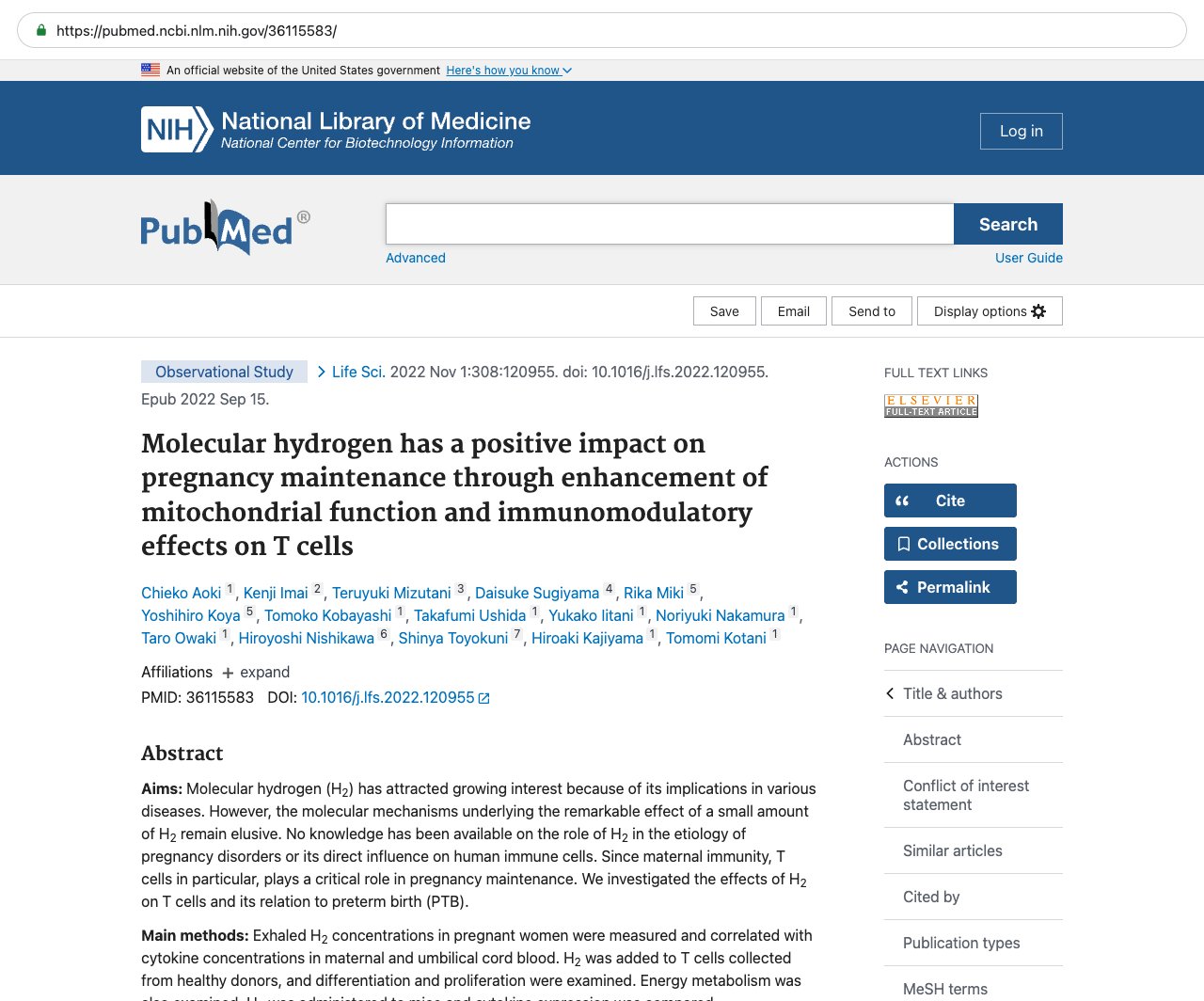
This page mirrors the published abstract (© the authors / publisher) for reference and citation. The canonical source is the PubMed record linked above. This is not medical advice.